1 April 2013
The Guardian, Andrew Clements
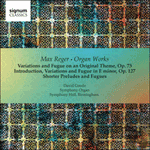
Reger: Organ Music'Even by Max Reger's standards, the works that fill the first of this pair of discs are massive: at 35 and 31 minutes respectively, they are his two most substantial organ works. The Introduction, Variations and Fugue on an Original Theme Op 73, composed in 1903, is couched in the dense, chromatic style typical of Reger's maturity and dominated by the huge central set of variations, which is followed by a relatively modest concluding fugue. In the Introduction, Passacaglia and Fugue in E minor Op 127, from 10 years later, the weight is again the central section, a passacaglia with 26 variations. In this case it is balanced by a hefty double fugue, while the textures have a clarity and, in David Goode's performance on the organ of Symphony Hall, Birmingham, a greater crispness, that really do suggest more transparency in Reger's later style. By contrast, the Five Easy Preludes and Fugues on the second disc seem much more straightforward and lighter in tone; Goode certainly makes them sparkle in a way that belies the composer's dour image' (The Guardian)
1 April 2013
The Guardian, Andrew Clements
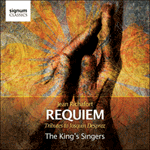
Richafort: Requiem'Josquin Des Prez, the most influential composer in the Flemish school of the early sixteenth century, died in 1521. Over the following decade, a whole generation of composers, many of them former pupils, wrote memorial works, often quoting material and techniques from Josquin's own music. The King's Singers' disc of those tributes centres on perhaps the most substantial of them: the Requiem in Memoriam Josquin Desprez composed by Jean Richafort (c1480-1550). Richafort, who worked at both the French court and in Bruges, may well have been a Josquin pupil, too, and his requiem, which borrows themes and devices from the older man's chansons, was one of the most successful of its time' (The Guardian)
» More
1 April 2013
The Times, Richard Morrison
Richafort: Requiem'An unexplored, if slightly morbid Renaissance treasure trove, this CD presents memorials composed by Josquin's colleagues after the Flemish master's death in 1521. The centrepiece is Jean Richaford's Requiem, with flowing counterpoint spiced by rich dissonances. But the most astonishing work is Jacquet de Mantua's Dum vastos, weaving together five Josquin 'hits'' (The Times)
1 March 2013
The Northern Echo, Gavin Engelbrecht
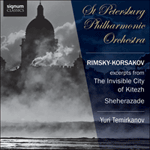
Rimsky-Korsakov: Scheherazade & The invisible city of Kitezh'The St Petersburg Philharmonic Orchestra, conducted by Yuri Temirkanov, presents sterling performances of excerpts from Rimsky-Korsakov's The Invisible City of Kitezh and Sheherazade' (The Northern Echo)
1 March 2013
The Daily Telegraph, Geoffrey Norris
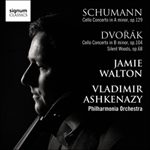
Schumann & Dvořák: Cello Concertos'Walton's interpretation of Silent Woods is sublime, its songful rapture sustained in a seamless stream of subtly inflected melody, with a gentle uplift to the spirits in the central, more animated section. The two concertos on either side of this lovely miniature, ably supported by the Philharmonia, confirm Walton as an artist with secure intuition in terms of style and with a manner of performing that speaks with natural fluency, eloquence and strength of purpose. The contrasting elements of fragility and resolve in the Schumann concerto are held in fine balance, and in the Dvořák there is the sense that Walton, while consistently true to the composer's own voice, has a fresh, personal and thoroughly captivating way of expressing it' (The Daily Telegraph)
» More1 March 2013
Composition Today, Christian Morris
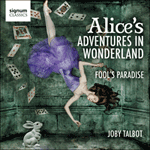
Talbot (J): Alice's Adventures in Wonderland & Fool's Paradise'Joby Talbot is composer perhaps best known far his film and television work, especially A Hitchhiker's Guide to the Galaxy and the hit BBC comedies The League of Gentleman and Psychoville. He has also, however, worked with some of Europe's leading choreographers, including with Christopher Wheeldon on a production for The Royal Ballet of Lewis Carroll's Alice in Wonderland. A highlights disk of this score has just been released on Signum Classics. The music is quirkily tonal, unabashedly melodic, imaginatively orchestrated and virtuously (because it is well written) accessible. Some might argue that this delightful music isn't properly 'contemporary classical', to which I would blow a very large raspberry. If you like any of the standard classical ballet repertoire—Tchaikovsky et al—you will love this' (Composition Today)