Like the Sonatas in E flat (BWV1031) and C major (BWV1033) the Sonata in G minor, BWV1020, is unlikely to be a product solely, if at all, of Bach’s pen. The equal partnership of flute and obbligato harpsichord and the galant gestures, especially of the fast movements, call to mind not only the E flat major Sonata (BWV1031), which may well have served as the model, but also the flute sonatas of Quantz and of other Berlin composers. Stylistically, it is the least ‘Bach-like’ of the three ‘doubtful’ sonatas and the present consensus of opinion inclines towards C P E Bach as its composer. One of the three surviving manuscripts is in his hand, while the other two simply carry the name ‘Bach’ at their head. Further doubt arises over the intended instrumentation for the G minor Sonata. The sources call for violin and harpsichord, yet the absence of any double-stopping has led musicians to believe it to have been a work for flute. Equally, though, an oboe qualifies for consideration on grounds of key, compass and apparent similarities between this piece and C P E Bach’s authentic Oboe Sonata in G minor (H566/Wq135).
from notes by Nicholas Anderson © 2002
Comme les Sonates en mi bémol (BWV1031) et en do majeur (BWV1033), la Sonate en sol mineur, BWV1020, n’est sans doute pas l’œuvre de Bach seul—ni peut-être même son œuvre du tout. L’égale importance de la flûte et du clavecin obligé et les procédés d’écriture galants, notamment dans les mouvements vifs, évoquent non seulement la Sonate en mi bémol (BWV1031), qui pourrait bien avoir servi de modèle, mais aussi les sonates pour flûte de Quantz et d’autres compositeurs berlinois. Stylistiquement, c’est des trois sonates «douteuses» celle qui rappelle le moins Bach, et on s’accorde actuellement à penser que l’auteur en serait plutôt C. P. E. Bach. L’un des trois manuscrits survivants est de sa main, tandis que les deux autres font simplement figurer le nom de «Bach» sur la première page. L’instrumentation de la Sonate en sol mineur soulève également des questions. Les sources indiquent «violon et clavecin», mais l’absence de doubles cordes a conduit certains musiciens à y voir une œuvre pour flûte. Le hautbois constitue cependant un candidat tout aussi plausible au regard de la tonalité, de l’ambitus, et d’apparentes similarités entre cette pièce et une authentique sonate pour hautbois de C. P. E. Bach en sol mineur (H566 / Wq135).
extrait des notes rédigées par Nicholas Anderson © 2002
Français: Josée Bégaud
Wie die Sonaten in Es-Dur (BWV1031) und C-Dur (BWV1033) ist auch die Sonate in g-Moll, BWV1020, wahrscheinlich nicht vollständig aus Bachs Feder geflossen—wenn er überhaupt Anteil an ihrer Komposition hatte. Die ungleiche Partnerschaft von Flöte und obligatem Cembalo und die galanten Gesten, die besonders in den schnellen Sätzen auftreten, erinnern nicht nur an die Sonate in Es-Dur (BWV1031), die gut als Vorlage gedient haben mag, sondern auch an die Flötensonaten von Quantz und anderen Berliner Komponisten. In stilistischer Hinsicht ist sie die am wenigsten „Bach-ähnliche“ der drei Sonaten mit umstrittener Urheberschaft, und der gegenwärtige Konsens tendiert zur Nennung C. Ph. E. Bachs als ihres Komponisten. Eines der drei noch erhaltenen Manuskripte ist in seiner Handschrift verfasst, währen die anderen beiden einfach an ihrem Kopf den Namen „Bach“ tragen. Es bestehen weitere Zweifel bezüglich der geplanten Instrumentierung für die g-Moll-Sonate. Die Quellen fordern Violine und Cembalo, doch führte das Fehlen von Doppelgriffen Musiker dazu, das Werk als für Flöte konzipiert zu betrachten. Aufgrund der Tonart, des Tonumfangs und der offensichtlichen Ähnlichkeiten zwischen diesem Stück und C. Ph. E. Bachs authentischer Oboensonate in g-Moll (H566/ Wq135) könnte dieses Stück ebensogut für Oboe geschrieben worden sein.
aus dem Begleittext von Nicholas Anderson © 2002
Deutsch: Atlas Translations


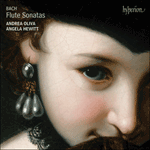 Bach: Flute Sonatas
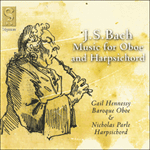 Bach: Music for oboe and harpsichord