
Welcome to Hyperion Records, a British classical label devoted to presenting high-quality recordings of music of all styles and from all periods from the twelfth century to the twenty-first.
Hyperion offers both CDs, and downloads in a number of formats. The site is also available in several languages.
Please use the dropdown buttons to set your preferred options, or use the checkbox to accept the defaults.

from notes by James O'Donnell © 2010
The Twelve de William Walton est l’une de ces rares œuvres à usage liturgique dont la musique fut commandée en même temps que le texte. Ici, l’idée germa quand, en 1964, Cuthbert Simpson, doyen de Christ Church (Oxford), invita deux des plus célèbres anciens élèves du collège à collaborer à un nouvel anthem. La substantielle pièce de onze minutes qui en résulta fut créée en la cathédrale de Christ Church en mai 1965, sous la direction de Sydney Watson. Walton avait auparavant déclaré que le texte de W. H. Auden était «obscur et difficile à mettre en musique» mais, à la vérité, il rencontrait souvent ce genre de problèmes avec les textes, l’inspiration lui venant, à son goût, lentement. Par bonheur, il est parvenu à surmonter ses difficultés pour nous offrir cette œuvre exceptionnelle d’envergure musicalo-émotionnelle et de variété, qui semble quitter la sphère de l’anthem liturgique pour se hisser vers la cantate. À n’en pas douter, Walton rend aussi justice à ce qui est généralement considéré comme un texte poétique plein d’imagination et d’invention. Parmi les moments phares de cette œuvre, citons le splendide duo central («O Lord, my God, Though I forsake Thee Forsake me not»), et l’exubérant final fugué («Twelve as the winds and the months»). Le saisissant passage initial pour baryton solo est emblématique de l’écriture inventive que Walton ne laisse d’adresser aux voix solo; il présente aussi une partie d’orgue remarquablement virtuose. Par la suite, Walton orchestra cet anthem pour la célébration du neuf centième anniversaire de l’abbaye de Westminster, en janvier 1966.
extrait des notes rédigées par James O'Donnell © 2010
Français: Hypérion
aus dem Begleittext von James O'Donnell © 2010
Deutsch: Viola Scheffel
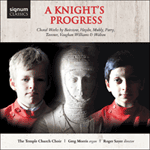 A Knight's Progress A Knight's ProgressStudio Master: SIGCD410Download onlyStudio Master FLAC & ALAC downloads available  The premiere recording of Nico Muhly’s 'Our present Charter' (celebrating 800 years since the sealing of the Magna Carta), alongside choral works by Parry, Vaughan Williams, Walton, Bairstow, Tavener and Haydn.» More |
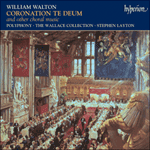 Walton: Coronation Te Deum & other choral works Walton: Coronation Te Deum & other choral worksCDA67330Temporarily out of stock  ‘An outstanding collection’ (Gramophone) ‘What a splendid work it is, especially when sung with the verve brought to it by Stephen Layton’s choir Polyphony’ (The Sunday Telegraph)» More |