
Welcome to Hyperion Records, a British classical label devoted to presenting high-quality recordings of music of all styles and from all periods from the twelfth century to the twenty-first.
Hyperion offers both CDs, and downloads in a number of formats. The site is also available in several languages.
Please use the dropdown buttons to set your preferred options, or use the checkbox to accept the defaults.


The first motet, My soul, there is a country, using words by Henry Vaughan, is perhaps the best-known, partly because of its length but also because of its more accessible four-part scoring. Through-composed, like the majority of the motets, it reveals some of Parry’s most florid polyphony and gift for melody. This is perhaps most readily exhibited in the last, highly contrapuntal section in which sequences of rising-fourth intervals (‘Thy God, thy life, thy cure’) interact with the avowal of an unchanging, loving Creator (‘But One who never changes’)—a musical statement that is distilled magnificently in the final set of chordal progressions. I know my soul hath power to know all things, by the much neglected Sir John Davies, is a solemn contemplation on humility, its climax occurring at the very end when Parry suddenly breaks away to a distant tonality—a gesture which accentuates the heart of the poem: ‘I know myself a Man, / Which is a proud and yet a wretched thing.’
Parry’s setting of Thomas Campion’s Never weather-beaten sail is, by contrast, stanzaic in structure. In five parts, the motet has a richer contrapuntal texture, which is particularly perceptible in the yearning refrain: ‘O come quickly, sweetest Lord’—one that Parry skilfully transforms in the second verse. The six-part There is an old belief is a setting of a poem by John Gibson Lockhart. At the heart of the motet Parry quotes the intonation of the Christian creed (‘That creed I fain would keep’) in the hope that, with the eternal sleep to come, the soul might waken to a new, serene life ‘on some solemn shore’. At this point Parry’s use of dissonance reaches an intensity and passion thitherto unequalled in English choral music, while the hushed ending expresses a rare sublimity.
For his penultimate motet Parry turned to John Donne’s sonnet At the round earth’s imagined corners. Cast in seven parts, Parry reached the heights of his harmonic experimentation in the ethereal paragraph beginning with the higher voices—‘and you whose eyes / Shall behold God and never taste death’s woe’—a passage that seems almost atonal in its contrapuntal wanderings. This is ultimately stabilized by the magical entry of the tenors and basses (‘But let them sleep’), and the motet concludes with some of the composer’s most luxuriant polyphony, replete with the visionary benediction: ‘As if thoud’st sealed my pardon with thy blood.’
The final motet, Lord, let me know mine end, a setting of Psalm 39, was written for double choir and is both the emotional and musical summation of the motet cycle. It is also surely the most moving and personal declaration. Though the motet carries a strong Judaeo-Christian message, for Parry the text captured something of his more heterodoxical approach to religion and ethics. After the violence of the central section (‘Take thy plague away from me’), the last part of this magnificent choral canvas combines a sense of lament with one of profound penitence. But more than this, Parry’s apologia is encapsulated by the yearning cry: ‘For I am a stranger with thee and a sojourner’—an assertion that summed up his extraordinary creative life as a deep thinker as well as a composer.
The first five motets were first performed at the Royal College of Music under the baton of Hugh Allen on 22 May 1916. A performance of Lord, let me know mine end was first given in the chapel of New College, Oxford, again under Allen on 17 June 1917. But the motets were not heard together as a full set until 23 February 1919, when they were sung (under Allen’s direction) by the combined choirs of New College and Christ Church at Parry’s Memorial Concert at Exeter College, where he had been an undergraduate. It was a fitting tribute to one of Oxford’s greatest musical sons.
from notes by Jeremy Dibble © 2020
 Anthem AnthemStudio Master: SIGCD465Download onlyStudio Master FLAC & ALAC downloads available  Founded in 1836, the Huddersfield Choral Society has developed an international reputation as one of the UK’s leading choral societies. This new recording features works that remain central to the choir's musical heritage: music by Handel, Elgar, ...» More |
 Parry: Songs of farewell Parry: Songs of farewellStudio Master: SIGCD267Download onlyStudio Master FLAC & ALAC downloads available Composed towards the end of Parry’s life, the Songs of Farewell have taken on something of an epithetical interpretation; they are almost a musical summation of his compositional life, reflecting Parry’s love of English renaissance madrigals and p ...» More |
 Parry: Songs of farewell & works by Stanford, Gray & Wood Parry: Songs of farewell & works by Stanford, Gray & WoodStudio Master: CDA68301Studio Master FLAC & ALAC downloads available  Performances of great sensitivity which perfectly convey the gently valedictory mood running through so much of this programme.» More |
 The English Anthem, Vol. 6 The English Anthem, Vol. 6CDA66826Download only ‘St Paul's is the king of cathedral choirs, and the sound of their singing, with the majesty of the organ in the awesome reverberance of the great bui ... ‘Truly heroic performances from the St Paul's Choir which is on top form. A memorable record’ (Organists' Review)» More |
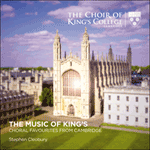 The music of King's The music of King'sStudio Master: KGS0034-DDownload onlyStudio Master FLAC & ALAC downloads available  This new recording presents nineteen opulently recorded treasures from the immense repertoire of this most august of choirs, everything from Baroque and Renaissance masterpieces to fresh arrangements of American and Chinese folk songs.» More |