Having wowed his sophisticated Parisian audiences with three Creole-inspired pieces (
Bamboula,
La Savane and
Le Bananier; the fourth of this Louisiana quartet,
Le Mancenillier, would follow in 1849), the nineteen-year-old Gottschalk set about producing some polished nods to Chopin before turning to the French countryside for inspiration.
La Moissonneuse (‘The Reaper’) and
La Glaneuse (‘The Gleaner’, now lost) reflected subjects that were popular with the French romantic painters of the time (though Millet’s famous picture of gleaners came eight years later). Gottschalk’s reaper is a playful Parisian, rather than a Pole, the mazurka peppered with scherzando, scintillante and brillante directions. It was one of three Gottschalk works which Bizet played as a child prodigy pianist. The key is A flat, save for an unexpected visit to B major towards the end and in the final bars. It was written in 1848 and dedicated to Gottschalk’s friend the Italian pianist Alfred Jaëll (who, coincidentally, emigrated to the USA the same year and whose wife Marie was the dedicatee of Saint-Saëns’s
Étude en forme de Valse).
La Moissonneuse was one of the pieces that Gottschalk included in his triumphant New York debut in February 1853.
from notes by Jeremy Nicholas © 2000
Ayant subjugué son raffiné public parisien avec trois pièces d’inspiration créole (
Bamboula,
La Savane et
Le Bananier—l’ultime chaînon de cette tétralogie louisianaise,
Le Mancenillier, devait suivre en 1849), Gottschalk, alors âgé de dix-neuf ans, se mit à produire quelques hommages élégants à Chopin, avant de puiser son inspiration dans la campagne française.
La Moissonneuse et
La Glaneuse (aujourd’hui perdue) reflétaient des sujets chers aux peintres romantiques français de l’époque (même si les célèbres Glaneuses de Millet ne furent peintes que huit ans plus tard).
La Moisonneuse de Gottschalk est une Parisienne enjouée davantage qu’une Polonaise, et la mazurka est émaillée de directions scherzando, scintillante et brillante. Cette pièce, qui fut l’une des trois œuvres de Gottschalk interprétées au piano par Bizet, enfant prodige, est en la bémol, hors une inattendue incursion en si majeur, vers la fin et dans les dernières mesures. Écrite en 1848 et dédiée au pianiste italien Alfred Jaëll (qui, fortuitement, émigra aux États-Unis cette année-là et dont la femme, Marie, fut la dédicataire de l’
Étude en forme de Valse de Saint-Saëns), ami du compositeur, elle figura dans les triomphants débuts new-yorkais de Gottschalk (février 1853).
extrait des notes rédigées par Jeremy Nicholas © 2000
Français: Hypérion
Nachdem er sein anspruchsvolles Pariser Publikum mit drei kreolisch inspirierten Stücken von den Sitzen gerissen hatte (
Bamboula,
La Savane und
Le Bananier;
Le Mancenillier, das vierte Stück dieses Louisiana-Quartetts, sollte 1849 folgen), nahm der neunzehnjährige Gottschalk mit mehreren ausgefeilten Stücken Chopin zur Kenntnis, ehe er künstlerische Anregung in der französischen Landschaft suchte.
La Moissonneuse („Die Schnitterin“) und
La Glaneuse („Die Ährenleserin“, ein verlorengegangenes Werk) behandelten Themen, die damals bei französischen Malern der Romantik beliebt waren (Millets bekannte Darstellung der Ährenleser wurde allerdings erst acht Jahre später gezeigt). Gottschalks Schnitterin ist eher verspielte Pariserin als Polin: Die Mazurka ist mit Anweisungen wie scherzando, scintillante und brillante gespickt. Sie war eines von drei Gottschalk-Werken, die Bizet als pianistisches Wunderkind gespielt hat. Die Tonart ist As-Dur, bis auf einen unerwarteten Abstecher nach H-Dur gegen Ende und in den Schlußtakten. Das Stück entstand 1848 und ist Gottschalks Freund gewidmet, dem italienischen Pianisten Alfred Jaëll (der übrigens im selben Jahr in die USA emigrierte und dessen Frau Marie Adressatin der Widmung von Saint-Saëns’s
Étude en forme de Valse war).
La Moissonneuse war eines der Stücke, mit denen Gottschalk im Februar 1853 sein triumphales New Yorker Debüt gab.
aus dem Begleittext von Jeremy Nicholas © 2000
Deutsch: Anne Steeb/Bernd Müller


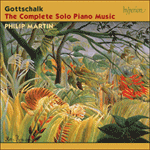 Gottschalk: The Complete Solo Piano Music