
Welcome to Hyperion Records, a British classical label devoted to presenting high-quality recordings of music of all styles and from all periods from the twelfth century to the twenty-first.
Hyperion offers both CDs, and downloads in a number of formats. The site is also available in several languages.
Please use the dropdown buttons to set your preferred options, or use the checkbox to accept the defaults.

This is thus the fourth of Schubert's twenty three Hölty settings (there are ten from 1815, the remainder from 1816), less of a miniature than most of them it is also certainly one of the most unusual and beautiful. The very opening words are almost a definition of piano accompanied song, and the composer obediendy places the 'Gesangeston' above an accompaniment that rustles like the murmuring of trees in a sacred Delphic grove. The poem is a tour de force of the use of alcaics, a Greek poetic stanza of four lines, with five long syllables in each of the first two lines, four in the third and fourth lines, and a weak upbeat (or anacrusis) in each of the first three lines The construction of the poem seems to have been well understood by Schubert: Hölty's carefully planned long lines are mirrored in music which creates the feeling of spaciousness inherent in the metre. This is ideal for the lofty emotional perspective of the piece which unites visions of the past, present and future. On a more mundane and practical level, however, this may also explain why so few singers have taken up this song. This vocal line seems never to give pause for breath. This challenge is exacerbated by the tempo Schubert chooses for this rapt and magical effusion; time seems to stand still. This is marvellous for the listener, but it can be to the detriment of the singer's oxygen supply, unless a measure of considerate help is given by a pianist who knows how to move discreetly forward. The third verse moves into the tonic minor, with fervent arioso echoing the spirit of a sacred vow. This enables the last verse (a projection into a distant time when the lovers will be no more) to be something of a recapitulation, the tune no longer underpinned by the rustling semiquavers of the opening, but by much more static triplets; the accompaniment thus achnowledges the difference between the quick and the dead. The piano's triplets in the last bar seem to whisper the tri-syllabic name mentioned only in the title of the poem, but nowhere in the text—Julia. There is something in this song of the throbbing ecstasy of another arboreal love song (plane trees rather than apple)—the second version of the Matthisson setting Stimme der Liebe.
from notes by Graham Johnson © 1990
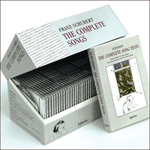 Schubert: The Complete Songs Schubert: The Complete SongsCDS44201/4040CDs Boxed set + book (at a special price) — Temporarily out of stock  ‘This would have been a massive project for even the biggest international label, but from a small independent … it is a miracle. An ideal Christ ... ‘Please give me the complete Hyperion Schubert songs set—all 40 discs—and, in the next life, I promise I'll "re-gift" it to Schubert himself … fo ...» More |