The Sonata in E flat major, Op 120 No 2 is more mellow and intimate in overall effect: any heroic passions are concentrated in the central scherzo. The Allegro amabile with which it begins—the very tempo direction is paradoxical—proves to be the most unassuming of Brahms’s sonata structures, yet one of the subtlest. Its musing, song-like character and explorations of colour and key conceal continuous, logical development and interrelation of themes, and its ending is gentle, marked dolce, tranquillo. In complete contrast, the second movement is a large and unexpectedly powerful scherzo in E flat minor. This Allegro appassionato is Brahms’s last scherzo, in the same key as his first (for piano, Op 4, composed forty-four years earlier) and it has something of the character of a heroic waltz. The function of the trio is assumed by a broad sostenuto melody, whose trend to asymmetric proportions—it has a rather Hungarian character—is echoed in the broad, glowing, fourteen-bar theme of the finale, Andante con moto. The classical poise, solidity of rhythm and opulent harmony of this tune offer enormous potential for the five variations to which Brahms subjects it. In fact these variations are comparatively simple and lyrical, paring the theme down to its smallest note-values and exploring its possibilities in modest contrapuntal textures of almost Mozartian clarity. The music rises to virtuosity only in the brief valedictory display of the closing pages.
from notes by Malcolm MacDonald © 2007
La Sonate en mi bémol majeur, op. 120 no 2 est globalement plus douce et plus intime: toutes les passions héroïques se concentrent dans le scherzo central. L’Allegro amabile initial—une indication de tempo paradoxale en soi—se révèle la plus modeste des structures de sonate brahmsiennes, l’une des plus subtiles aussi. Son caractère songeur, chantant, ses explorations de couleurs et de tonalités cachent un développement continu, logique, doublé d’une corrélation thématique; sa conclusion est douce, marquée dolce, tranquillo. A contrario, le second mouvement est un grand scherzo en mi bémol mineur, d’une puissance inattendue. Cet Allegro appassionato, qui tient un peu de la valse héroïque, est l’ultime scherzo de Brahms—il présente, d’ailleurs, la même tonalité que le premier, écrit pour piano (op. 4) quarante-quatre ans auparavant. Le fonctionnement du trio est assumé par une ample mélodie sostenuto, dont la tendance aux proportions asymétriques—elle est de caractère plutôt hongrois—se retrouve dans le large thème incandescent (quatorze mesures) du finale, Andante con moto. L’équilibre classique, la solidité du rythme et l’opulente harmonie de cet air offrent un énorme potentiel aux cinq variations auxquelles Brahms le soumet. En réalité, ces variations, relativement simples et lyriques, réduisent le thème à ses plus petites valeurs de note et explorent ses possibilités dans de modestes textures contrapuntiques d’une clarté quasi mozartienne, la musique n’atteignant à la virtuosité que dans le bref adieu démonstratif des pages conclusives.
extrait des notes rédigées par Malcolm MacDonald © 2007
Français: Hypérion
Die Sonate in Es-Dur, op. 120, Nr. 2 ist insgesamt milder und intimer; heroische Leidenschaft bleibt auf den Scherzo-Mittelsatz beschränkt. Das Allegro amabile, mit dem sie beginnt—die Tempovorschrift bereits ein Paradox—erweist sich als Brahms’ bescheidenste, doch subtilste Sonatenstruktur. Sein beschaulich-liedhafter Charakter und die Exploration von Klangfarbe und Tonalität verbergen eine durchweg logische Verarbeitung und Wechselbeziehung der Themen. Es schließt sacht, dolce, tranquillo. Der zweite Satz ist im Gegensatz dazu ein großangelegtes und unerwartet kraftvolles Scherzo in es-Moll. Dieses Allegro appassionato ist Brahms’ letztes Scherzo, in der gleichen Tonart wie sein erstes (für Klavier, op.4, und 44 Jahre zuvor komponiert) und im Charakter eines heroischen Walzers. Die Funktion des Trios wird von einer breiten sostenuto-Melodie übernommen, deren Neigung zu assymetrischen Proportionen—sie besitzt einen eher ungarischen Charakter—sich im breiten, glühenden vierzehntaktigen Thema des Finales, Andante con moto, wiederspiegelt. Die klassische Anmut, rhythmische Festigkeit und üppige Harmonik dieser Melodie bietet enormes Potential für die fünf Variationen, denen Brahms sie unterwirft. Diese Variationen sind verhältnismäßig schlicht und lyrisch, beschränken das Thema auf seine kleinsten Notenwerte und untersuchen seine Möglichkeiten in bescheidenem kontrapunktischen Gefüge von nahezu mozartischer Transparenz. Die Musik rafft sich nur im kurzen Lebewohl der abschließenden Takte zu virtuoser Schau auf.
aus dem Begleittext von Malcolm MacDonald © 2007
Deutsch: Renate Wendel


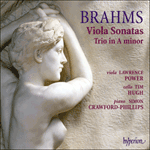 Brahms: Viola Sonatas