Tye’s Western Wynde Mass is one of three surviving English Masses based on the same monophonic song (the other two are by John Taverner and John Sheppard). The song’s avowedly secular text (‘Western wind, when wilt thou blow? The small rain down can rain, Christ, if my love were in my arms, and I in my bed again!’) is exactly the kind of Mass model that The Council of Trent found inappropriate at its debates concerning sacred music in the early 1560s. It is not certain which of the three Western Wynde Masses appeared first, although it would not have been Sheppard’s. Tye’s setting clearly complements Taverner’s, and it is generally assumed that Taverner’s Mass was the original. Where Taverner’s cantus firmus migrates between three of the four voice parts, Tye presents the melody exclusively in the alto part—the very one that Taverner chose not to use. And Taverner’s fivefold ascending melodic ostinato in the bass part of the opening of the Sanctus is matched by a sixfold descending melodic ostinato in the bass part of Tye’s Sanctus (both encompassing exactly the same range of a tenth). Both settings were written in the second half of King Henry VIII’s reign, and Tye’s setting contains some decidedly antique devices, which makes it possible (though far from probable) that Tye’s setting was chronologically the earlier. Among these devices is the late-medieval cadential formula at the end of the Osanna to the Sanctus, where the bass part leaps up an octave to arrive above the tenor, the first-inversion phrase ending at ‘miserere nobis’ in the Gloria, and the busily syncopated writing at the ‘qui venit’ section of the Benedictus which is reminiscent of the style of the late-fifteenth-century Eton Choirbook. But Tye’s interrupted subdominant cadence makes three appearances (to indicate the end of the bass ostinato in the Sanctus, at ‘gloria tua’ in the Sanctus, and halfway through the third and final Agnus Dei)—an indication that Tye had, by this stage, formulated his own modus operandi. The English cadence also makes two appearances (at ‘unigenitum’ in the Credo, and at ‘peccata mundi’ in Agnus Dei II), and a unique submediant cadence (in later classical harmony the archetypal form of interrupted cadence) colours the end of the Benedictus before the start of its Osanna.
from notes by Jeremy Summerly © 2012
La Western Wynde Mass de Tye est, avec celles de John Taverner et de John Sheppard, l’une des trois messes anglaises fondées sur le même chant monophonique à nous avoir été conservées. Le texte ouvertement profane du chant («Vent d’ouest, quand souffleras-tu? La petite pluie peut bien tomber, Christ, si mon amour pouvait être dans mes bras, et moi de nouveau dans mon lit!») en fait exactement le genre de modèle que le concile de Trente jugea inconvenant pour une messe, quand il débattit de la musique sacrée, au début des années 1560. On ne sait au juste laquelle des trois Western Wynde Masses fut la première, mais ce ne fut pas celle de Sheppard. Celle de Tye est le complément évident de celle de Taverner, généralement considérée comme l’originale. Là où Taverner fait migrer son cantus firmus entre trois des quatre parties vocales, Tye présente la mélodie à la seule partie d’alto—celle-là même que Taverner choisit de ne pas utiliser. Et le quintuple ostinato mélodique ascendant, à la basse, de l’ouverture du Sanctus de Taverner est égalé, dans le Sanctus de Tye, par un sextuple ostinato mélodique descendant, à la basse (chacun couvrant exactement une dixième). Ces deux messes furent rédigées dans la seconde moitié du règne d’Henri VIII et celle de Tye renferme quelques procédés résolument archaïques, si bien qu’elle a pu (mais c’est hautement improbable) être chronologiquement la première. Parmi ces procédés figurent la formule cadentielle médiévale tardive, à la fin de l’Hosanna menant au Sanctus, où la partie de basse bondit d’une octave pour arriver au-dessus du ténor; la fin de phrase à l’état de premier renversement à «miserere nobis», dans le Gloria; et l’écriture très syncopée au «qui venit» du Benedictus, qui rappelle le style de l’Eton Choirbook (fin du XVe). La cadence interrompue à la sous-dominante n’en apparaît pas moins trois fois (pour indiquer la fin de l’ostinato à la basse dans le Sanctus, à «gloria tua» dans le Sanctus et à mi-chemin du troisième et dernier Agnus Dei)—signe que Tye avait, à cette époque, formulé sa propre méthode. La cadence anglaise apparaît aussi deux fois (à «unigenitum» dans le Credo et à «peccata mundi» dans l’Agnus Dei II), tandis qu’une cadence unique à la sus-dominante (ce sera, dans l’harmonie classique plus tardive, la forme archétypale de la cadence interrompue) colore la conclusion de Benedictus avant le début de l’Hosanna.
extrait des notes rédigées par Jeremy Summerly © 2012
Français: Hypérion
Tyes Western Wynde Mass ist eine von drei überlieferten englischen Messen, denen dasselbe monophone Lied zugrunde liegt (die anderen beiden Vertonungen stammen von John Taverner und John Sheppard). Der ausgesprochen weltliche Text des Liedes („Western wind, when wilt thou blow? The small rain down can rain, Christ, if my love were in my arms, and I in my bed again!“ [Westwind, wann wirst du wehen? Der leichte Regen kann herunterregnen, Christus, wenn doch meine Liebe in meinen Armen wäre, und ich wieder in meinem Bett!]) ist genau die Art Vorlage, die das Tridentiner Konzil als ungeeignet befand, als es zu Beginn der 1560er Jahre geistliche Musik diskutierte. Es lässt sich nicht mit Sicherheit sagen, welche der drei Western Wynde Messen als erste erschien, doch kann man wohl davon ausgehen, dass es nicht die von Sheppard war. Tyes Vertonung ist offenbar als Gegenstück zu Taverners angelegt und es wird weithin angenommen, dass Taverners Messe das Originalwerk war. Während der Cantus firmus bei Taverner in drei der vier Stimmen hin- und herwandert, wird bei Tye die Melodie ausschließlich in der Altstimme präsentiert—eben der Stimme, die Taverner nicht verwendete. Und Taverners fünffaches aufsteigendes melodisches Ostinato in der Bassstimme zu Beginn des Sanctus findet bei Tye sein Pendant in dem sechsfachen absteigenden melodischen Ostinato in der Bassstimme des Sanctus (und beide haben genau denselben Tonumfang von einer Dezime). Beide Vertonungen entstanden während der zweiten Hälfte der Herrschaft Heinrichs VIII. und in Tyes Version finden sich einige ausgesprochen altertümliche Stilmittel, so dass die Möglichkeit (weniger jedoch die Wahrscheinlichkeit) besteht, dass Tyes Vertonung chronologisch früher entstand. Unter jenen Stilmitteln ist die spätmittelalterliche Kadenzformel am Ende des Osanna im Sanctus, wo die Bassstimme einen Oktavsprung nach oben macht und oberhalb des Tenors ankommt, das Phrasenende in der ersten Umkehrung bei „miserere nobis“ im Gloria und der eifrig synkopierte Satz bei dem „qui venit“-Teil des Benedictus, der an den Stil des Eton Choirbooks des späten 15. Jahrhunderts erinnert. Doch tritt auch Tyes subdominantischer Trugschluss dreimal auf (um das Ende des Ostinatos im Bass des Sanctus anzuzeigen, bei „gloria tua“ im Sanctus und bei der Hälfte des dritten und letzten Agnus Dei)—ein Hinweis darauf, das Tye zu dieser Zeit bereits seinen eigenen Modus Operandi ausgestaltet hatte. Die englische Kadenz tritt ebenfalls zweimal auf (bei „unigenitum“ im Credo und bei „peccata mundi“ im Agnus Dei II) und eine einzigartige submediantische Kadenz (die in der späteren klassischen Harmonie die archetypische Form des Trugschlusses bilden sollte) färbt das Ende des Benedictus ein, bevor dessen Osanna beginnt.
aus dem Begleittext von Jeremy Summerly © 2012
Deutsch: Viola Scheffel


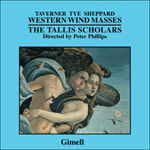 Taverner, Tye & Sheppard: Western Wynde Mass
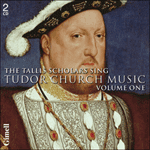 The Tallis Scholars sing Tudor Church Music, Vol. 1