
Welcome to Hyperion Records, a British classical label devoted to presenting high-quality recordings of music of all styles and from all periods from the twelfth century to the twenty-first.
Hyperion offers both CDs, and downloads in a number of formats. The site is also available in several languages.
Please use the dropdown buttons to set your preferred options, or use the checkbox to accept the defaults.


The Op 27 sonatas were issued in 1801, both of them with the sub-heading of ‘quasi una Fantasia’—a qualification indicating the freedom with which Beethoven was treating the traditional sonata design. The ‘Moonlight’ Sonata’s famous opening movement bears the direction: Si deve suonare tutto questo pezzo delicatissimamente e senza sordino (‘This entire piece must be played with the utmost delicacy, and without dampers’). ‘Senza sordino’ was Beethoven’s habitual marking at this stage of his career for the use of the sustaining pedal, and although on a modern piano his instruction needs to be treated with some caution, a certain degree of harmonic blurring is implied in order to convey the music’s unbroken atmosphere of plaintive mystery. Beethoven was to exploit similar overlapping pedal effects in the rondo theme of the ‘Waldstein’ Sonata.
As he was to do the following year in his ‘Tempest’ Sonata Op 31 No 2, Beethoven maintains the darkness of the minor mode throughout the two outer movements, while writing the middle movement entirely in the major. (‘A flower between two abysses’ was Liszt’s evocative description of the minuet-like second movement of Op 27 No 2.) The finale is an unrelentingly agitated piece whose coda, with its ‘strummed’ diminished-seventh chords sweeping up the keyboard, reaches new heights of turbulence. Not until the ‘Appassionata’ Op 57 did Beethoven write another finale for piano of comparable dramatic intensity.
from notes by Misha Donat © 2010
Les sonates, op. 27, ont été publiées en 1801, toutes deux avec le sous-titre «quasi una Fantasia»—qui souligne la liberté avec laquelle Beethoven traite le modèle traditionnel de la sonate. Le célèbre premier mouvement de la Sonate «Clair de lune» est précédé de la mention: Si deve suonare tutto questo pezzo delicatissimamente e senza sordino («Toute cette pièce doit être jouée avec la plus grande délicatesse et sans sourdine»). «Senza sordino» était l’indication habituelle de Beethoven à ce stade de sa carrière pour l’utilisation de la pédale forte et si, sur un piano moderne, cette indication doit être traitée avec quelque précaution, il faut parvenir à un certain degré de flou harmonique afin de traduire l’atmosphère ininterrompue de mystère plaintif de la musique. Beethoven allait exploiter des effets analogues de pédales qui se chevauchent dans le thème du rondo de la Sonate «Waldstein».
Comme il allait le faire l’année suivante dans sa Sonate «La Tempête», op. 31 no 2, Beethoven conserve l’obscurité du mode mineur d’un bout à l’autre des deux mouvements externes, alors qu’il écrit le mouvement central entièrement en majeur. («Une fleur entre deux abysses», c’est ainsi que Liszt a décrit de manière évocatrice le second mouvement en forme de menuet de l’op. 27 no 2.) Le finale présente une agitation acharnée; sa coda, avec ses accords effleurés de septième diminuée qui balaient le clavier, atteint de nouveaux sommets en matière de turbulence. Il faudra attendre l’«Appassionata», op. 57, pour que Beethoven écrive un autre finale pour piano d’une telle intensité dramatique.
extrait des notes rédigées par Misha Donat © 2010
Français: Marie-Stella Pâris
Die Klaviersonaten op. 27 wurden 1801 mit dem gemeinsamen Untertitel „quasi una Fantasia“ veröffentlicht, wodurch die Freizügigkeit angedeutet wird, mit der Beethoven die traditionelle Sonatenform abwandelt. Der erste Satz der Mondscheinsonate trägt die Anweisung: Si deve suonare tutto questo pezzo delicatissimamente e senza sordino („Man muß dieses ganze Stück sehr zart und ohne Dämpfer spielen“). Zu dieser Zeit hatte Beethoven die Gewohnheit, „senza sordino“ für den Gebrauch des Sostenuto-Pedals zu verlangen, und wenngleich diese Anweisung auf einem modernen Klavier mit einiger Vorsicht zu befolgen ist, impliziert die Interpretation ein gewisses Maß an harmonischer Überblendung, um die Atmosphäre eines klagenden Mysteriums zu erzielen. Ähnlich überlappende Pedaleffekte wird Beethoven dann auch im Rondothema der „Waldstein“-Sonate verwenden.
Wie auch ein Jahr später in der Klaviersonate Nr. 17 d-Moll op. 31 Nr. 2 („Der Sturm“) setzt Beethoven die dunkle Mollstimmung in den beiden Ecksätzen der Mondscheinsonate durchgängig fort, während der mittlere Satz vollständig in Dur steht und von Liszt anschaulich als „eine Blume zwischen zwei Abgründen“ beschrieben wurde. Das Finale ist ein beharrlich aufgewühltes Stück, dessen Coda mit ihren „geklimperten“ kleinen Septimen sich zu neuen turbulenten Höhen die Tastatur hinauf schwingt. Erst mit der „Appassionata“ op. 57 komponiert Beethoven ein weiteres Klavierfinale von vergleichbar dramatischer Intensität.
aus dem Begleittext von Misha Donat © 2010
Deutsch: Henning Weber
 Beethoven: Alessio Bax plays Beethoven Beethoven: Alessio Bax plays BeethovenStudio Master: SIGCD397Download onlyStudio Master FLAC & ALAC downloads available  Pianist Alessio Bax returns to Signum with two masterworks of Beethoven’s piano repertoire, as well as two new arrangements from 'The Ruins of Athens'.» More |
 Beethoven: Beethoven Unbound Beethoven: Beethoven UnboundStudio Master: SIGCD52712CDs Download onlyStudio Master FLAC & ALAC downloads available A comprehensive new cycle of the Beethoven sonatas recorded live at London's Wigmore Hall during the pianist's epic fourth rendition of these masterpieces .» More |
 Beethoven: Moonlight Sonata & other piano music Beethoven: Moonlight Sonata & other piano musicStudio Master: CDA68237Studio Master FLAC & ALAC downloads available  The ‘Moonlight’ sonata sounds newly minted in this remarkable reading, Pavel Kolesnikov’s hallmark virtues of ‘intelligence, sensitivity and imagination’ (Gramophone) guaranteeing a very special Beethoven recital indeed.» More |
 Beethoven: Piano Sonatas Opp 10/2, 26, 27/2 & 90 Beethoven: Piano Sonatas Opp 10/2, 26, 27/2 & 90CDA67797 Angela Hewitt’s legion of fans will be delighted at this eagerly awaited third volume of Beethoven sonatas. Her first two releases in this series were praised for their ‘clarity, intelligence and elegance’ … ‘fusing poetry and passion’, and all th ...» More |
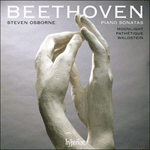 Beethoven: Piano Sonatas Opp 13, 27/2, 53 & 79 Beethoven: Piano Sonatas Opp 13, 27/2, 53 & 79CDA67662 Steven Osborne has been performing Beethoven live in concert for many years, always to great acclaim. Now for the first time he has committed these extraordinary performances to disc. It is clear from listening to the opening movement of the ‘Moon ...» More |
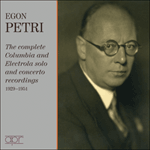 Egon Petri - The complete Columbia and Electrola solo and concerto recordings Egon Petri - The complete Columbia and Electrola solo and concerto recordingsAPR77017CDs Download only  Egon Petri (1881-1962) studied with Busoni and was perhaps his greatest disciple. In his fusion of intellect with an astonishing virtuoso technique he echoed his master and gives us today the clearest idea of Busoni’s own legendary pianism.» More |
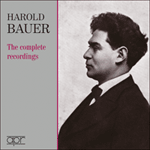 Harold Bauer - The complete recordings Harold Bauer - The complete recordingsAPR73023CDs Download only  Gramophone» More Gramophone» More |
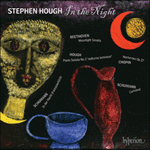 In the Night In the NightStudio Master: CDA67996Studio Master FLAC & ALAC downloads available This recital album by ‘the thinking person’s virtuoso: an extraordinary pianist’ (The New York Times) takes the listener on a journey through that most intense and absorbing of nineteenth-century obsessions, the night. Stephen Hough’s thoughtful p ...» More |
 Lullabies for Mila Lullabies for MilaStudio Master: SIGCD439Download onlyStudio Master FLAC & ALAC downloads available From acclaimed pianist Alessio Bax, this new compilation presents a lovingly curated playlist of soothing classics—to calm a baby or an adult, with music from Bach and Brahms to Rachmaninov and Scriabin.» More |