Welcome to Hyperion Records, a British classical label devoted to presenting high-quality recordings of music of all styles and from all periods from the twelfth century to the twenty-first.
Hyperion offers both CDs, and downloads in a number of formats. The site is also available in several languages.
Please use the dropdown buttons to set your preferred options, or use the checkbox to accept the defaults.
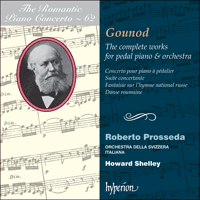


The Romantic Piano Concerto series reaches 62 and makes an interesting (although temporary) departure: these four works are for pedal piano (a piano which includes a separate keyboard for the feet, to be played rather in the manner of an organ). Gounod was inspired by the talent of the young and apparently very attractive Lucie Palicot (born circa 1860) whom he heard performing Alkan’s music for pedal piano in 1882. Gounod is far better known for his operatic and liturgical compositions: these works show a different side to this nineteenth-century luminary.
Italian pianist Roberto Prosseda makes his debut on Hyperion. He gave the first modern performance of Gounod’s Concerto for pedal piano and orchestra. His pedal piano repertoire also includes the original works by Schumann, Boëly and Alkan and new pieces written for him by Ennio Morricone, Michael Nyman and other contemporary composers.
 PERFORMANCE RECORDING
The visual spectacle was as appealing as the talent of the artist. The musicologist Paul Landormy later recalled the scene: ‘I remember what a strange impression was produced by the sight of this graceful and dainty person perched on a huge case containing the lower strings of the pedal-board beneath a grand piano resting on the aforementioned case; and what surprised us above all, pleasantly enough to be sure, was to see Mme Palicot wearing a short knee-length skirt (entirely necessary, but astonishing in those days), and her pretty legs darting most adroitly to reach the different pedals of the keyboard she had at her feet, very similar to an organ pedal-board.’ Lucie Palicot (née Schneckenburger) seems to have given up her career in 1895 when she embarked on her second marriage, to David Gilmon Henderson.
The Fantaisie sur l’hymne national russe dates from 1885. Completed towards mid-September, this paraphrase of Alexey L’vov’s anthem God Save the Tsar was premiered on 16 November at the Salons Érard in Paris by Lucie Palicot, its dedicatee, with the composer accompanying her on a standard piano. The orchestral version received its first performance under the direction of Édouard Colonne at the Théâtre du Châtelet on 23 February 1886. We do not know what opportunity or reasons of friendship may have prompted Gounod to choose this theme.
After a brassy introduction, a condensed synthesis of the anthem, the piano states its two sections, then repeats them with the orchestra enriched by virtuoso pedal playing. A second exposition follows the same principle of contrast of colour and texture, but now it is the brass, not the piano, that alternates with the full orchestra while the soloist presents a countermelody in semiquavers, sometimes on the pedal-board and sometimes on the keyboard.
The development introduces more numerous modulations. It is based on a broken four-note motif ‘à la Bach’ that eventually takes on the form of a fugal subject. The climax comes with a varied restatement of the hymn by the entire orchestra, supported by piano arpeggios and brightened by the glittering sound of the triangle. The conclusion, though deploying all the pomp called for by the context, is none the less coherent for that.
More personal and of another stature altogether is the Suite concertante in A major, completed in early spring 1886. Its premiere in Bordeaux on 17 March 1887 was followed by a second performance at the Royal Philharmonic Society in London on 23 April, while in Paris the Société des Concerts du Conservatoire had to abandon a projected performance because the firm of Pleyel-Wolf anticipated needing forty minutes to set up the instrument and twenty to remove it.
The score is conceived as a sweeping fresco, giving pride of place to clarity, simplicity and a wholesome brio. After the neoclassical flavour of the opening tutti, Entrée de fête, a deliciously frivolous motif precedes the reprise of the first theme by the soloist. But this restatement is elliptical and modulatory, leading to a succession of parallel sixth chords that introduce the second theme: a long flowing, undulating melody sung by the left hand.
The evocation of the hunt in the horns and strings of the Chasse is thoroughly realistic. The piano takes up these formulas and soon launches into galloping figuration. A harsh ‘mort’ on the pedal-board gives the signal for a second crescendo, grimmer and more concise, modulating and rising to fortissimo. Then the strings establish a meditative mood. The piano responds with a cantabile theme in almost choral style, shifting curiously from the religious to the galant. The orchestra takes up the cantabile theme, accompanied by arpeggios from the soloist. Anguished tremolos bring back the hunting motif, which bursts forth in a fortissimo tutti. This recurrence of the initial motif is the starting point for a true development in which the full forces are deployed.
A chain of modulating arpeggiated chords provides a transition to the Romance. A long introverted clarinet theme, prolonged and intensified by the strings, prepares the entry of the piano. It is tempting to consider the central section as an ornamented free variation of the opening theme, in which the soloist emerges from the amiably supportive orchestra in a highly Mozartian style of pianism. Halfway through, the accompaniment is reduced to almost no more than the Alberti bass in the violas. Thus, when the violins take up the opening theme of the first section, it seems natural that the piano should accompany it with that same Alberti bass, as in Beethoven’s ‘Emperor’ Concerto. The cadenza, which extends over a tonic pedal in the horns, sets the ethereal piano against the melancholy song of the lower woodwind in one of those valedictory atmospheres whose secret Gounod found in Mozart.
The piano leads the way in the Tarentelle, for the orchestra seems merely to cling to its coat-tails. When the flutes and clarinets, in flowing parallel thirds, impose C major over a double pedal point, the effect is like a ray of sunshine that increases the tension: modulations, crescendo, chromaticisms, rapid exchanges between the sections of the orchestra and the soloist up to an imposing fortissimo over 6–4 harmonies that are maintained virtually until the conclusion.
On 4 September 1888 Gounod wrote to his wife: ‘All at once I have come up with two pieces that will do nicely for my little Palicote [sic] this winter: one is a Chorale and Toccata [this has not been not located], the other a concertante Danse roumaine with orchestra that will fill out her repertoire somewhat, and I am sure that our good Mme Desgenétais will give her the opportunity to play them at her soirées.’ One hesitates to link this inspiration with the advent of a ravishingly beautiful Romanian singer, Hariclea Darclée, who was scheduled to sing Juliette at the Opéra.
The Danse roumaine was premiered in Paris by Lucie Palicot during the winter of 1888–9, when the composer informs us it was encored, but it remains unpublished. The work is cast in sonata form with an orchestral introduction that outlines the themes. Then a furious toccata for pedal-board alone sweeps the orchestra along with it, and the first theme—a simple cell, energetic and piquant, in D minor without leading note—makes its appearance. It has a whiff of eastern Europe about it, no more than that. Modulating variations lead to the second theme, which runs up and down the scale of F major in dotted rhythms, supported by a viola countermelody.
A furious outburst from the piano launches the development: a folk-like motif combining woodwind and percussion frames further exchanges on the opening motif of the first theme; the latter’s reappearance heralds a recapitulation in which the second theme, introduced by trumpet calls, undergoes considerable development until the advent of a vigorous coda.
The Concerto for pedal piano in E flat major remained unpublished because Gounod, finding that the cost of hiring the parts for the Suite concertante hindered its diffusion, gave sole ownership of this new work to Lucie Palicot in September 1889, thus guaranteeing her exclusivity and free use. The desire to spotlight the contribution of the pedal-board is more apparent here than in the Suite and the recurrence of certain formulas from one movement to the next reinforces the work’s cohesion.
From the outset the tone of the Allegro moderato is that of Beethovenian heroism. An initial development leads to the second theme, which is chordal without excessive heaviness and suggests a song of triumph. First stated by the piano, it no sooner receives an embryonic echo from the orchestra than the soloist transposes it, and the power struggle between them will form the material for this second, more modulatory development. A disguised recapitulation brings back the second theme, followed by a final development.
A modulating introduction on the orchestra, then the piano, opens the brisk, piquant Scherzo. The solo piano presents the initial strain of the first part of the movement, in which keyboard and pedal-board interact in imitation. The orchestra joins in, doubling them, for the second part, where legato phrases attempt to dominate staccato. The Trio is more sustained in character. The piano occupies the foreground with fairly subdued support from the trumpet, then a few discreet doublings. The Scherzo section is then reprised dal segno al fine without formal repeats.
The Adagio ma non troppo gives the impression of a funeral march. After a sombre orchestral introduction, the piano threads its solitary way through the first section. The central section provides the first broad, lyrical melody in the work. This song of hope is one of those eloquent inspirations so characteristic of Gounod. Then the march is resumed by piano and orchestra, which follow a common course until the conclusive wails from the horns.
The more important role accorded to orchestral timbres, the brio of the keyboard writing and the sustained rhythmic verve all ensure the finale makes an undeniable effect. The music has the character of a rondo, although not the structure: four episodes succeed one another linked by their sheer affinity. Despite the warlike accents of trumpets and percussion, the movement never abandons a spirit of playfulness.
Gérard Condé © 2013
English: Charles Johnston
Le spectacle avait de quoi le séduire autant que le talent de l’artiste. Le musicologue Paul Landormy en témoignera plus tard: «Je me rappelle que l’impression fut étrange de cette toute gracieuse et mignonne personne juchée sur une immense caisse contenant les cordes graves du pédalier sous un piano de concert reposant sur ladite caisse; et surtout, ce qui nous surprit, assez agréablement d’ailleurs, ce fut de voir madame Palicot vêtue d’une jupe courte, au genou, bien nécessaire, mais étonnante en ce temps-là et s’escrimant fort adroitement de ses jolies jambes pour atteindre successivement les différentes touches du clavier qu’elle avait sous les pieds, tout semblable à un pédalier d’orgue.» Lucie Palicot (née Schneckenburger) semble avoir arrêté sa carrière en 1895 quand elle épousa David Gilmon Henderson en secondes noces.
La Fantaisie sur l’hymne national russe date de 1885. Achevée vers la mi-septembre, cette paraphrase de l’hymne Dieu protège le Tsar d’Alexeï Lvov, fut créée à Paris, salle Érard, le 16 novembre, par sa dédicataire Lucie Palicot; le compositeur lui donnait la réplique sur un piano ordinaire. La version orchestrale sera créée au Châtelet sous la direction d’Édouard Colonne le 23 février 1886. On ignore quelles raisons d’opportunité ou d’amitié ont pu dicter à Gounod le choix du thème.
Après une introduction cuivrée, synthèse condensée de l’hymne, le piano en expose les deux sections qu’il reprend avec l’orchestre enrichies par un jeu de pédale virtuose. Une seconde exposition suit le même principe d’opposition de couleur et de texture, mais ce sont les cuivres, et non plus le piano, qui alternent avec l’orchestre tandis que le soliste fait entendre, tantôt au pédalier, tantôt au clavier, un contre-chant en doubles croches.
Le développement introduit des modulations plus nombreuses. Il repose sur un motif brisé de quatre notes «à la Bach» qui prendra des allures de thème de fugue. L’aboutissement sera une réexposition variée de l’hymne par tout l’orchestre, soutenu par des arpèges de piano et éclairé par le scintillement du triangle. La conclusion, d’une pompe obligée, n’en est pas moins cohérente.
Plus personnelle et d’une tout autre envergure, la Suite concertante fut achevée au début du printemps 1886. La création à Bordeaux, le 17 mars 1887, fut suivie d’une reprise à la Royal Philharmonic Society de Londres le 23 avril tandis qu’à Paris, la Société des Concerts du Conservatoire dut y renoncer car la maison Pleyel-Wolf prévoyait quarante minutes pour installer l’instrument et vingt pour l’enlever.
La partition est conçue comme une fresque, privilégiant la clarté, la simplicité et un brio de bon aloi. Après la saveur néoclassique du tutti initial d’Entrée de fête, un motif d’une frivolité délicieuse précède la reprise du premier thème par le soliste. Reprise elliptique, modulante, débouchant sur une succession d’accords de sixte parallèles qui introduisent le second thème: une longue mélodie fluide et ondoyante chantée à la main gauche.
L’évocation de la Chasse aux cors et aux cordes, est réaliste. Le piano en reprend les formules pour se lancer bientôt dans une sorte de chevauchée. Un rude hallali, au pédalier, donne le signal d’un second crescendo plus âpre, plus concis, modulant, jusqu’au fortissimo. Puis les cordes instaurent un climat méditatif. Le piano y répond par un cantabile quasi choral, passant curieusement du religieux au galant. L’orchestre reprend ce cantabile sur des arpèges du soliste. Des trémolos angoissés ramènent la chasse qui éclate en tutti fortissimo. Ce retour au motif initial est le départ d’un vrai développement où toutes les forces se déploient.
Les modulations d’une chaîne d’accords arpégés assurent une transition avec la Romance. Un long thème introverti de la clarinette, qui se poursuit et s’exacerbe aux cordes, prépare l’entrée du piano. On serait tenté de considérer la section centrale comme une variation libre, ornementée, du thème initial, où le soliste se détache au dessus d’un orchestre complice dans un pianisme très mozartien. À mi-parcours, l’accompagnement se réduit presque à une basse d’Alberti aux altos. Ainsi, quand les violons reprennent le thème initial de la première section, il semble naturel que le piano l’accompagne avec cette basse d’Alberti, comme dans le Concerto l’«Empereur» de Beethoven. La cadence, qui s’étire sur pédale de tonique aux cors, met en contrepoint le piano aérien et le chant mélancolique des bois graves dans un de ces climats d’adieu dont Gounod a trouvé le secret chez Mozart.
Le piano mène la Tarentelle car l’orchestre semble seulement s’accrocher à ses pas. Quand les flûtes et les clarinettes, en tierces coulées, imposent ut majeur sur une double pédale, c’est comme un rayon de soleil qui fait monter la tension: modulations, crescendo, chromatismes, échanges rapides entre les pupitres et avec le soliste jusqu’au fortissimo imposant sur une harmonie de quarte et sixte pratiquement maintenue jusqu’à la fin.
Le 4 septembre 1888, Gounod écrivait à sa femme: «J’ai trouvé, tout d’une venue, deux pièces de concert qui, cet hiver, feront joliment l’affaire de ma petite Palicote [sic]: l’une est un Choral et Toccata [non retrouvée]; l’autre une Danse roumaine concertante avec orchestre: cela lui garnira un peu son répertoire, et je suis bien sûr que la bonne Mme Desgenétais lui donnera, dans ses soirées, l’occasion de les faire entendre.» On hésite à mettre en relation cette inspiration avec la venue d’une ravissante cantatrice roumaine, Hariclea Darclée, pressentie pour chanter Juliette à l’Opéra.
Créée à Paris par Lucie Palicot au cours de l’hiver 1888–89, bissée selon l’auteur, mais toujours inédite, cette page est coulée dans une forme sonate dont l’introduction orchestrale esquisse les thèmes. Puis une toccata furieuse pour le seul pédalier entraîne l’orchestre; alors le premier thème—simple cellule nerveuse et piquante, en ré mineur sans sensible—fait son apparition. Il a, sans plus, un air d’Europe orientale. Des variations modulantes mènent au second thème qui descend et remonte la gamme de fa majeur en rythme pointé, soutenu par un contrechant des altos.
Un emballement furieux du piano lance le développement: un motif folklorisant associant bois et percussions, encadre de nouveaux échanges sur la tête du premier thème; sa réapparition donnera le signal d’une réexposition où le second thème, introduit par des appels des trompettes, se développe largement jusqu’à une vigoureuse coda.
Le Concerto pour piano à pédalier en mi bémol majeur est resté inédit car Gounod, trouvant que le prix de location du matériel de la Suite en gênait la diffusion, donna cette nouvelle œuvre en toute propriété à Lucie Palicot en septembre 1889, lui assurant ainsi exclusivité et gratuité. Le souci de mettre en valeur le jeu de pédalier est plus net que dans la Suite et, d’un mouvement à l’autre, le retour de certaines formules renforce la cohérence de l’ouvrage.
D’emblée le ton de l’Allegro moderato est à l’héroïsme beethovénien. Un premier développement mène au second thème, un thème d’accords sans lourdeur aux allures de chant de triomphe. Donné par le piano, à peine est-il esquissé en écho par l’orchestre que le soliste le transpose, et cette lutte de pouvoir va former la matière de ce second développement, plus modulant. Une réexposition déguisée ramène le second thème suivi d’un développement terminal.
Une introduction modulante à l’orchestre, puis au piano, ouvre le Scherzo alerte et piquant. Le piano assume seul le volet initial de la première partie où le clavier et le pédalier dialoguent en imitations. L’orchestre s’y joint en doublures pour le second volet où les liés tentent de prendre l’avantage sur les piqués. Le Trio est d’un caractère plus soutenu. Le piano y est au premier plan avec le soutien, assez doux, d’une trompette puis de quelques doublures discrètes. La première partie est ensuite reprise sans redites.
L’Adagio ma non troppo a l’allure d’une marche funèbre. Le piano, sombrement introduit par l’orchestre, erre en solitaire au fil du premier volet. Le volet central offre la première mélodie large et lyrique de l’ouvrage. Ce chant d’espoir est une de ces inspirations éloquentes dont Gounod a le secret. Puis la marche est reprise par le piano et l’orchestre qui cheminent de conserve jusqu’aux hoquets conclusifs des cors.
Le rôle plus important des timbres de l’orchestre, le brio de l’écriture du clavier, la verve rythmique soutenue, assurent au final une indéniable efficacité. La composition est dans l’esprit d’un rondo sans en avoir la structure, les quatre épisodes étant reliés entre eux non pas par un refrain, mais par leurs affinités. Malgré les accents guerriers de la batterie et des trompettes, l’esprit ludique ne perd jamais ses droits.
Gérard Condé © 2013
Das visuelle Schauspiel war dabei genauso interessant wie das Talent der Künstlerin. Der Musikwissenschaftler Paul Landormy beschrieb es später folgendermaßen: „Ich erinnere mich an das seltsame Bild dieser anmutigen und zarten Person, die auf einem riesigen Kasten mit den tiefen Saiten saß; auf diesem Kasten lag ein Flügel. Was uns jedoch am meisten überraschte—in durchaus angenehmer Weise—war der Anblick Mme Palicots in einem kurzen, knielangen Rock (ganz und gar notwendig, aber zu jener Zeit noch erstaunlich) und ihrer hübschen Beine, die überaus geschickt hin- und herschnellten, um die verschiedenen Pedale der Tastatur zu erreichen, die sie zu ihren Füßen hatte, sehr ähnlich wie eine Pedalklaviatur an der Orgel.“ Lucie Palicot (geb. Schneckenburger) gab ihre Karriere offenbar im Jahre 1895 auf, als sie ihren zweiten Ehemann, David Gilmon Henderson, heiratete.
Die Fantaisie sur l’hymne national russe entstand 1885. Diese Paraphrase der Hymne Gott erhalte den Zaren von Alexei Lwow wurde Mitte September fertiggestellt und am 16. November im Pariser Érard-Salon von ihrer Widmungsträgerin Lucie Palicot uraufgeführt, wobei der Komponist sie an einem normalen Flügel begleitete. Die Orchesterfassung wurde erstmals am 23. Februar 1886 unter der Leitung von Édouard Colonne im Théâtre du Châtelet aufgeführt. Aus welchem Grunde Gounod dieses Thema wählte, ob es etwa einen bestimmten Anlass dazu gab oder eine Freundschaft dabei eine Rolle spielte, ist nicht bekannt.
Nach einer blechernen Einleitung, eine verdichtete Synthese der Hymne, spielt das Klavier seine beiden Abschnitte und wiederholt sie dann, wobei das Orchester durch virtuose Pedalpassagen angereichert wird. Eine zweite Exposition folgt demselben Muster der Gegenüberstellung von Klangfarben und Texturen, doch sind es nun die Blechbläser und nicht das Klavier, die mit dem gesamten Orchester alternieren, während der Solist eine Gegenmelodie in Sechzehnteln präsentiert, die sowohl pedaliter als auch manualiter gespielt wird.
In der Durchführung werden weitere, zahlreiche Modulationen vorgestellt. Es liegt hier ein gebrochenes Vierton-Motiv im Stile Bachs zugrunde, das schließlich die Form eines Fugenthemas annimmt. Der Höhepunkt kommt in einer variierten Wiederholung der Hymne durch das gesamte Orchester, unterstützt von Klavier-Arpeggien und aufgehellt durch den glitzrigen Klang der Triangel. Der Schluss verliert trotz des sich durch den Kontext einstellenden Pomps nicht an Geschlossenheit.
Von völlig anderem Format und deutlich persönlicher gehalten ist die Suite concertante in A-Dur, die zu Beginn des Frühjahrs 1886 fertiggestellt wurde. Auf die Premiere in Bordeaux am 17. März 1887 folgte eine zweite Aufführung im Rahmen der Konzerte der Royal Philharmonic Society in London am 23. April, während die Société des Concerts du Conservatoire in Paris eine geplante Aufführung absagen musste, da die Firma Pleyel-Wolf vierzig Minuten dafür kalkulierte, das Instrument zu installieren, und zwanzig, um es wieder abzubauen.
Das Werk ist in der Art eines Freskos angelegt, wo Klarheit, Schlichtheit und ein lebhafter Schwung von besonderer Wichtigkeit sind. Nach dem neoklassischen Anflug im Anfangstutti der Entrée de fête geht ein köstlich frivoles Motiv der Reprise des ersten Themas durch den Solisten voran. Doch ist diese Wiederholung elliptisch und mit Modulationen versehen und leitet in eine Folge von parallelen Sextakkorden hinüber, die das zweite Thema einleiten: eine lange, fließende und wellenförmige Melodie, die von der linken Hand gesungen wird.
Die Darstellung der Jagd durch die Hörner und Streicher in der Chasse ist realistisch gestaltet. Das Klavier übernimmt diese Formeln ebenfalls und geht bald zu galoppierenden Figurationen über. Ein derbes Halali in der Pedalstimme gibt das Signal zu einem zweiten Crescendo, das verbissener und prägnanter ist, moduliert und zu einem Fortissimo aufsteigt. Danach stellen die Streicher eine meditative Stimmung her, worauf das Klavier mit einem kantablen, fast chorischen Thema reagiert, das sich in kurioser Weise zwischen religiösem und galantem Stil hin und her bewegt. Das Orchester nimmt das kantable Thema auf und wird von Arpeggien des Solisten begleitet. Schmerzerfüllte Tremoli führen zurück zum Jagdmotiv, das mit einem Fortissimo-Tutti hervorbricht. Diese Wiederkehr des Anfangsmotivs ist der Ausgangspunkt für eine echte Durchführung, in der der gesamte Apparat zum Einsatz kommt.
Eine Kette von modulierenden Arpeggio-Akkorden dient als Überleitung zur Romance. Ein langes introvertiertes Klarinettenthema, das von den Streichern verlängert und intensiviert wird, bereitet den Einsatz des Klaviers vor. Man ist in Versuchung, den Mittelteil als freie ornamentierte Variation des Anfangsthemas zu betrachten, wo der Solist aus dem liebenswürdig-unterstützenden Orchester mit einem sehr an Mozart erinnernden Klavierstil hervortritt. Nach etwa der Hälfte ist die Begleitung auf kaum mehr als die in den Bratschen erklingenden Alberti-Bässe reduziert. Wenn in den Geigen dann also wieder das Anfangsthema des ersten Teils erklingt, erscheint es ganz natürlich, dass das Klavier dies mit demselben Alberti-Bass begleitet—in gleicher Weise wie es auch im Fünften Klavierkonzert von Beethoven geschieht. Die Kadenz, die sich oberhalb eines Tonika-Orgelpunkts in den Hörnern erstreckt, stellt den ätherischen Klang des Klaviers dem melancholischen Gesang der tieferen Holzbläser gegenüber, woraus sich eine jener Abschiedsstimmungen ergibt, deren Geheimnis Gounod bei Mozart gefunden hatte.
Das Klavier leitet in die Tarentelle hinein, denn das Orchester scheint sich lediglich an seinen Frackschößen festzuhalten. Wenn die Flöten und Klarinetten in fließenden Terzparallelen ein C-Dur über einem doppelten Orgelpunkt durchsetzen, wirkt sich dies wie ein Sonnenstrahl aus, der die Spannung steigert: Modulationen, Crescendi, chromatische Passagen, rasche Wortwechsel zwischen den verschiedenen Gruppen des Orchesters und dem Solisten bis hin zu einem beeindruckenden Fortissimo über Quartsext-Harmonien, die praktisch bis zum Schluss beibehalten werden.
Am 4. September 1888 schrieb Gounod an seine Frau: „Mir sind plötzlich zwei Stücke in den Sinn gekommen, für die meine kleine Palicote [sic] diesen Winter gut Verwendung finden wird: eines ist ein Choral mit Toccata [welcher bisher noch nicht aufgefunden wurde] und das andere ist eine konzertante Danse roumaine mit Orchester, mit der ihr Repertoire ziemlich ausgefüllt sein wird, und ich bin mir sicher, dass unsere gute Mme Desgenétais ihr Gelegenheit geben wird, sie bei ihren Soireen zu spielen.“ Ob die Inspiration hierzu mit der Ankunft der wunderschönen rumänischen Sängerin Hariclea Darclée zusammenhängt, die an der Opéra die Juliette singen sollte, sei dahingestellt.
Die Danse roumaine wurde von Lucie Palicot in Paris im Winter 1888/89 uraufgeführt; von dem Komponisten erfahren wir, dass das Stück nochmals als Zugabe gegeben wurde, doch existiert immer noch keine Ausgabe davon. Das Werk ist in Sonatenform angelegt und hat eine Orchestereinleitung, in der die Themen umrissen werden. Dann reißt eine furiose Toccata für Pédalier allein das Orchester mit sich und das erste Thema—eine schlichte Nervenzelle mit Energie und Würze, die in d-Moll steht und ohne Leitton erklingt—tritt in Erscheinung. Es lässt sich hier ein gewisser Anklang an Osteuropa feststellen, mehr jedoch nicht. Modulierende Variationen leiten zum zweiten Thema hinüber, das sich mit punktierten Rhythmen die F-Dur-Tonleiter auf und ab bewegt und von einer Gegenmelodie der Bratsche unterstützt wird.
Ein heftiger Ausbruch des Klaviers eröffnet die Durchführung: ein volksmusikartiges Motiv, in dem sich Holzbläser und Schlagwerk miteinander verbinden, rahmt weitere Wortwechsel zwischen dem Anfangsmotiv und dem ersten Thema ein; der Auftritt des Letzteren kündigt eine Reprise an, in der das von Trompetensignalen eingeleitete zweite Thema beträchtlich weiterentwickelt wird, bis eine energische Coda erklingt.
Das Konzert für Pedalflügel in Es-Dur blieb unveröffentlicht, da Gounod erfahren hatte, dass die Leihgebühren für das Stimmmaterial seiner Suite concertante die Verbreitung des Werks behinderten, und er daher im September 1889 den alleinigen Besitz seines neuen Werks Lucie Palicot überschrieb, um ihr Exklusivität und freie Verwendung zu garantieren. Der Wunsch, den Beitrag des Pédaliers zu betonen, ist hier deutlicher ausgeprägt als in der Suite, und das Wiederkehren bestimmter Formeln eines Satzes im nächsten sorgt für einen stärkeren Zusammenhang innerhalb des Werks.
Das Allegro moderato nimmt von Anfang an den Ton eines Beethoven’schen Heroismus an. Eine erste Durchführung leitet zum zweiten Thema, das akkordisch gehalten ist, ohne dabei zu schwer zu wirken, und das einen Triumphgesang andeutet. Es wird zunächst vom Klavier dargeboten und sobald es vom Orchester auch nur ansatzweise wiederholt wird, transponiert der Solist es auch schon, und dieser Machtkampf zwischen den beiden Parteien bildet dann die Grundlage für die zweite, eher modulierende Durchführung. Eine versteckte Reprise sorgt für die Rückkehr des zweiten Themas, worauf eine abschließende Durchführung folgt.
Eine modulierende Einleitung, die zunächst vom Orchester, dann vom Klavier gespielt wird, eröffnet das zügige, pikante Scherzo. Der Solist präsentiert die erste Melodie des ersten Teils des Satzes, wo Manual und Pedal sich gegenseitig imitierend interagieren. Dann tritt das Orchester hinzu und verdoppelt die beiden Stimmen im zweiten Teil, wo die Legato-Phrasen versuchen, das Staccato zu dominieren. Das Trio hat einen anhaltenderen Charakter; das Klavier nimmt mit relativ zurückhaltender Unterstützung der Trompete und einigen diskreten Verdopplungen den Vordergrund ein. Es erklingt dann eine Reprise des Scherzo-Teils ohne formale Wiederholungen.
Das Adagio ma non troppo vermittelt den Eindruck eines Trauermarsches. Nach einer trauervollen Orchestereinleitung fädelt sich das Klavier einsam durch den ersten Abschnitt. Im mittleren Abschnitt erklingt die erste weite, lyrische Melodie des Werks. Dieser Hoffnungsgesang ist einer jener gewandten Inspirationen, die für Gounod so typisch sind. Dann wird der Marsch nochmals vom Klavier und Orchester aufgenommen, die einen gemeinsamen Weg einschlagen, bis die Klagen der Hörner das Ende signalisieren.
Die wichtigere Rolle der orchestralen Timbres, das Brio des Klavierparts und die anhaltende rhythmische Verve sorgen gemeinsam dafür, dass das Finale einen unbestreitbaren Effekt erzeugt. Die Musik hat den Charakter eines Rondos, allerdings nicht die entsprechende Struktur: vier Episoden folgen aufeinander und sind nicht durch einen Refrain sondern durch ihre Ähnlichkeit miteinander verbunden. Trotz der kriegerischen Akzente der Trompeten und des Schlagwerks verliert der Satz nie seine Atmosphäre der Verspieltheit.
Gérard Condé © 2013
Deutsch: Viola Scheffel
In the second half of the nineteenth century the pedal piano gained popularity in France, thanks to the interest of two major piano manufacturers, Érard and Pleyel, who produced several models. Charles-Valentin Alkan composed more than three hours’ worth of music for the pedal piano, and Charles Gounod, who admired the skills and pedal technique of his friend Lucie Palicot, composed the four pieces for pedal piano and orchestra that are included on this recording.
In 2010 I had the privilege to see the then unpublished manuscript of Gounod’s Concerto in E flat major for pedal piano and orchestra, thanks to Mr Gérard Condé. This particular discovery enthused me so much that I started practising the pedal piano, acquiring a vintage Pfeiffer upright Pedalklavier from 1906. I had to develop a particular pedal technique, which is quite different from that needed to play the organ. Unfortunately, there is no record of the pedal technique used by Alkan or Lucie Palicot, nor do we have any performance manuals or treatises. The pedal technique used for the organ cannot be applied to the pedal piano, since the latter requires a particular sensitivity of touch, as the pedals control a piano action with hammers and strings. So a more pianistic approach to pedal technique is required, using the weight of the leg and transferring this weight from one note to another in order to achieve a legato, as well as to enable a rich sonority and good control of dynamics. The sustaining pedal is seldom used, as both feet are often busy playing the pedal board. Furthermore, the hands are required to play differently than on a normal piano, as the player’s balance and seating position are often altered by the constant movement of the legs. Thus, the general sound is drier and more transparent than from a normal piano, and this is probably a specific feature that Gounod and Alkan wanted for their pedal piano music.
The present recording employs the Pinchi pedal piano system, here combined with two Steinway D grand pianos. This innovative model was conceived and built in 2012 by the Italian organ builder Claudio Pinchi, so that a pedal piano can be created from any two grand pianos. This makes the performance of pedal piano music more viable, since it avoids the need to source and transport a dedicated pedal piano. The Pinchi pedal-board has 37 pedals, but these operate 61 wooden ‘fingers’, which depress the lowest 61 keys of the piano, giving an overall range of five octaves. In addition, three independent stops add octave doublings, and these can be combined (allowing triple octaves) to enrich the sound palette of the pedal-board, as can be heard on this recording.
Roberto Prosseda © 2013
Au cours de la seconde moitié du XIXe siècle, le piano à pédalier a acquis une certaine popularité en France, grâce à l’intérêt que lui ont porté deux grands facteurs de pianos, Érard et Pleyel, qui en ont produit plusieurs modèles. Charles-Valentin Alkan a composé plus de trois heures de musique pour le piano à pédalier et Charles Gounod, qui admirait le talent et la technique du pédalier de son amie Lucie Palicot, a composé les quatre morceaux pour piano à pédalier et orchestre enregistrés ici.
En 2010, j’ai eu le privilège de voir le manuscrit alors inédit du Concerto en mi bémol majeur pour piano à pédalier et orchestre de Gounod, grâce à Gérard Condé. Cette découverte m’a tellement enthousiasmé que j’ai commencé à travailler le piano à pédalier et j’ai acheté un Pedalklavier Pfeiffer droit ancien datant de 1906. J’ai dû mettre au point une technique de pédalier particulière, très différente de celle requise pour jouer de l’orgue. Malheureusement, il n’y a aucune trace de la technique de pédalier utilisée par Alkan ou Lucie Palicot et l’on ne dispose pas non plus de manuels ou de traités d’exécution. La technique de pédalier utilisée pour l’orgue ne peut s’appliquer au piano à pédalier, car ce dernier requiert une sensibilité de toucher particulière, puisque les pédales commandent un mécanisme de piano avec des marteaux et des cordes. Il faut donc une approche plus pianistique de la technique du pédalier, en utilisant le poids de la jambe et en transférant ce poids d’une note à une autre afin d’obtenir un legato et pour permettre une riche sonorité ainsi qu’un bon contrôle des nuances. La pédale forte est rarement utilisée car les deux pieds sont souvent occupés à jouer sur le pédalier. En outre, les mains doivent jouer autrement que sur un piano normal, car l’équilibre de l’instrumentiste et sa position assise sont souvent modifiés par le mouvement constant des jambes. Ainsi, le son général est plus sec et plus transparent que celui qui émane d’un piano normal et c’est probablement une caractéristique spécifique que recherchaient Gounod et Alkan pour leur musique pour piano à pédalier.
Le présent enregistrement utilise le système Pinchi de piano à pédalier, associé ici à deux pianos à queue Steinway D. Ce modèle novateur a été conçu et fabriqué en 2012 par le facteur d’orgue italien Claudio Pinchi: il permet de créer un piano à pédalier à partir de deux pianos à queue quels qu’ils soient. La musique pour piano à pédalier a ainsi davantage de chances d’être jouée, car ce système évite de se procurer et de transporter un véritable piano à pédalier. Le pédalier Pinchi possède 37 pédales, mais elles actionnent 61 «doigts» en bois, qui enfoncent les 61 touches les plus graves du piano, lui donnant une tessiture globale de cinq octaves. En outre, trois jeux indépendants ajoutent les doublures d’octave et peuvent être combinés pour enrichir la palette sonore du pédalier (ce qui permet d’obtenir des triples octaves), comme on peut l’entendre dans cet enregistrement.
Roberto Prosseda © 2013
Français: Marie-Stella Pâris
In der zweiten Hälfte des 19. Jahrhunderts gewann der Pedalflügel in Frankreich dank des Interesses zweier großer Klavierbaufirmen, Érard und Pleyel, die mehrere Modelle anfertigten, an Popularität. Charles-Valentin Alkan komponierte über drei Stunden Musik für den Pedalflügel und Charles Gounod, der die Fertigkeiten und die Pedaltechnik seiner Freundin Lucie Palicot bewunderte, schrieb die vier hier vorliegenden Stücke für Pedalflügel und Orchester.
2010 wurde mir dank Gérard Condé die Ehre zuteil, das damals unveröffentlichte Manuskript von Gounods Konzert in Es-Dur für Pedalflügel und Orchester einzusehen. Diese Entdeckung regte mich dazu an, mich näher mit dem Instrument auseinanderzusetzen, so dass ich mir ein altes Pfeiffer Pedalklavier aus dem Jahre 1906 anschaffte. Dabei musste ich eine besondere Pedaltechnik entwickeln, die sich deutlich von derjenigen unterscheidet, die man beim Orgelspiel einsetzt. Leider sind keinerlei Aufzeichnungen zu der Pedaltechnik überliefert, derer sich Alkan oder Lucie Palicot bedienten, und es existieren auch keine Spielanweisungen oder entsprechende Traktate. Die Pedaltechnik, die bei der Orgel eingesetzt wird, kann beim Pedalflügel nicht verwendet werden, da bei diesem ein besonderer, feinfühliger Anschlag vonnöten ist, da mit den Pedalen eine Klaviermechanik mit Hämmern und Saiten gesteuert wird. Es muss hier also ein eher pianistischer Ansatz bei der Pedaltechnik gefunden werden, wobei das Gewicht eines Beins eingesetzt und dann von einer Note zur nächsten verlagert wird, um ein Legato und auch eine gewisse Klangfülle sowie die Steuerung der Dynamik zu realisieren. Das Sostenuto-Pedal wird nur selten eingesetzt, da beide Füße zumeist auf dem Pédalier spielen. Zudem müssen auch die Hände anders spielen als auf einem normalen Klavier, da die Balance und Sitzposition des Ausführenden oft durch die fortwährende Bewegung der Beine verändert wird. Dadurch gestaltet sich der Klang insgesamt trockener und transparenter als bei einem herkömmlichen Klavier, und wahrscheinlich ist dies ein spezifisches Merkmal, das Gounod und Alkan sich für ihre Musik für Pedalflügel wünschten.
Für die vorliegende Aufnahme wurde das Pinchi-Pedalflügelsystem verwendet, hier in Kombination mit zwei Steinway D-Flügeln. Dieses innovative Modell wurde 2012 von dem italienischen Orgelbauer Claudio Pinchi konzipiert und gebaut, wobei ein Pedalflügel aus zwei beliebigen herkömmlichen Flügeln eingerichtet werden kann. Das Aufführen von Werken für Pedalflügel wird dadurch erheblich erleichtert, da ein solches Instrument nicht mehr extra beschafft und transportiert werden muss. Die Pinchi-Pedalklaviatur hat 37 Pedale, doch werden damit 61 hölzerne „Finger“ betätigt, die die 61 tiefsten Klaviertasten anschlagen, woraus sich ein Tonumfang von insgesamt fünf Oktaven ergibt. Zudem erzeugen drei unabhängige Register Oktavverdopplungen, die kombiniert werden können (was dreifache Oktaven ermöglicht), um die Klangpalette des Pédaliers zu erweitern, wie es bei der vorliegenden Einspielung zu hören ist.
Roberto Prosseda © 2013
Deutsch: Viola Scheffel