Welcome to Hyperion Records, a British classical label devoted to presenting high-quality recordings of music of all styles and from all periods from the twelfth century to the twenty-first.
Hyperion offers both CDs, and downloads in a number of formats. The site is also available in several languages.
Please use the dropdown buttons to set your preferred options, or use the checkbox to accept the defaults.
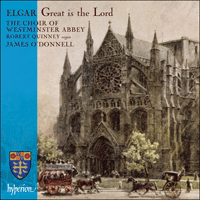




Elgar from the Abbey—what could be more fitting? From the regal opulence of Great is the Lord, first performed in Westminster Abbey in 1912, to the quiet devotion of the opus 2 Ave verum and Ave Maria, this varied programme is the perfect guide through Elgar’s rich choral output.
Performances on this new recording are astounding, as James O’Donnell guides the men and boys of Westminster Abbey through the grandiloquence and tenderness of this seminal music. The full gamut of Elgar’s career—from son of provincial instrument dealer to ‘composer laureate’—is represented and at every turn these performers offer new insights into the performing possibilities of these all-too-often-hackneyed works. There is also a rare performance of the long-forgotten Queen Alexandra Memorial Ode—a fitting tribute by Poet Laureate (John Masefield) and Master of the King’s Musick (Elgar) to Edward VII’s much-lamented consort.
Performances by The Choir of Westminster Abbey, under the direction of James O’Donnell and with the sympathetic organ accompaniment of Robert Quinney, are every bit as good as their previous Hyperion recordings would lead us to expect.

Although his first job on leaving school was in a solicitor’s office, where he lasted a year, Elgar was, though not formally indentured, in a very real sense the product of being de facto apprenticed to his father’s business. Essentially able to turn his hand to anything, by his later twenties was making a rapidly growing local reputation in the West Midlands as a musician and composer.
Elgar took his first musical post as assistant organist to his father at St George’s Roman Catholic Church, Worcester, first playing there in July 1872 and succeeding his father in 1880. He was Director of Music at Powick Lunatic Asylum from 1879. But it was through choral music that he became known and his fame spread to other provincial choral centres. As he approached the age of forty he was acknowledged as the composer of such vivid scores as The Black Knight, The Light of Life and King Olaf. His marriage, just before his thirty-second birthday to Caroline Alice Roberts, a woman nearly nine years his senior, became the driving force behind his later development. It also emphasized the social and religious pressures on Elgar, for his wife came from a ‘county’ military background. Worse, Elgar was a Catholic (to which Church his wife converted). Until the outbreak of the Great War, Elgar’s star was vigorously in the ascendant and most of the music for which he is remembered was written before then. He received many honours, including his knighthood; he moved in Court circles and at the time of the Coronation of King George V he was appointed to the Order of Merit.
When the Enigma Variations were taken up by Hans Richter in 1899, he found almost overnight he had arrived. All too soon Richter was the chosen conductor for the first performance of Elgar’s The Dream of Gerontius in October 1900, but thanks to Elgar delivering it very late and the chorus master dying during rehearsals, it was not a successful first performance, though despite Elgar’s passing despair within three years it had established itself. In spite of his various orchestral works—Enigma, the first four Pomp and Circumstance marches, Cockaigne, In the South and the Introduction and Allegro—at the height of Edward VII’s reign Elgar remained best known as a choral composer. By 1908, Gerontius was a repertory work, given everywhere. The earlier choral music, especially King Olaf, Caractacus and The Banner of Saint George, was also frequently performed, while the more recent Apostles and The Kingdom (both written for Birmingham, in 1903 and 1906 respectively) were highly regarded.
The War of 1914–1918 and the death of his wife in 1920 represented for Elgar turning points, and although appointed Master of the King’s Musick in 1924 he composed comparatively little.
Elgar came to music from the organ loft, a Roman Catholic organ loft, and his first attempts especially for choir were practical music for performance by the Choir of St George’s. We hear four of these: the early O salutaris hostia of 1880, one of three settings of these words; from 1887 the Ave verum and Ave Maria, later revised as part of his Opus 2; and from 1888 a setting of the Gradual Ecce sacerdos magnus, written for liturgical use in Birmingham.
As Elgar became known by a wider musical world his music became more and more influenced by the Anglican liturgy heard in the Cathedrals of the Three Choirs Festival and especially at Worcester. Elgar’s first appearance as a composer at the Worcester Three Choirs in 1890 must have been the outcome of much careful lobbying, yet to us it seems to have come out of the blue, with the orchestral overture Froissart. Just how did he suddenly learn to write and score like that? Here Elgar seems to arrive at his mature personality and orchestral manner at a stroke: what a remarkable achievement this now seems in comparison with his contemporaries. This orchestral imagination coupled with his growing expertise at choral writing combined during the 1890s to allow him to write The Black Knight in 1892 (heard at Worcester in 1893), the Scenes from the Bavarian Highlands in 1895 (1896), and later that year The Light of Life and Scenes from the Saga of King Olaf. In 1900 Birmingham heard The Dream of Gerontius: and the rest is history.
Great is the Lord Op 67 (1912)
This setting was started in 1910 but without an immediate commission or performance in view it dragged on until 1912 and was first performed with organ accompaniment at Westminster Abbey on 16 July 1912 conducted by Sir Frederick Bridge. It was orchestrated in September 1913.
Elgar’s setting is markedly less complex than many other similar works, and it falls into a number of sections each using new material. At the opening the altos, tenors and basses are in unison, later in two parts and with passages of block harmony. Elgar sets the central text ‘We have thought on Thy loving-kindness, O God’ for bass solo, and in the richer choral setting of the closing section finds invention that is reminiscent of similar moments in the oratorios.
They are at rest Anthem for SATB (1909)
Elgar’s elegy for unaccompanied chorus sets words by Cardinal Newman. It was written in response to a commission from Sir Walter Parratt for an anthem to be sung on the anniversary of Queen Victoria’s death, and was first performed at the Royal Mausoleum at Frogmore on 22 January 1910.
Queen Alexandra Memorial Ode (1932)
Written for the unveiling of the Queen Alexandra Memorial outside Marlborough House on 8 June 1932, this was the formal elegy by the Poet Laureate and Master of the King’s Musick. Elgar’s setting of Masefield’s words was scored for chorus and military band and it was heard in the open air accompanied by the band of the Welsh Guards.
For Elgar it closed an era more effectively than almost any of his other works. In 1902 he had written the Coronation Ode for Edward VII and Queen Alexandra, but it took the orchestration by Anthony Payne in 2004 to reveal how the Memorial Ode returns to the world of that piece, celebrating its final close.
Among the choristers at the unveiling was Sir David Willcocks who (in conversation with Andrew Neill) recalled the occasion:
I remember it was a fine day and we were in cassocks and surplices. I was from Westminster Abbey but the choirs taking part, if I remember rightly, were the choirs of St Paul’s Cathedral, The Chapel Royal and Westminster Abbey. We were stretched out in a semi-circle and I happened to be on the end of the row. After the performance I said to one of the St Paul’s boys: ‘Elgar seems to be looking in our direction’; and of course the chap said: ‘No, he was looking at us the whole time.’ Elgar has that all embracing gaze, and I remember feeling that I was in the presence of a great person. Of course he had great charisma.
The Ode was not published and the manuscript short score remained forgotten in the Royal Library. In 1975 when I first researched this work and was supplied a photocopy from Windsor the full score and parts could not be traced and they are still missing. One is aware that reconstructions of the original band scoring are afoot but none has yet been heard and it is good to have this performing edition by Jonathan Wix with organ accompaniment by Robert Quinney.
Ave verum Op 2 No 1 (1887)
Ave Maria Op 2 No 2 (1887)
When Elgar left school at the age of fifteen his father asked his friend W A Allen, a local solicitor and the treasurer of St George’s, if he had a position for the young Edward. Elgar thus worked, as what appears to have been office boy and clerk, but left after a year. When Allen died in January 1887 Elgar marked it with a funeral setting from the Requiem Mass for the choir of St George’s, subsequently resetting it to the words of Ave verum in 1902. Ave Maria was similarly written for St George’s and revised with Ave verum for publication in 1902 when the opus number was allocated. The music for Ave Maria is dedicated to Mrs H A Leicester, wife of his friend Hubert Leicester.
The Spirit of the Lord from The Apostles, Op 49 (1903)
Elgar’s oratorio The Apostles was first heard at Birmingham Town Hall on 14 October 1903. The Prologue ‘The Spirit of the Lord’ was extracted by Novello in 1907 and issued in their series of choruses for church use. The Apostles was the first of Elgar’s two Biblical oratorios to be completed and tells of the calling of the Apostles, their teaching and Jesus’s betrayal and the ascension. He set a composite text which he compiled from a variety of Biblical texts. In the Prologue—Jaeger called it a ‘chorus mysticus’—Elgar introduces many of the musical themes and motifs used throughout, and thus when performed as a separate item it is remarkable for its variety of invention. Jaeger identified a succession of themes starting with the opening idea in the accompaniment which he associated with the Spirit of the Lord. At the words ‘and recovering of sight’ Elgar quotes from his earlier oratorio The Light of Life.
Te Deum & Benedictus Op 34 (1897)
The Te Deum and Benedictus was written for chorus and orchestra for Elgar’s friend G R Sinclair (GRS of the Enigma Variations), organist of Hereford Cathedral, to mark the Hereford Three Choirs Festival in 1897. It was first heard there on 12 September 1897. Here Elgar takes two morning service canticles and treats them as a whole. This was the year of the Imperial March and The Banner of Saint George and Elgar was clearly aiming at a big, popular, setting, revelling in writing for large forces in a big space; the grand festival occasion was already meat and drink to him. The opening motif recurs throughout and in the Benedictus reappears at the words ‘And thou, child, shalt be called the Prophet of the Highest’. Elgar has the Te Deum end serenely, gradually fading away on a long organ (or orchestral) postlude. In the Benedictus Elgar opens with the choir only lightly accompanied, if at all. Later however he signals the Gloria (‘Glory be to the Father …’) with a crash on the cymbals and now returns to the world of the Te Deum with a grand and celebratory treatment of the words.
O salutaris hostia (1880)
One of three settings of these words, this strophic setting of a Gregorian hymn was made for service use at St George’s, and is perhaps reassuring to us of the choral standard they achieved.
Ecce sacerdos magnus Gradual for SATB and organ (1888)
In October 1888 the Archbishop of Birmingham visited St George’s and for this occasion Elgar produced this setting developed from a melody in Haydn’s Harmoniemesse. It was orchestrated in 1893 for St Catherine’s of Siena, Birmingham. In this case it is dedicated to his boyhood friend Hubert Leicester, the son of a Worcester printer. Leicester was choirmaster at St George’s when Elgar was organist. His career was spent as a Worcester Accountant. He was for many years Mayor of Worcester and was later responsible for Elgar receiving the freedom of the city.
O hearken Thou Op 64 (1911)
O hearken Thou was written, for chorus and orchestra, for the Coronation of King George V and Queen Mary and was completed in March 1911 and first performed at the Coronation service in Westminster Abbey on 22 June 1911, when the conductor was Sir Frederick Bridge. It was immediately issued by Novello in this version for chorus and organ in Novello’s series of church anthems. Elgar had also written a Coronation March and a Coronation Hymn, but here he is not looking to make a big public statement. Elgar takes verses 2 and 3 from Psalm 5 for his setting which was sung while the King took communion. This was not the time for his ceremonial manner and Elgar’s intense mood encompassing a rich choral sound took advantage of the huge acoustic to underline the fervent but essentially private dedication of the moment.
Give unto the Lord Op 74 (1914)
Written in February 1914, Give unto the Lord was immediately published by Novello. It was first heard in a version for chorus and orchestra at the Festival of the Sons of the Clergy at St Paul’s Cathedral on 30 April 1914, and was consequently dedicated to Sir George Martin, the organist of St Paul’s.
Elgar responds to the words of Psalm 29 with vigour and powerfully contrapuntal choral writing, but with a gentle central interlude at the words ‘In His Temple’. Eventually Elgar returns to the music of the opening but ends with the words ‘the blessing of peace’. As these words are, uniquely, repeated and given added emphasis by being echoed round the choir, one has to wonder whether Elgar had any inkling in April 1914 of what was to be.
Lewis Foreman © 2007
Quoiqu’il eût d’abord, au sortir de l’école, travaillé pendant un an dans une étude d’avoué, Elgar fut le fruit d’un apprentissage de facto—même s’il ne fut jamais officiel—dans le commerce paternel. Foncièrement capable de tout faire, à moins de trente ans, il s’acquit dans les Midlands de l’ouest une réputation, vite grandissante, de musicien-compositeur.
Pour son premier poste musical, Elgar fut assistant organiste de son père (il lui succéda en 1880) à l’église catholique Saint George de Worcester, où il joua pour la première fois en juillet 1872. À partir de 1879, il dirigea la musique à l’asile d’aliénés de Powick, mais ce furent ses compositions chorales qui lui valurent une réputation croissante, jusque dans d’autres centres choraux de province. À l’approche de la quarantaine, il fut salué pour avoir écrit des pages éclatantes comme The Black Knight, The Light of Life et King Olaf. Son mariage, juste avant ses trente-deux ans, avec Caroline Alice Roberts (de presque neuf ans son aînée) devint l’élément moteur de son développement, tout en accentuant les pressions socialo-religieuses qui pesaient sur lui, car sa femme était de la «haute», issue d’un milieu militaire. Et pour tout arranger, il était catholique et sa femme se convertit au catholicisme. Jusqu’à la Première Guerre mondiale, l’étoile d’Elgar ne cessa de monter et la plupart des œuvres pour lesquelles on se le rappelle datent de cette époque. Il reçut maints honneurs, et fut notamment créé chevalier; fréquentant les cercles de la cour, il fut nommé à l’Ordre du mérite au moment du couronnement du roi George V.
En 1899, Hans Richter reprit les Enigma Variations et Elgar découvrit le succès presque du jour au lendemain. Bien trop vite, Richter fut choisi pour diriger la création de The Dream of Gerontius en octobre 1900; mais la première ne fut pas un succès—Elgar rendit sa partition très en retard et le maître de chœur mourut pendant les répétitions—, même si l’œuvre finit par s’imposer, malgré les trois années de désespoir qu’elle valut à son auteur. À l’apogée du règne d’Edward VII, toutes ses pièces orchestrales (Enigma, les quatre premières marches Pomp and Circumstance, Cockaigne, In the South et Introduction and Allegro) n’empêchèrent pas Elgar d’être surtout connu pour sa musique chorale. En 1908, Gerontius était inscrit au répertoire et on le jouait partout. Les pages chorales antérieures, surtout King Olaf, Caractacus et The Banner of Saint George, étaient, elles aussi, souvent jouées; quant aux compositions plus récentes, The Apostles et The Kingdom (écrites pour Birmingham l’une en 1903, l’autre en 1906), elles jouissaient d’une grande considération.
La guerre de 1914–1918 et la mort de sa femme, en 1920, marquèrent un tournant chez Elgar: bien que nommé Master of the King’s Musick en 1924, il composera désormais relativement peu.
Elgar vint à la musique par la tribune d’orgue—une tribune d’orgue catholique—et ses premières tentatives de composition, pour chœur notamment, débouchèrent sur une musique pratique destinée au chœur de Saint George. Quatre de ces essais sont réunis ici: le précoce O salutaris hostia de 1880 (le premier de trois); l’Ave verum et l’Ave Maria de 1887, révisés plus tard dans le cadre de l’op.2; et une mise en musique du graduel Ecce sacerdos magnus écrite en 1888 pour un usage liturgique à Birmingham.
À mesure qu’il fut connu d’un plus large cercle musical, Elgar composa des œuvres de plus en plus influencées par la liturgie anglicane proposée par les cathédrales du Three Choirs Festival, notamment à Worcester. La première fois qu’il apparut au Worcester Three Choirs, en 1890, ce fut avec l’ouverture orchestrale Froissart et, même si elle nous semble le fruit du hasard, cette participation résulta probablement d’un lobbying méticuleux. Mais comment Elgar a-t-il donc pu apprendre à écrire et à orchestrer ainsi? Il paraît, ici, avoir trouvé d’un coup sa personnalité aboutie et sa manière orchestrale: quelle remarquable réalisation cela semble aujourd’hui, comparé aux œuvres de ses contemporains. Cette inventivité orchestrale, couplée à une maîtrise croissante de l’écriture chorale, lui permit de composer dans les années 1890 The Black Knight (1892; joué à Worcester en 1893), les Scenes from the Bavarian Highlands (1895; 1896) et, plus tard dans l’année 1895, The Light of Life et Scenes from the Saga of King Olaf. En 1900, Birmingham découvrit The Dream of Gerontius—tout le monde connaît la suite.
Great is the Lord op.67 (1912)
Cette œuvre fut entamée en 1910 mais, sans commande immédiate ni perspective d’interprétation, sa composition s’éternisa jusqu’en 1912; elle fut créée avec une accompagnement d’orgue en l’abbaye de Westminster le 16 juillet 1912, sous le baguette de Sir Frederick Bridge, puis orchestrée en september 1913.
Sensiblement moins complexe que bien des œuvres similaires, cette mise en musique elgarienne est découpée en plusieurs sections utilisant chacune un matériel nouveau. À l’ouverture, altos, ténors et basses sont à l’unisson, puis à deux parties et avec des passages d’harmonie en blocs. Elgar adresse le texte central «We have thought on Thy loving-kindness, O God» à une basse solo et, dans l’écriture chorale plus riche de la section conclusive, certaines inventions rappellent des moments comparables dans les oratorios.
They are at rest Anthem pour SATB (1909)
Cette élégie pour chœur sans accompagnement met en musique un texte du cardinal Newman. Elle fut écrite en réponse à une commande de Sir Walter Parratt, qui voulait un anthem pour l’anniversaire de la mort de la reine Victoria, et fut créée au Royal Mausoleum de Frogmore le 22 janvier 1910.
Queen Alexandra Memorial Ode (1932)
Écrite pour l’inauguration du Queen Alexandra Memorial, devant Marlborough House, le 8 juin 1932, cette œuvre fut l’élégie officielle du poète lauréat et du Master of the King’s Musick. Sur les mots de Masefield, Elgar conçut une mise en musique pour chœur et fanfare militaire; elle fut créée en extérieur, accompagnée par la fanfare des Welsh Guards. Pour Elgar, cette pièce marqua véritablement la fin d’une époque, plus que ne le firent presque toutes ses autres œuvres. En 1902, il avait écrit la Coronation Ode pour Edward VII et la reine Alexandra et, pour le présent auteur, ce fut l’orchestration d’Anthony Payne, en 2004, qui révéla de manière saisissante combien la Memorial Ode renoue avec l’univers de cette composition, célébrant son point final.
Sir David Willcocks, qui figurait au nombre des choristes présents lors de l’inauguration, se remémora l’événement (au cours d’une conversation avec Andrew Neill):
Je me souviens que c’était une belle journée et que nous étions en soutane et en surplis. Je venais de l’abbaye de Westminster mais les chœurs qui participaient auc célébrations étaient, si j’ai bonne mémoire, ceux de la cathédrale St Paul, de la Chapel Royal et de l’abbaye de Westminster. Nous formions un demi-cercle et il se trouve que j’étais en bout de rang. Une fois l’interprétation achevée, je dis à un des garçons de St Paul: «Elgar semble regarder dans notre direction»; ce à quoi le gars me répondit bien sûr: «Non, il ne nous a pas quitté des yeux». Elgar avait ce regard qui embrasse tout et je me rappelle m’être senti en présence d’un grand personnage. Il avait, naturellement, un formidable charisme.
L’Ode ne fut jamais publiée et la particelle manuscrite est tombée dans l’oubli à la Royal Library. En 1975, quand j’ai commencé à chercher cette œuvre et qu’on m’en a fourni une photocopie de Windsor, la grande partition et les parties avaient disparu—elles manquent toujours à l’appel. Certes, la reconstitution de l’orchestration originale pour fanfare est bien en préparation mais personne n’a encore rien entendu et il est bon d’avoir cette édition pratique de Jonathan Wix, avec un accompagnement d’orgue de Robert Quinney.
Ave verum op.2 no1 (1887)
Ave Maria op.2 no2 (1887)
Quand Elgar quitta l’école à l’âge de quinze ans, son père demanda à son ami W. A. Allen, avoué local et trésorier de Saint George, s’il avait un poste pour son jeune fils. Ce fut ainsi qu’Elgar travailla, semble-t-il, comme garçon de bureau et comme clerc, mais pendant un an seulement. À la mort d’Allen (janvier 1887), il composa une musique funèbre inspirée de la messe de requiem pour le chœur de Saint George, musique qu’il recycla, en 1902, sur les paroles de l’Ave verum. L’Ave Maria, également destiné à Saint George, fut révisé en même temps que l’Ave verum pour être publiée en 1902, année de l’attribution du numéro d’opus. Elgar dédia son Ave Maria à Mrs H. A. Leicester, la femme de son ami Hubert Leicester.
The Spirit of the Lord op.49 (1903) L’oratorio The Apostles fut créé à l’hôtel de ville de Birmingham le 14 octobre 1903. Le Prologue «The Spirit of the Lord» en fut extrait par Novello en 1907 et publié dans la série des chœurs à usage liturgique. Elgar composa deux oratorios bibliques, dont celui-ci, achevé en premier, qui évoque l’appel des apôtres, leur enseignement, la trahison et l’ascension de Jésus. Le texte, composite, est compilé à partir de plusieurs passages bibliques. Dans le Prologue—Jaeger parle de «chorus mysticus»—, Elgar introduit nombre des thèmes et motifs musicaux présents dans toute l’œuvre, d’où une pièce qui, prise isolément, s’illustre par sa diversité d’invention. Jaeger identifia une succession de thèmes, à commencer par l’idée initiale de l’accompagnement, qu’il associa à l’Esprit du Seigneur. Aux mots «and recovering of sight» («et recouvrant la vue») correspond une citation d’un autre oratorio d’Elgar: The Light of Life.
Te Deum & Benedictus op.34 (1897)
Le Te Deum and Benedictus fut écrit pour chœur et orchestre à l’occasion du Hereford Three Choirs Festival de 1897, où il fut créé le 12 septembre, et à l’intention de G. R. Sinclair (le GRS des Enigma Variations), un ami d’Elgar, organiste de la cathédrale d’Hereford. Ici, Elgar traite comme un tout deux cantiques du service matinal. En cette année qui vit aussi naître l’Imperial March et The Banner of Saint George, Elgar envisageait manifestement une grande pièce populaire, où il se délecterait d’écrire pour d’imposantes forces chorales, dans un vaste espace; déjà, l’événement que constituait le festival était une aubaine pour lui. Le motif d’ouverture, sans cesse récurrent, réapparaît dans le Benedictus aux mots «And thou, child, shalt be called the Prophet of the Highest». Le Te Deum s’achève sereinement, en mourant peu à peu sur un long postlude organistique (ou orchestral). Elgar ouvre le Benedictus sur le chœur peu, voire pas, accompagné. Mais, par la suite, il marque le Gloria («Glory be to the Father …») par un fracas sur les cymbales avant de renouer avec l’univers du Te Deum grâce à un traitement grandiose et festif des mots.
O salutaris hostia (1880)
Cette mise en musique strophique d’une hymne grégorienne—un des trois O salutaris hostia elgariens—fut écrite pour un usage liturgique à Saint George, et nous rassure peut-être quant au niveau atteint par ce chœur.
Ecce sacerdos magnus Graduel pour SATB et orgue (1888)
Elgar produisit cette œuvre en octobre 1888, à l’occasion d’une visite à Saint George de l’archevêque de Birmingham. Développée à partir d’une mélodie de l’Harmoniemesse de Haydn, elle fut orchestrée en 1893 pour l’église Sainte-Catherine de Sienne, à Birmingham. Cette fois, Elgar la dédia à son ami d’enfance Hubert Leicester, un fils d’imprimeur de Worcester qui fut maître de chœur à Saint George quand Elgar y était organiste. Il fut, durant toute sa carrière, comptable à Worcester, ville dont il fut longtemps le maire—il fut, plus tard, chargé de nommer Elgar citoyen d’honneur de la ville.
O hearken Thou op.64 (1911)
Écrite pour le couronnement du roi George V et de la reine Mary, cette pièce pour chœur et orchestre (achevée en mars 1911) fut créée le 22 juin 1911, lors du service de couronnement, en l’abbaye de Westminster, sous la baguette de Sir Frederick Bridge. Novello la publia immédiatement, dans cette version pour chœur et orgue, dans la série des anthems liturgiques. Elgar avait déjà composé une Coronation March et une Coronation Hymn mais, ici, il ne cherche pas à faire une vaste énonciation publique: il prend juste les versets 2 et 3 du psaume 5 pour produire cette œuvre qui fut chantée pendant que le roi recevait la communion. L’heure n’était pas aux manières cérémonielles et le climat intense instauré par Elgar grâce, notamment, à une riche sonorité chorale, tira parti de l’immense acoustique pour souligner la consécration fervente, mais fondamentalement privée, de l’instant.
Give unto the Lord op.74 (1914)
Écrite en février 1914, et immédiatement publiée par Novello, cette œuvre fut créée dans une version pour chœur et orchestre lors du Festival of the Sons of the Clergy, en la cathédrale St Paul, le 30 avril 1914—aussi fut-elle dédiée à Sir George Martin, l’organiste de St Paul.
Elgar répond aux paroles du psaume 29 avec vigueur, grâce à une écriture chorale puissamment contrapuntique, mais avec un doux interlude central aux mots «In His Temple», avant de finalement revenir à la musique d’ouverture—même si l’œuvre se clôt sur «the blessing of peace» («la bénédiction de la paix»). Ces mots étant exceptionnellement répétés et accentués (le chœur les reprend en écho), c’est à se demander si, dès avril 1914, Elgar ne se doutait pas de ce qui allait arriver.
Lewis Foreman © 2007
Français: Hyperion Records Ltd
Obwohl er nach der Schule zuerst in einem Anwaltsbüro arbeitete, wo er ein Jahr blieb, ging Elgar dann, obwohl nicht förmlich angestellt, de facto im Geschäft seines Vaters in die Lehre. Da er vielseitig begabt und fähig war, verbreitete sich in seinen Spätzwanzigern im englischen Gebiet der West Midlands bald sein wachsender Ruf als Musiker und Komponist.
Elgar nahm seine erste musikalische Stelle als stellvertretender Organist für seinen Vater an der römisch-katholischen St. Georgskirche in Worcester an, wo er im Juli 1872 zum ersten Mal spielte und 1880 die Nachfolge seines Vaters antrat. Ab 1879 war er Musikdirektor am Powick Lunatic Asylum (Irrenanstalt). Aber bald wurde er durch seine Chormusik bekannt, und sein Ruf verbreitete sich auch in anderen provinziellen Chorzentren. Als er sich seinen Vierzigern näherte, hatte er sich bereits als Komponist solch dynamischer Partituren wie The Black Knight („Der schwarze Ritter“), The Light of Life („Das Lebenslicht“) und King Olaf („König Olaf“) Anerkennung geschaffen. Seine Ehe mit der nahezu neun Jahre älteren Caroline Alice Roberts kurz vor seinem 32. Geburtstag war die Triebkraft für seine spätere Entwicklung. Sie betonte jedoch auch den sozialen und religiösen Druck für Elgar, denn seine Frau stammte aus einem militärischen „County“-Milieu (Landadel), und noch schlimmer: Elgar war Katholik (und seine Frau konvertierte). Bis zum Ausbruch des 1. Weltkrieges strahlte Elgars Stern immer heller, und die meiste Musik, für die er berühmt ist, entstand in dieser Zeit. Er erhielt viele Auszeichnungen, einschließlich der Erhebung in den Ritterstand, bewegte sich in höfischen Kreisen und zur Zeit der Krönung König Georgs V. Wurde ihm der Order of Merit (Verdienstorden) verliehen.
Als Hans Richter 1899 die Enigma-Variationen in sein Repertoire aufnahm, fand Elgar praktisch über Nacht Erfolg. Richter war prompt die Wahl als Dirigent für die Uraufführung für Elgars The Dream of Gerontius („Der Traum des Gerontius“) im Oktober 1900, aber da Elgar die Partitur erst sehr spät lieferte und der Chorleiter während der Proben starb, war die Uraufführung kein Erfolg. Doch trotz Elgars vorübergehender Verzweiflung sollte sich das Werk innerhalb von drei Jahren fest etablieren. Obwohl Elgar viele verschiedene Orchesterwerke schrieb—Enigma, die ersten vier Pomp and Circumstance-Märsche, Cockaigne, In the South („Im Süden“) und Introduktion und Allegro—blieb er am Höhepunkt der Regierungszeit von Eduard VII. Als Chorkomponist am besten bekannt. Bis 1908 hatte sich Gerontius im Standardrepertoire etabliert und wurde überall gespielt. Seine frühere Chormusik, besonders King Olaf, Caractacus and The Banner of St. George („Das Banner des Hl. Georg“), wurden ebenfalls häufig aufgeführt, während die 1903, respektive 1906 für Birmingham geschriebenen neueren Oratorien The Apostles („Die Apostel“) and The Kingdom („Das Königreich“) hoch angesehen wurden.
Der Weltkrieg von 1914–18 und der Tod seiner Frau 1920 stellten einen Wendepunkt für Elgar dar, und obwohl er 1924 zum „Master of the King’s Musick“ ernannt wurde, komponierte er nur noch relativ wenig.
Elgar trat aus der Perspektive einer Orgelempore, einer römisch-katholischen Orgelempore, an die Musik heran, und seine ersten Versuche, besonders für Chor, waren praktische Musikstücke zur Aufführung durch den Chor der St. Georgskirche. Wir hören vier dieser Werke: das frühe O salutaris hostia von 1880 (eine von drei Sätzen dieses Textes), das Ave verum und Ave Maria von 1887, die später als Teil seines Opus 2 revidiert wurden, und eine Vertonung des Graduales Ecce sacerdos magnus von 1888, das zum liturgischen Gebrauch in Birmingham geschrieben wurde.
Je mehr Elgar einem weiteren Publikum bekannt wurde, desto größeren Einfluss gewann die anglikanische Liturgie, wie sie in den Kathedralen des Three Choirs Festival, und besonders Worcester zu hören war, auf seine Musik. Elgars erster Auftritt als Komponist im Three Choirs Festival in Worcester 1890 mit der Orchesterouvertüre Froissart muss das Ergebnis von viel sorgfältiger Lobbyarbeit gewesen sein, obwohl es aus dem Nichts heraus zu kommen scheint. Wie lernte er, so zu schreiben und orchestrieren? Elgar scheint hier gleichzeitig seine reife Persönlichkeit und Orchestertechnik gefunden zu haben: welch erstaunliche Errungenschaft das heute im Vergleich zu seinen Zeitgenossen scheint! Diese orchestrale Vorstellungskraft vereint mit seiner wachsenden Kompetenz in der Chorkomposition kamen in den 1890er Jahren zusammen und ermöglichten ihm, 1892 The Black Knight zu schreiben (1893 in Worcester aufgeführt), 1895 (1896 aufgeführt) die Scenes from the Bavarian Highlands („Szenen aus dem bayerischen Gebirge“) und später im gleichen Jahr The Light of Life und Scenes from the Saga of King Olaf („Szenen aus der Sage von König Olaf“). 1900 hörte Birmingham The Dream of Gerontius, und der Rest ist Geschichte.
Great is the Lord Op. 67 (1912)
Dieser Satz wurde 1910 begonnen, aber ohne unmittelbaren Auftrag oder Gelegenheit zur Aufführung zog sich die Komposition bis 1912 hin. Das Werk wurde am 16. Juli 1912 mit Orgelbegleitung unter Sir Frederick Bridge in der Westminster Abbey uraufgeführt. Es wurde im September 1913 orchestriert.
Elgars Satz ist wesentlich weniger komplex als viele ähnliche Werke und ist in mehrere Abschnitte unterteilt, die jeweils neues Material verwenden. Am Anfang singen Alt, Tenor und Bass unisono, später zweistimmig mit Passagen von Blockharmonik. Elgar setzt den zentralen Text „Wir gedenken deiner liebenden Güte, o Gott“ für Bass-Solo und findet im üppigeren Chorsatz des Schlussteils einen Erfindungsreichtum, der an ähnliche Momente in den Oratorien erinnert.
They are at rest Anthem für SATB (1909)
Elgars Elegie für Chor a cappella vertont Worte des Kardinals Newman. Sie entstand als Auftragskomposition für Sir Walter Parratt für ein Anthem, das zum Jahrestag des Todestages von Königin Viktoria gesungen werden sollte, und wurde am 22. Januar 1910 im Königlichen Mausoleum in Frogmore uraufgeführt.
Queen Alexandra Memorial Ode (1932)
Diese Gedenkode wurde zur Enthüllungsfeier am 8. Juni 1932 für das Denkmal für Königin Alexandra außerhalb von Marlborough House geschrieben und war die förmliche Elegie des Poet Laureate und Master of the King’s Musick. Elgars Vertonung von Masefields Worten war für Chor und Militärkapelle instrumentiert und wurde im Freien mit der Begleitung der Band of the Welsh Guards gespielt.
Für Elgar beschloss die Ode eine Ära effektiver als nahezu jedes andere seiner Werke. 1902 hatte er die Krönungsode für Eduard VII. Und Königin Alexandra geschrieben, und für den Autor dieser Zeilen war es die Orchestration von Anthony Payne aus dem Jahre 2004, die eklatant enthüllte, wie die Gedenkode zu dieser Welt zurückkehrt und ihr letztes Kapitel feierlich beschließt.
Unter den Chorknaben bei der Enthüllung befand sich auch Sir David Willcocks, der sich (im Gespräch mit Andrew Neill) an die Gelegenheit erinnert:
Ich erinnere mich, dass es ein schöner Tag war und wir Talare und Chorhemden trugen. Ich war von der Westminster Abbey, aber so weit ich mich erinnere, waren die Chöre, die teilnahmen von der St. Paulkathedrale, der Chapel Royal und Westminster Abbey. Wir standen in einem lang ausgezogenen Halbkreis, und ich war am Ende der Reihe. Nach der Aufführung sagte ich zu einem der Chorknaben von St. Paul: „Elgar scheint in unsere Richtung zu schauen“, und der andere Bube sagte: „Nein, er hat uns die ganze Zeit angesehen.“ Elgar hat diesen allumfassenden Blick, und ich erinnere mich, dass ich das Gefühl hatte, mich in der Gegenwart eines großen Menschen zu befinden. Er besass natürlich großes Charisma.
Die Ode wurde nicht veröffentlicht, und das handschriftliche Particell lag vergessen in der Royal Library. 1975, als ich dieses Werk zum ersten Mal erforschte, erhielt ich eine Photokopie von Windsor, aber die volle Partitur und Stimmen konnten nicht gefunden werden und sind bis heute verschollen. Ich weiss, dass Rekonstruktionen der Originalinstrumentation für Militärkapelle existieren, habe sie aber bis heute nie gehört, und es ist gut, dass es diese Konzertfassung von Jonathan Wix mit Orgelbegleitung von Robert Quinney gibt.
Ave verum Op. 2, Nr. 1 (1887)
Ave Maria Op. 2, Nr. 2 (1887)
Als Elgar im Alter von 15 Jahren die Schule verließ, bat sein Vater seinen Freund W. A. Allen, einen ortsansässigen Rechtsanwalt und Kassenwart der St. Georgskirche, um eine Position für den jungen Edward. Elgar arbeitete also für ihn, vermutlich als Bürogehilfe, kündigte aber nach einem Jahr. Als Allen im Januar 1887 starb, gedachte er ihm mit einem Satz aus der Requiemsmesse für den Chor der Georgskirche, den er 1902 auf die Worte des Ave verum umarbeitete. Ave Maria wurde ebenfalls für St. Georg geschrieben und zur Veröffentlichung 1902 zusammen mit dem Ave verum revidiert, wenn sie auch ihre Opusnummer erhielten. Die Musik für Ave Maria ist Frau H. A. Leicester, der Frau seines Freundes Hubert Leicester gewidmet.
The Spirit of the Lord aus The Apostles, Op. 49 (1903) Elgars Oratorium The Apostles war am 14. Oktober 1903 in der Birmingham Town Hall zum ersten Mal zu hören. Der Prolog „The Spirit of the Lord“ („Der Geist des Herrn“) wurde 1907 von Novello als Auszug in der Serie von Chorwerken zum Kirchengebrauch einzeln veröffentlicht. The Apostles war das erste der beiden biblischen Oratorien, die Elgar vollenden sollte und erzählt die Geschichte von der Berufung der Apostel, ihrer Lehre und dem Verrat an Jesus und der Auferstehung. Er setzt ein aus einer Vielfalt biblischer Texte zusammengestelltes Libretto. Im Prolog—Jaeger nannte ihn einen „Chorus mysticus“—führt Elgar viele der musikalischen Themen und Motive ein, die im Verlauf des Oratoriums verwendet werden, und als Einzelstück ist er daher bemerkenswert in der Vielfalt der Erfindungskraft. Beginnend mit der Anfangsidee identifizierte Jaeger eine Reihe von Themen, die er mit dem „Geist des Herrn“ assoziierte. Bei den Worten „und das Augenlicht wieder finden“ zitiert Elgar aus seinem früheren Oratorium The Light of Life.
Te Deum & Benedictus Op. 34 (1897)
Das Te Deum und Benedictus für Chor und Orchester wurde für Elgars Freund G. R. Sinclair (GRS in den Enigma-Variationen), Organist an der Kathedrale von Hereford anlässlich des Hereford Three Choirs Festivals 1897 geschrieben. Es war am 12. September 1897 dort zum ersten Mal zu hören. Elgar nimmt hier zwei Cantica (Lobgesänge) aus dem Frühgottesdienst und bearbeitet sie als eine Einheit. Es war das Jahr des Imperial March („Reichsmarsch“) und The Banner of St. George; Elgar bemühte sich eindeutig, ein populäres Großwerk zu schreiben, und genießt offensichtlich, für umfangreiche Kräfte in einem großen Raum zu schreiben: der Anlass des großen Festspieles war sozusagen schon sein tägliches Brot. Das Anfangsmotiv erscheint durchweg und kehrt im Benedictus bei den Worten „Und du Kind, wirst Prophet des Höchsten heißen“ wieder. Elgar lässt das Te Deum ruhig enden, indem er es langsam in einem langen Orgel- (oder Orchester-)Nachspiel abebben lässt. Im Benedictus beginnt Elgar mit dem nur leicht oder gar nicht begleiteten Chor, kündigt später jedoch das Gloria („Ehre sei dem Vater …“) mit einem Beckenschlag an und kehrt von da an mit grandios-feierlicher Behandlung des Textes zur Welt des Te Deums zurück.
O salutaris hostia (1880)
Dieser strophische Satz einer gregorianischen Hymne—eine von drei Vertonungen dieser Worte—entstand für den Gebrauch im Gottesdienst an der St. Georgskirche, und versichert uns des Niveaus, das der Chor erreicht hatte.
Ecce sacerdos magnus Graduale für SATB und Orgel (1888)
Im Oktober 1888 besuchte der Erzbischof von Birmingham die St. Georgskirche, und für diesen Anlass produzierte Elgar diese Vertonung, die auf einer Melodie aus Haydns Harmoniemesse basiert. Sie wurde 1893 für die Kirche der Hl. Katharina von Siena in Birmingham orchestriert. In diesem Fall ist sie Elgars Kindheitsfreund Hubert Leicester gewidmet, der Chorleiter der Georgskirche war, als Elgar dort als Organist wirkte. Leicester arbeitete als Buchhalter in Worcester und war viele Jahre lang Bürgermeister von Worcester; er war später dafür verantwortlich, dass Elgar die Ehrenbürgerschaft erhielt.
O hearken Thou Op. 64 (1911)
O hearken Thou („Herr, höre meine Worte, merke auf mein Reden!“) für Chor und Orchester wurde für die Krönung von König Georg V. Und Königin Maria geschrieben. Es wurde im März 1911 vollendet und am 22. Juni 1911 im Krönungsgottesdienst in der Westminster Abbey unter dem Dirigenten Sir Frederick Bridge uraufgeführt. Das Werk wurde sofort von Novello in der vorliegenden Fassung für Chor und Orgel in der Novello-Serie von Kirchenanthems veröffentlicht. Elgar hatte auch einen Krönungsmarsch und eine Krönungshymne geschrieben, aber hier sucht er keine große öffentliche Aussage zu machen. Elgar verwendet den 2. und 3. Vers aus Psalm 5 für diese Vertonung, die gesungen wurde, während der König die Kommunion empfing. Seine zeremonielle Manier wäre hier nicht angebracht gewesen, und Elgar machte sich stattdessen mit intensiver Stimmung und üppigem Chorklang die gewaltige Akustik zu Nutze, um die glühende, im Wesentlichen jedoch private Hingabe dieses Moments zu unterstreichen.
Give unto the Lord Op. 74 (1914)
Give unto the Lord („Bringet dar dem Herrn“) wurde im Februar 1914 geschrieben und sofort von Novello veröffentlicht. Es war in einer Fassung für Chor und Orchester auf dem „Sons of the Clergy“ Festival am 30. April 1914 in der St. Paulskathedrale zum ersten Mal zu hören und wurde später dem Organisten der St. Paulskathedrale, Sir George Martin, gewidmet.
Elgar reagiert auf die Worte des 29. Psalms mit Energie und kraftvoll-kontrapunktischem Chorsatz, aber einem zarteren Mittelteil als Interludium auf die Worte „In seinem Tempel“. Elgar kehrt schließlich wieder zur Musik des Anfangs zurück, schließt aber mit den Worten „[Der Herr] segne [sein Volk] mit Frieden“. Da diese Worte allein wiederholt und noch dadurch unterstrichen werden, dass sie durch den Chor echoen, muss man sich wundern, ob Elgar schon im April 1914 ahnte, was bevorstand.
Lewis Foreman © 2007
Deutsch: Renate Wendel