
Welcome to Hyperion Records, a British classical label devoted to presenting high-quality recordings of music of all styles and from all periods from the twelfth century to the twenty-first.
Hyperion offers both CDs, and downloads in a number of formats. The site is also available in several languages.
Please use the dropdown buttons to set your preferred options, or use the checkbox to accept the defaults.
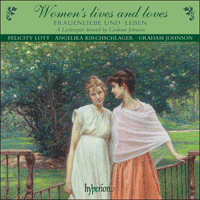



Taking as its cue the Frauenliebe und -Leben cycles by Robert Schumann and Carl Loewe, this captivating duet recital follows the poet Chamisso’s story of a single woman’s life and love, expanding it to encompass the life stories of two women as they share and compare their experiences. As part of this broadening of the story we also hear songs and duets on the themes of love, marriage, motherhood and bereavement by Brahms, Mendelssohn and Wolf.
Hyperion’s much-loved soprano Felicity Lott is here joined by the young, sought-after mezzo Angelika Kirchschlager who won a Grammy award in 2004 for her recording with René Jacobs of Mozart’s Le nozze di Figaro.

But it is here that the real difficulties begin. Any two opera singers can like each other sufficiently to want to make music together away from the operatic stage, but the success of the recital programme depends on whether or not the musical material available to them is suitable. The duet repertoire for voices and piano is not as endless as one might imagine. For men and women wishing to collaborate there is, it is true, a large number of love songs and a fair number of duets; when operatic or musical items are included, the dramaturgy of the evening can be made to work. The closing kiss between Dame Felicity Lott and Sir Thomas Allen at the end of a long scena from Carousel seems the natural outcome of a mostly classical evening where almost every single musical item has voiced the singers’ on-stage romantic involvement. In this case we are transferring to the concert hall the conventions of the opera house. The hidden difficulty here is that soprano and baritone repertoire is very much harder to find than that for soprano and tenor. Schumann duets for example would either be too low for the soprano in a transposed key or too high for any baritone in the original. Mezzo and baritone would seem to be an easier choice, but even here (despite the splendid Op 28 duets by Brahms) an evening of songs (as opposed to arias) is likely to comprise alternating sequences from each of the singers’ repertoires. This surely is more of a shared recital than a duet recital, a return to the nineteenth-century conventions when everyone invited everyone else to take part in their evenings. In those days there was a nominal ‘host’ for advertising or billing purposes, as well as for financial reasons, but Clara Schumann, for example, would make guest appearances in Joachim’s recitals, and he in hers. Duetting between the star artists was not to be taken for granted on such occasions; Joachim would often be accompanied by a pianist other than Clara Schumann who waited in the wings for her solos.
The song repertoire for two singers of the same sex has special difficulties, and a concluding kiss à la Carousel is usually less appropriate. Beyond Monteverdi and early music, two tenors, let alone three, are sorely tested without resorting to specially commissioned arrangements; large amounts of money have to be in the offing to make such an idea practical, as well as palatable, to the singers concerned. Tenor and baritone have invariably to turn to the duet from Les pêcheurs de perles. Mainly for reasons of temperament, as well as of repertoire, the idea of two baritones singing together is almost as unworkable as the combination of two soprano prima donne. The soprano and mezzo combination is completely different however: it is supported by the nineteenth-century salon tradition of young ladies (often sisters) singing duets together—and this in turn stems, surely, from Mozart and Da Ponte who created in Così fan tutte a scenario with a plausible raison d’être for this ravishing combination of timbres. Bellini presented Norma and Adalgisa (although the latter was originally a soprano part), and Mendelssohn, Schumann and Brahms duly catered for the Fiordiligis and Dorabellas of their own time. Fauré, and other French composers, were especially inspired by Pauline Viardot’s duetting daughters, Claudie and Marianne. Here and there one finds further useful duets for women’s voices (Purcell, Beethoven folk songs, Rossini, Dvorák and so on) but the list is relatively short if one insists on high musical quality. The travesti passions of Cherubino and Oktavian are not comfortable within the bounds of a concert hall; take away love duets and one is reduced to songs extolling the beauties of nature, or two women admiring, or competing for, the same man. As Irving Berlin put it: ‘God help the mister who comes between me and my sister / And God help the sister who comes between me and my man.’ That is as succinct a summation of the plot of Così fan tutte as I can imagine.
It seems to me that the challenge in planning such programmes is to find some musical reason or other for two voices to come, and stay, together for an evening. Over twenty years ago I devised a Songmakers’ Almanac programme for Felicity Lott and her regular duet partner Ann Murray entitled If Fiordiligi and Dorabella had been lieder singers. The plot of Mozart’s opera was followed in very general terms allowing for duets and solos of devotion, wavering, capitulation and reconciliation. The deus ex machina was Richard Jackson in Don Alfonso mode where that character’s recitatives were spoken rather than sung as the connecting tissue between the women’s songs. Another such experiment was A Lieder Capriccio, a whole evening of Richard Strauss lieder where the plot and the casting (soprano, baritone, tenor, and a speaking part for the major-domo) were based on Strauss’s opera Capriccio, and where the lieder were connected by fragments from the opera itself. Over many years, and after devising some three hundred different recital programmes, I have learned that solo songs are an important part of every duet recital—the constituent parts of any vocal combination are more to be valued when they can also be heard separately. I realized that a mixture of styles and languages, including items from the English Music Hall, was possible as long as there was a strong enough unifying thread—in the case above, the story-line of Mozart’s opera reduced to its basic outline. If an opera can have a ‘plot’, why not a song recital?
Women’s lives and loves
The challenge of planning this duet programme was very different from that of one based on Così fan tutte. I wanted something more serious, a concept that did not dissolve into comedy—and a lieder programme rather than a mixture of music from many lands. Cross-over performances are sometimes more joyful for the performer than for the audience. Some singers (Dame Felicity Lott among them) are excellent with lighter music, but despite a glut of this in the recitals of today it is a type of singing for which most classical artists are not trained. I have nightmare memories of a famous lieder singer’s all-jazz evening; when the interval came the public had been ‘delighted long enough’—as Jane Austen has it in Pride and Prejudice—and were praying for Goethe to replace Gershwin.
The crucial idea was to follow the shape of Adelbert von Chamisso’s cycle of poems entitled Frauenliebe und -leben. Robert Schumann wrote his famous songs in 1840, though his was by no means the first musical setting. This honour fell to the artist and poet Franz Kugler (1808–1858), a close friend of Chamisso, who published the cycle with his own simple but touching music in his Skizzenbuch of 1830. In 1831 Franz Lachner wrote a setting of Seit ich ihn gesehen (the cycle’s first song) with clarinet obbligato. Schumann was not even the second composer to write a full setting of the poetic sequence; this was Carl Loewe whose cycle was composed and published in 1836. By the time Schumann came to set these words he was almost certainly already aware of their musical possibilities in other hands. Schumann’s Frauenliebe und -leben quickly became a staple of the repertoire; it is so well known in fact that many song enthusiasts could hum the piece through from start to finish without difficulty! The Loewe on the other hand is much more of a rarity: it has moments, indeed whole songs, of great beauty, but also longueurs and patches where Schumman’s greater inspiration invites unfavourable comparisons.
Women’s lives and loves is a programme based on the various stages of romantic and marital experience where these two cycles, the Schumann and the Loewe, are interleaved with each other. This music is in turn enriched with duets by Schumann himself as well as Mendelssohn and Brahms, and there are further solo songs by Brahms and Wolf. There are complete performances of neither Schumann’s nor Loewe’s cycle. A straightforward side-by-side performance of the two works with each singer alternating the same poems may seem a good idea in theory, but this proves deadly in practice, a kind of juke-box jury that is unfair to both composers in different ways. Nevertheless we hear all Chamisso’s texts, and in the poet’s sequence (not including, however, the ninth poem for the suddenly aged heroine as a grandmother, which Loewe set in rather uninspired fashion, and Schumann simply ignored).
In this scenario it is as if two women are feeling similar emotions, but fixing their gaze on different men in different tessituras. Throughout the recital Angelika Kirchschlager is the advocate of the Loewe cycle (which the composer intended to be sung by a mezzo-soprano) while Felicity Lott remains identified with Schumann’s setting for soprano. Instead of creating an atmosphere of rivalry, the mood suggests two women able to confide in each other about the joys and pains of their different relationships. At the end of the evening the mezzo is drawn into the soprano’s orbit and takes part in a performance of Schumann’s final song. Between the songs we hear fragments of Schumann’s cycle in a solo piano arrangement by Schumann’s younger contemporary Theodor Kirchner (1823–1903); this arrangement was sanctioned by, and dedicated to, Clara Schumann—indeed it has emerged fairly recently that Kirchner was Clara’s lover for a short time following Robert’s death. This programme’s scheme allows room for other songs and duets which are placed in such a way as to comment on the cycle’s broader themes.
Lovestruck: the first meeting
Chamisso’s heroine tells us that since first encountering the all-important ‘him’ she is so dazzled, so profoundly moved, that it is as if she has lost her sight. The songs in this group expand on the experience of that blinding coup de foudre and act as a prelude to the secret tears of Schumann’s heroine as she weeps alone in her little room. At the very beginning of the recital we hear a premonition of things to come—the closing notes from the last tragic song in Schumann’s cycle in the solo piano arrangement of Theodor Kirchner (track 1, GJ). From this doleful Prelude emerge the strummed guitar rhythms of Erste Begegnung (track 2, duet) by way of a flashback to the imaginary first meeting of the future couple: from the Biedermeier confines of a German city we are spirited to Spain. This opening item in Schumann’s Spanisches Liederspiel throbs with excitement and newly awoken passion. The girls have seen a young man picking roses and receive one from his hands. The invisible presence of their mother (‘o Mutter’) is a guarantee of their relative inexperience. Ach, wende diesen Blick (Brahms, track 3, AK) is an impassioned plea from the mezzo who begs the beloved to avert his blinding, potentially fatal, glance. In the middle of this heartfelt outburst, the opening song from the Schumann cycle makes its first appearance (track 4, FL). After this musical parenthesis the Brahms song is continued and concluded (track 5, AK). It is clear that these two characters react very differently—the soprano more calmly on the whole, though she now seeks her mother’s help in the impassioned Bitt’ ihn, o Mutter from Wolf’s Spanisches Liederbuch (track 6, FL). The boy referred to in this poem is Cupid with his deadly darts—another manifestation of love’s power suddenly to strike its victims blind and powerless. A pianistic echo of Schumann’s opening song in Kirchner’s arrangement (track 7, GJ) acts as an interlude before a complete performance of Seit ich ihn gesehen as set by Loewe (track 8, AK).
Hopeless adoration
At the heart of this section is Schumann’s famous song Er, der Herrlichste von allen. This is often mistakenly performed in a mood of almost militant triumphalism. The song’s dotted rhythms can lead to the inappropriate emergence of a Valkyrie at this point in the cycle, and the man’s attributes (eyes, lips, etc.) become a shopping list of greedy relish and imminent possession. In fact the text makes it clear that this particular girl cannot aspire to the man in question, almost certainly because she is not his match in terms of birth and class. This is not the submissive worship of a male in a pre-feminist era; rather it is the sad reckoning of a girl of relatively humble origins who must come to terms with the fact that her secret pin-up is destined to marry someone from his own social background. (That he does in fact marry our heroine, as opposed to making her his mistress in the manner of the time, is a reflection of Chamisso’s own egalitarian beliefs.) Mendelssohn’s Ich wollt’ meine Lieb’ ergösse sich (track 9, duet) depicts the excited flush of first love (however impractical) where the lover is seen in the poet’s dreams.
We now hear part of the second strophe of Schumann’s Seit ich ihn gesehen (track 10, FL). Attached to this fragment is Wolf’s Was für ein Lied soll dir gesungen werden? (track 11, AK) which expresses the fervent admiration of a lover who can scarcely find the words to praise the object of her affections. This leads into the famous Er, der Herrlichste von allen (track 12, FL) in Schumann’s setting; romantic elation is punctured by the bitter realization that only a girl as high-born as the beloved himself will be worthy to be his life companion. The singer can only promise herself that she will bless this worthy consort, whoever it may be, while her own heart breaks. As a despondent echo of Schumann’s song we hear the last strophes of Loewe’s very different setting of these words (track 13, AK). Unlike Schumann, who opts for a recapitulation of the opening words as his coda, Loewe is content to end his song with the poet—the bereft words ‘Brich, o Herz, was liegt daran?’
Brahms’s Mädchenlied (track 14, AK) is the song of a young woman who feels that after much waiting and hoping she no longer has any marital prospects. After a further piano interlude (another echo of Seit ich ihn gesehen—track 15, GJ) the second extract from Wolf’s Italienisches Liederbuch, the song Wohl kenn’ ich Euren Stand (track 16, FL), underlines the mood of tender veneration where one person in a relationship feels scarcely worthy of the other. This imbalance is soon to right itself, but not before this Wolf song, and Schumann’s Seit ich ihn gesehen, are made briefly to entwine in an impassioned outburst of emotion (track 17, duet). This music is suddenly interrupted by the postman’s knock, nineteenth-century style.
Reciprocation and betrothal
In this fanciful scenario it is letters (delivered at different times) which inform each of the enamoured ladies that their feelings are reciprocated by the men of their dreams. The arrival of these life-changing missives is preceded by extracts from the accompaniment to a song from Schubert’s Winterreise—the celebrated Die Post with its fanfare for post horn. After the first appearance of this motif Angelika receives her letter and opens it; the declaration of love is an extract from Goethe’s novel Die Wahlverwandtschaften (track 18, AK). ‘I cannot grasp it or believe it’ is the response of Chamisso’s heroine when she realizes that she too is loved.
Loewe’s setting of Ich kann’s nicht fassen, nicht glauben (track 19, AK) is less excitable perhaps than Schumann’s, but equally enraptured. Felicity, who up to this moment has been feeling decidedly left out, now receives a visit from the same postman, albeit in a different key; her letter contains a German folk poem as a declaration of love. As she reads this we hear Schumann’s Ich kann’s nicht fassen, nicht glauben arranged for solo piano (track 20, FL, GJ). The voice takes up Chamisso’s text with that tender avowal of love (‘Mir war’s, er habe gesprochen: / Ich bin auf ewig dein’, track 21, FL)—a Schumann characterization unequalled by other composers. Now Schumann’s Botschaft (the Spanisches Liederspiel again) insinuates itself into the musical fabric (track 22, duet), a languid bolero from southern climes. The musical mood suggests the sighs of pre-nuptial longing as girls prepare their trousseaux and wedding garlands. Du Ring an meinem Finger betokens the actual betrothal. These are very different rings for different fingers: we hear Loewe’s setting from the mezzo (track 23, AK) give way to the second half of Schumann’s from the soprano where there is a recapitulation of the song’s famous opening theme, here briefly made to combine in duet with the melody of the Loewe setting (track 24, FL joined by AK).
Kirchner’s piano arrangement of Schumann’s Helft mir, ihr Schwestern (track 25, GJ) serves as an interlude; this signifies the two girls imagining their weddings—dreaming about their big days before they actually take place. The two remaining songs in the section further depict their excitement and impatience. The Brahms song Das Mädchen spricht (track 26, FL and AK) is shared between the singers as they compare their imminent marital happiness to that of the joyful female swallow. (The German word ‘Braut’ means ‘fiancée’, rather than ‘bride’.) Schumann’s duet Das Glück (track 27, duet) seems to continue the conversation with the birds initiated in the Brahms song. Schumann’s own impatience for his marriage day, and all the sweet things it will bring, leaves the singers in a state of giddy rapture.
Fiancées and brides
This section begins with two songs indicative of deepening courtship. Mendelssohn’s Gruss (track 28, duet) is a justly famous song: the Eichendorff text has a momentary warning of the mortality of the loved one, a hint of tragedy to come. Wolf’s O wär’ dein Haus (track 29, FL) is more light-hearted; it is written for lovers who are unmarried and thus unable, as yet, to share the same house. It is as if the soprano wants to keep her lover under glass, so precious has he become to her. She also wants to keep her eye on him. The shyness of her being blinded at the beginning of the programme has been replaced by a hunger for his glances and more than a touch of possessiveness. The wedding day arrives at last. This is celebrated with Loewe’s Helft mir, ihr Schwestern (track 30, AK), the most rapturous song in that composer’s cycle. Grafted on to the end of this song we hear a part of Schumann’s setting of the same words (track 31, FL)—the moment when the bride addresses her sisters just before walking down the aisle, surely one of the most tender asides in all lieder—followed by Schumann’s famous postlude with its pre-echo of the bridal march from Wagner’s Lohengrin. The girls turn their backs on their sisters’ playful preparations as they face the solemnity of the church and the rows of assembled guests.
Chamisso’s cycle of poems sends the girl down the aisle and we hear nothing more from her until she announces to her overjoyed, but surprisingly astounded, husband that they are expecting a baby. In this extended musical narration incorporating the lovers’ honeymoon we permit ourselves to make some suggestion of the events which lie between. In concert performances of this recital the seemingly naive Felicity was aghast as Angelika whispered in her ear what was expected of her on her wedding night. Her surprised facial reaction to this information triggers Wolf’s Erstes Liebeslied eines Mädchens (track 32, FL) where everything about the music, including its tempo (Äusserst schnell) comes as something of a shock. The song has a text by Mörike which employs astonishingly Freudian imagery: ‘It would lacerate a block of marble’, Wolf proudly said of it, and it seems suitable enough to depict a wedding night which leads to unexpected lift-off—unexpected, that is, by the heroine, though no doubt passionately foreseen, and hoped for, by her new husband. The indolent charms of Spanisches Lied by Brahms (track 33, AK) suggest a pleasure that has quickly become a habit, a song where the bird-like energy of Das Glück is replaced by the lassitude of a lazy honeymoon in the Canaries.
Joyful motherhood
On the return from our notional Spanish honeymoon, unbridled ecstasy settles down and we return to the proprieties expected of a German bride. Süsser Freund (track 34, FL) is a confession of pregnancy which begins in shy tears and turns into something rapturous and decisive—for it is the woman from now on who is mistress of her own destiny. The cycle, far from being a feminist’s nightmare, makes a strong case, for its time, for female independence. This is the song that shines like a jewel at the heart of Schumann’s great cycle. The actual moment of breaking-news is a matter of such intimacy that Schumann cuts the third strophe of Chamisso’s poem in order that the good news might be whispered by the mother-to-be in what might be termed a pregnant piano interlude, music which barely conceals the growing sense of wonder in the husband’s wide-eyed reaction. The more down-to-earth Loewe sees no reason to mince words at this point, although his music also aims for the most tender Innigkeit. After an interlude, where we hear part of Kirchner’s arrangement of Schumann’s Süsser Freund (track 35, GJ), we are led gently into Loewe’s setting (track 36, AK), beginning at the poem’s second strophe which then goes on to Chamisso’s third verse, the strophe omitted by Schumann.
After sharing these experiences with each other, and with us, we must imagine that the two women go their separate ways and have children of their own. We hear two very different versions of An meinem Herzen, an meiner Brust. This is the only occasion on this disc when a Schumann setting, and one on the same words by Loewe, are sung complete and side by side. Schumann (track 37, FL) depicts the more immediate excitement of motherhood—breast-feeding in the first verse leads to mother rocking the baby in her arms and then bouncing him delightedly on her knee. Loewe aims for tender contentment with a touch of coloratura rapture (track 38, AK). In both songs there is a strong sense of the woman’s empowerment as she pities men unable to share the depth of her experience. Roles have been reversed, and it is now the man who is blinded by mysteries that he can only observe with wonder. The Mendelssohn setting of a poem by Burns (Volkslied, track 39, duet) is a final statement of the devotion of the married couple; the imagery may also apply to parents’ love for their children, for this is music which implies the strength of family life. It also mentions ill fortune and the willingness to shoulder it with one’s loved ones. Sadly the heroine will have to bear her desperate ill fortune all too soon.
Bitter loss, love everlasting
Chamisso does not make it clear how much time elapses between the birth of the baby and the death of the husband and father. One somehow feels that our heroine has been left a widow in her youthful years. Only very recently a celebrated soprano suddenly lost her partner—still a young man; she has been left with their two daughters aged three years and six months. I was with her on tour when she received the news. The tragedy at the end of this cycle no longer seems to me (if it ever did) the stuff of Biedermeier exaggeration and sentimentality. It would be hard to imagine asking her to sing the Schumann cycle again, especially the last song, although I believe she has the strength to do so eventually. Both Schumann and Loewe (four years earlier) cast their final numbers in D minor and in 4/4—they are astonishingly similar in many ways. We hear them here in alternate sections—track 40 (Loewe, AK), track 41 (Schumann, FL), track 42 (Loewe, AK). At the end of the song (track 43 FL and AK) the mezzo is drawn into Schumann’s world for the closing bars (‘Ich zieh mich in mein Innres still zurück’). This passage cannot be compared to that of any other composer—it is unfair to expect Loewe to match the tone of this music, both profound and revelatory. Knowing Schumann’s setting, the listener would now expect to plunge immediately into the piano’s postlude, a recapitulation of the cycle’s opening music. On this occasion we delay this closure and extend the moment of mourning with Brahms’s exquisite Klänge I (track 44, duet). This is followed by music, also by Schumann of course, that suggests acceptance and inner reconciliation: his setting of Rückert’s So wahr die Sonne scheinet (track 45, duet) (he also set these words as a wonderful vocal quartet). In this music there is a calmness which suggests both a marital devotion which will survive the grave and the strength to carry on with the rest of one’s life. It is only now that we hear at last the closing page of Schumann’s cycle (track 46, GJ), the piano’s solitary echo of Seit ich ihn gesehen which is perhaps the most famous postlude in the entire song repertoire.
Graham Johnson © 2006
Là commencent les vraies difficultés, car deux chanteurs lyriques peuvent s’apprécier suffisamment pour vouloir faire de la musique ensemble, ailleurs qu’à l’opéra, mais le succès d’un programme de récital tient à l’adéquation du matériau musical disponible. Or, le répertoire du duo vocal et piano n’est pas aussi infini qu’on pourrait l’imaginer. Certes, un grand nombre de chansons d’amour et pas mal de duos s’offrent aux hommes et aux femmes désireux de se produire ensemble; l’inclusion de morceaux opératiques et musicaux rend possible la dramaturgie de la soirée. Le baiser final entre Dame Felicity Lott et Sir Thomas Allen, au terme d’une longue scena de Carousel, semble la conclusion naturelle d’une soirée essentiellement classique, où presque chaque morceau a traduit l’implication romantique des chanteurs sur scène. Dans ce cas, les conventions de l’opéra sont simplement appliquées à la salle de concerts. Reste une difficulté cachée: le répertoire pour soprano et baryton est bien plus dur à dénicher que celui pour soprano et ténor. Les duos de Schumann, par exemple, seraient soit trop graves pour la soprano dans une tonalité transposée, soit trop aigus pour un baryton chantant dans la tonalité originale. Le duo mezzo/baryton est apparemment plus aisé, mais même là (et malgré les splendides duos, op. 28 de Brahms), une soirée de lieder (à l’opposé des arias) risque de se réduire à une alternance de séquences tirées du répertoire de chacun des chanteurs—ce qui tient certainement plus du récital en commun que du récital en duo, un retour aux conventions du XIXe siècle où chacun invitait les autres à prendre part à ses soirées. Il y avait, en ce temps-là, un «hôte» symbolique pour des raisons de publicité ou d’annonce, mais Clara Schumann était vedette invitée dans les récitals de Joachim, et réciproquement. Rien ne garantissait alors un duo entre les artistes vedettes: souvent, Joachim était accompagné au piano par quelqu’un d’autre que Clara Schumann, laquelle attendait ses solos, en coulisse.
Le répertoire de chants dévolus à deux chanteurs du même sexe présente des écueils particuliers, et un baiser final à la Carousel s’avère, en général, moins approprié. Au-delà de Monteverdi et de la musique ancienne, deux ténors (et a fortiori trois) sont mis à rude épreuve sans qu’il soit besoin de recourir à des arrangements spécifiques: il faut beaucoup d’argent en perspective pour rendre l’idée de duo concrète, et acceptable, aux yeux des chanteurs concernés. Un ténor et un baryton doivent immanquablement en venir au duo tiré de Les pêcheurs de perles. Pour des raisons de tempérament, mais aussi de répertoire, l’idée de deux barytons chantant ensemble est presque aussi irréalisable qu’un duo de prima donne sopranos. Il en va, en revanche, tout autrement de la combinaison soprano/mezzo, soutenue par la tradition des salons du XIXe siècle, où des jeunes femmes (souvent sœurs) chantaient des duos—une tradition sûrement héritée de Mozart et de Da Ponte qui imaginèrent, dans Così fan tutte, un scénario offrant une raison d’être plausible à cette ravissante combinaison de timbres, à laquelle Bellini offrit Norma et Adalgisa (bien que cette dernière fût originellement une partie de soprano). Mendelssohn, Schumann et Brahms s’occupèrent des Fiordiligi et des Dorabella de leur temps; quant à Fauré, il fut, avec d’autres compositeurs français, particulièrement inspiré par Claudie et Marianne, les filles duettistes de Pauline Viardot. On trouve, ça et là, d’autres duos intéressants pour voix de femmes (Purcell, Volkslieder de Beethoven, Rossini, Dvorák, etc.), mais ils sont relativement rares si l’on tient à préserver une grande qualité musicale. Les passions de travesti de Cherubino et d’Octavian conviennent mal à la salle de concerts: enlevez les duos d’amour et ne resteront plus que des chants louant les beautés de la nature ou deux femmes admirant, voire se disputant, le même homme. Pour citer Irving Berlin: «Que Dieu aide le monsieur qui m’éloigne de ma sœur/ Et que Dieu aide la sœur qui m’éloigne de mon homme». Voilà qui résume l’intrigue de Così fan tutte de la manière la plus succincte que je puisse imaginer.
Élaborer ce genre de programmes suppose—et là est tout le défi—de trouver une quelconque raison musicale de réunir deux voix pendant toute une soirée. Il y a plus de vingt ans, j’ai conçu pour Felicity Lott et pour sa partenaire régulière en duo, Ann Murray, un programme des «Songmakers’ Almanac» intitulé If Fiordiligi and Dorabella had been lieder singers. La trame de l’intrigue mozartienne était reprise, ce qui permettait des duos et des solos de dévotion, d’irrésolution, de capitulation et de réconciliation. Le deus ex machina, Richard Jackson, intervenait, sur le mode de Don Alfonso, avec des récitatifs plus parlés que chantés pour faire le lien entre les lieder des femmes. Dans A lieder Capriccio, un programme consacré, cette fois, aux lieder de Richard Strauss, l’intrigue et la distribution (soprano, baryton, ténor) s’appuyaient sur Capriccio, opéra straussien d’où étaient aussi extraits les fragments servant de liaison entre les lieder. Au fil des ans, et après quelque trois cents programmes de récitals, j’ai appris que les chants solo sont une part importante de tout récital en duo, les éléments d’une combinaison vocale s’appréciant d’autant mieux qu’on peut les entendre séparément. J’ai compris aussi qu’un mélange de styles et de langages (music-hall anglais inclus) était possible dès lors qu’il existait un fil rouge suffisamment fort—en l’occurrence, l’intrigue de l’opéra de Mozart réduite à sa trame fondamentale. Et si un opéra peut avoir une «intrigue», pourquoi pas un récital de lieder?
Vies et amours de femmes
Comme le programme fondé sur Così fan tutte, ce récital de duos fut un défi à la conception, mais d’un tout autre genre. Je souhaitais ici quelque chose de plus sérieux, un concept qui ne se dispersât pas dans la comédie, et un programme de lieder plutôt qu’un mélange de musiques venues de différents pays. Les récitals de «cross-over» procurent parfois plus de plaisir à l’interprète qu’à l’auditeur. Certains chanteurs (dont Dame Felicity Lott) excellent dans la musique légère, mais rares sont les artistes classiques formés à ce genre, pourtant surreprésenté dans les récitals actuels. J’ai le cauchemardesque souvenir d’une soirée de jazz donnée par une fameuse chanteuse de lieder; à l’entracte, le public, qui s’était «suffisamment délecté»—comme le dit Jane Austen dans Orgueil et Préjugé—réclama Goethe à la place de Gershwin.
L’idée cruciale était de reprendre l’ossature de Frauenliebe und -leben, le cycle de poèmes d’Adelbert von Chamisso, dont Robert Schumann tira ses fameux lieder en 1840, même s’il ne fut pas le premier à le mettre en musique—cet honneur revint à l’artiste et poète Franz Kugler (1808–1858), ami intime de Chamisso, qui publia ce cycle assorti de sa simple et touchante musique dans son Skizzenbuch (1830). En 1831, Franz Lachner mit en musique Seit ich ihn gesehen (premier lied du cycle) avec clarinette obbligato. Schumann ne fut même pas le deuxième compositeur à mettre en musique toute la séquence poétique, puisque Carl Loewe écrivit et publia son cycle en 1836. Lorsqu’il en vint à mettre ces mots en musique, Schumann était donc très clairement conscient de leurs possibilités musicales en d’autres mains. Rapidement, sa Frauenliebe und -leben s’imposa dans le répertoire—elle est tellement connue que bien des passionnés de lieder pourraient sans peine la fredonner en entier! La version de Loewe, en revanche, tient beaucoup plus de la rareté, avec des moments (en fait, des lieder entiers) de toute beauté, mais aussi des longueurs et des pages où l’inspiration supérieure de Schumann invite à des comparaisons peu flatteuses.
Vies et amours de femmes est un programme fondé sur les diverses étapes de l’expérience romantique et matrimoniale, où les deux cycles (celui de Schumann et celui de Loewe) s’entremêlent. Cette musique est à son tour enrichie de duos de Schumann, mais aussi de Mendelssohn et de Brahms, ainsi que d’autres lieder solo de Brahms et de Wolf. Aucun des deux cycles n’est interprété en entier. Une simple exécution en parallèle des deux œuvres, avec chaque chanteuse présentant en alternance les mêmes poèmes, peut paraître, en théorie, une bonne idée, mais elle s’avère barbante, une sorte de jury juke-box qui, à bien des égards, ne rend justice ni à Schumann, ni à Loewe. Nous n’en entendrons pas moins tous les textes de Chamisso, et dans l’ordre du poète (hormis, toutefois, le neuvième poème, à cause de l’apparition de l’héroïne subitement âgée, sous les traits d’une grand-mère; Loewe le mit en musique sans grande inspiration et Schumann l’ignora tout bonnement).
Dans ce scénario, tout se passe comme si deux femmes éprouvaient des émotions identiques, mais fixaient leur regard sur des hommes différents, dans des tessitures différentes. Tout au long du récital, Angelika Kirchschlager est l’avocate du cycle de Loewe (qui le voulait chanté par une mezzo soprano), Felicity Lott demeurant, elle, identifiée au cycle schumannien, pour soprano. Loin de créer un climat de rivalité, l’ambiance fait penser à deux femmes à même de se confier les joies et les peines de leurs relations. À la fin de la soirée, la mezzo est attirée dans l’orbite de la soprano pour prendre part au dernier lied schumannien. Les lieder sont entrecoupés de fragments du cycle de Schumann dans un arrangement pour piano solo du jeune contemporain du compositeur, Theodor Kirchner (1823–1903), approuvé par sa dédicataire, Clara Schumann—il est d’ailleurs apparu assez récemment que Kirchner fut brièvement l’amant de Clara, après la mort de Robert. Ce programme laisse de la place pour d’autres lieder et duos, disposés de manière à commenter les grands thèmes du cycle.
Touchée par l’amour: la première rencontre
L’héroïne de Chamisso nous le dit: depuis qu’elle l’a rencontré pour la première fois, «lui», l’homme suprême, elle est si éblouie, si profondément émue, qu’elle en a comme perdu la vue. La présente série de lieder développe cette expérience du coup de foudre aveuglant et prélude aux larmes secrètes de l’héroïne de Schumann pleurant, seule, dans sa petite chambre. Au tout début du récital, on entend une prémonition de ce qui va se passer: les notes conclusives du dernier lied tragique du cycle schumannien, dans l’arrangement pour piano solo de Theodor Kirchner (piste 1, GJ). De ce prélude dolent émergent les rythmes de guitare d’Erste Begegnung (piste 2, duo), tel un flashback sur la première rencontre imaginaire du futur couple: des confins Biedermeier d’une ville allemande, nous voilà en Espagne. Cette première pièce du Spanisches Liederspiel de Schumann vibre d’enthousiasme et de passion fraîchement éveillée. Les demoiselles ont reçu des mains d’un jeune homme une des roses qu’elles venaient de le voir cueillir. La présence invisible de leur mère («o Mutter») est un gage de leur relative inexpérience. Ach, wende diesen Blick (Brahms, piste 3, AK) est une vibrante supplique de la mezzo qui implore le bien-aimé de détourner son regard aveuglant, potentiellement fatal. Au creux de cet élan venu du cœur, le lied initial du cycle schumannien fait sa première apparition (piste 4, FL), parenthèse musicale au terme de laquelle le lied de Brahms est repris et achevé (piste 5, AK). De toute évidence, ces deux personnages réagissent très différemment—la soprano est, dans l’ensemble, plus calme, même si la voilà maintenant qui recherche l’aide de sa mère dans le fervent Bitt’ ihn, o Mutter, extrait du Spanisches Liederbuch de Wolf (piste 6, FL). Ici, le garçon en question est Cupidon, avec ses flèches mortelles, autre manifestation du pouvoir de l’amour qui frappe soudain ses victimes de cécité et d’impuissance. Un écho pianistique du lied schumannien initial (arrangement de Kirchner, piste 7, GJ) fait office d’interlude avant l’exécution complète de Seit ich ihn gesehen, dans la version de Loewe (piste 8, AK).
Adoration désespérée
Situé au cœur de cette section, le fameux lied schumannien Er, der Herrlichste von allen est souvent interprété, à tort, dans un climat de triomphalisme presque militant. De fait, à ce moment du cycle, les rythmes pointés peuvent induire l’émergence inappropriée d’une Walkyrie, les attributs de l’homme (yeux, lèvres, etc.) devenant alors une liste de commission du plaisir gourmand et de la possession imminente. En réalité, ce texte explique que cette jeune fille-là ne peut prétendre à cet homme-là, très certainement parce qu’elle n’est son égale ni par l’extraction, ni par la classe. Ce n’est pas l’adoration veule d’un homme dans une ère préféministe, mais plutôt le triste constat d’une jeune fille d’origine relativement modeste, qui doit admettre que son amour secret est voué à épouser quelqu’un de son milieu social. (Qu’il finisse par se marier avec notre héroïne, au lieu d’en faire sa maîtresse comme le voulaient les mœurs de l’époque, traduit les idées égalitaires de Chamisso.) Ich wollt’ meine Lieb’ ergösse sich (piste 9, duo) de Mendelssohn dépeint l’ivresse passionnée du premier amour (aussi peu réaliste soit-il) quand l’être aimé est vu dans les rêves du poète.
On entend alors partiellement la deuxième strophe du Seit ich ihn gesehen de Schumann (piste 10, FL). Adjoint à ce fragment, Was für ein Lied soll dir gesungen werden? de Wolf (piste 11, AK) dit l’admiration fervente d’une amante qui peine à trouver les mots pour louer l’objet de son affection. S’ensuit le fameux Er, der Herrlichste von allen (piste 12, FL), dans sa version schumannienne. L’euphorie romantique est grevée par ce constat amer: seule une jeune fille d’extraction aussi élevée que celle du bien-aimé sera digne d’être sa compagne pour la vie. Cette digne épouse, la chanteuse peut juste se promettre de la bénir, qui qu’elle soit, et ce alors même que son cœur à elle se brise. En écho consterné au lied schumannien résonnent les dernières strophes de la version de Loewe, fort différente (piste 13, AK). Contrairement à Schumann, qui choisit de reprendre les premiers mots en guise de coda, Loewe se contente de clore son lied avec les paroles dépouillées du poète: «Brich, o Herz, was liegt daran?».
Le Mädchenlied de Brahms (piste 14, AK) est le chant d’une jeune femme qui, après bien des attentes et des espoirs, sent qu’elle n’a plus aucune perspective de mariage. Passé un nouvel interlude pianistique (toujours écho de Seit ich ihn gesehen—piste 15, GJ), un second extrait de l’Italienisches Liederbuch de Wolf, Wohl kenn’ ich Euren Stand (piste 16, FL) souligne le climat de tendre vénération qui règne dans une relation, quand l’un se sent à peine digne de l’autre—un déséquilibre qui se rectifiera bientôt de lui même, mais pas avant que ce lied wolfien ne s’entortille brièvement au Seit ich ihn gesehen schumannien dans un fébrile accès d’émotion (piste 17, duo). Cette musique est soudain interrompue par le toc-toc du facteur, dans le style du XIXe siècle.
Réciprocité des sentiments et fiançailles
Dans ce scénario imaginaire, ce sont des lettres (remises à différents moments) qui informent chacune des dames enamourées que les hommes de leurs rêves partagent leurs sentiments. L’arrivée de ces missives décisives est précédée d’extraits de l’accompagnement d’un lied de la Winterreise de Schubert, le célèbre Die Post, avec sa sonnerie pour cor de postillon. Suite à la première apparition de ce motif, Angelika reçoit sa lettre et la décachette: la déclaration d’amour est un extrait du roman de Goethe intitulé Die Wahlverwandtschaften (piste 18, AK). «Je ne puis le concevoir, le croire», répond l’heroïne de Chamisso en réalisant qu’elle est aimée en retour.
Le Ich kann’s nicht fassen, nicht glauben de Loewe (piste 19, AK) est peut-être moins nerveux que celui de Schumann, mais il est tout aussi extasié. Felicity—qui s’est sentie, jusqu’à présent, résolument délaissée—reçoit alors la visite du même facteur, mais dans une autre tonalité: sa lettre contient, en guise de déclaration d’amour, un poème populaire allemand. Durant sa lecture, le Ich kann’s nicht fassen, nicht glauben schumannien se fait entendre, arrangé pour piano solo (piste 20, FL, GJ). La voix reprend le texte de Chamisso avec ce tendre aveu d’amour («Mir war’s, er habe gesprochen:/Ich bin auf ewig dein» piste 21, FL)—une caractérisation schumannienne sans égale chez les autres compositeurs. La Botschaft de Schumann (de nouveau le Spanisches Liederspiel) s’insinue dans le tissu musical (piste 22, duo), languide boléro venu du Sud. Ce climat musical fait penser aux soupirs de la fébrilité prénuptiale, quand les jeunes filles préparent leurs trousseaux et leurs guirlandes de mariées. Du Ring an meinem Finger annonce les fiançailles en tant que telles. Mais à doigts différents, anneaux différents: la version de Loewe, exécutée par la mezzo (piste 23, AK), cède la place à la seconde moitié de la version schumannienne, chantée par la soprano; intervient alors une reprise du fameux thème d’ouverture du lied, qui se combine à la mélodie du lied de Loewe en un bref duo (piste 24, FL rejointe par AK).
L’arrangement pour piano (Kirchner) du Helft mir, ihr Schwestern de Schumann (piste 25, GJ) sert d’interlude; il symbolise les deux jeunes filles en train d’imaginer leur mariage, de rêver à ce grand jour avant qu’il n’arrive vraiment. Les deux derniers lieder de cette section brossent plus avant leur excitation et leur impatience. Le lied brahmsien Das Mädchen spricht (piste 26, FL et AK) est partagé entre les chanteuses comparant leur imminent bonheur conjugal à celui de la joyeuse hirondelle. (L’allemand «Braut» signifie «fiancée» plutôt qu’«épousée».) Le duo schumannien Das Glück (piste 27, duo) semble prolonger cette conversation avec les oiseaux. La propre impatience de Schumann quant au jour de son mariage, et à toutes les douceurs qu’il apportera, laisse les chanteuses dans un état d’extase ravie.
Fiancées et épousées
Les deux premiers lieder de cette section témoignent d’une cour de plus en plus poussée. Gruss de Mendelssohn (piste 28, duo) est un lied célèbre, à juste titre: le texte d’Eichendorff renferme un fugace avertissement quant à la mortalité de l’être aimé—une allusion à la tragédie à venir. Plus léger, O wär’ dein Haus de Wolf (piste 29, FL) est écrit pour deux amants qui, non mariés, ne peuvent vivre sous le même toit. C’est comme si la soprano voulait garder son amoureux sous cloche, tant il lui est devenu précieux. Mais elle veut aussi garder un œil sur lui. La timidité de son aveuglement, en début de programme, a cédé la place à une soif de ses regards à lui et à ce qui est plus qu’une pointe de possessivité. Le jour du mariage arrive enfin, que l’on célèbre avec Helft mir, ihr Schwestern (piste 30, AK), le lied le plus enchanté du cycle de Loewe. Apparaît, greffée sur la fin de ce lied, une partie de la mise en musique schumannienne du même texte (piste 31, FL), quand la fiancée s’adresse à ses sœurs juste avant d’entrer dans l’église—certainement l’un des apartés les plus tendres de tout le répertoire du lied, suivi du fameux postlude schumannien, avec son pré-écho de la marche nuptiale du Lohengrin de Wagner. Les jeunes filles tournent le dos aux préparatifs enjoués de leurs sœurs pour faire face à la solennité de l’église et aux rangées d’invités.
Dans le cycle poétique de Chamisso, la jeune fille entre dans l’église et l’on n’entend plus parler d’elle jusqu’à ce qu’elle annonce à son mari fou de joie, mais étonnamment surpris, qu’ils attendent un bébé. Nous nous permettons ici d’émettre quelques suggestions quant aux événements intermédiaires. Lorsque ce récital fut donné en concert, Felicity, faussement naïve, fut pantoise quand Angelika lui murmura à l’oreille ce qu’on attendait d’elle lors de sa nuit de noces. Sa surprise, visible sur son visage, lance l’Erstes Liebesleid eines Mädchens de Wolf (piste 32, FL), où tout dans la musique, y compris le tempo (Äusserst schnell), arrive comme un choc. Le texte de Mörike recourt à une image étonnamment freudienne: «Il lacérerait un bloc de marbre», commenta fièrement Wolf, ce qui semble assez bien convenir à la description d’une nuit de noces aboutissant à un «décollage» inattendu—inattendu de la part de l’héroïne, s’entend, car il est sans nul doute fébrilement prévu, et espéré, par son jeune époux. Puis les charmes indolents du Spanisches Lied de Brahms (piste 33, AK) suggèrent un plaisir qui est vite devenu une habitude, un lied où l’énergie avienne de Das Glück est remplacée par la lassitude d’une morose lune de miel aux Canaries.
Maternité heureuse
Revenus de notre imaginaire lune de miel espagnole, l’extase débridée s’assagit et nous retrouvons les vertus qui doivent être celles d’une épousée allemande. Süsser Freund (piste 34, FL) est un aveu de grossesse qui commence dans des larmes gênées pour se métamorphoser en quelque chose de ravi et de résolu—désormais, la femme est maîtresse de son destin. Le cycle, loin d’être un cauchemar de féministe, présente de forts arguments, surtout pour l’époque, en faveur de l’indépendance des femmes. C’est le lied qui brille comme un joyau au cœur du grand cycle schumannien. L’annonce même de la nouvelle est une affaire si intime que Schumann coupe la troisième strophe du poème de Chamisso pour que la future mère puisse murmurer l’heureux événement lors de ce qu’on pourrait appeler un interlude pianistique «gravide», une musique qui ne cache guère l’émerveillement grandissant du mari ébahi. Loewe, plus pragmatique, ne voit aucune raison de mâcher ses mots, bien que sa musique aspire, elle aussi, à la plus tendre Innigkeit. Passé un interlude où l’on découvre un bout du Süsser Freund schumannien arrangé par Kirchner (piste 35, GJ), on arrive en douceur à la version de Loewe (piste 36, AK), qui va de la deuxième à la troisième strophe, celle-là même omise par Schumann.
Après avoir partagé ces expériences entre elles, et avec nous, on peut imaginer que les deux femmes vont chacune leur chemin, qu’elles ont chacune des enfants. Surviennent alors deux versions fort différentes d’An meinem Herzen, an meiner Brust. C’est l’unique fois sur ce disque où deux versions (l’une de Schumann, l’autre de Loewe) d’un même texte sont entièrement chantées côte à côte. Schumann (piste 37, FL) dépeint l’excitation plus immédiate de la maternité: la mère allaite l’enfant dans la première strophe, puis elle le berce et le fait joyeusement sauter sur ses genoux. Loewe, lui, aspire à un tendre contentement avec une pointe de ravissement en coloratura (piste 38, AK). Les deux lieder témoignent d’une forte assurance de la femme, quand elle plaint les hommes, incapables de partager la profondeur de son expérience. Les rôles ont été inversés: c’est désormais l’homme qui est aveuglé par des mystères qu’il peut juste contempler avec émerveillement. La mise en musique mendelssohnienne d’un poème de Burns (Volkslied, piste 39, duo) est une ultime énonciation de la dévotion du couple marié; l’image convient aussi à l’amour des parents pour leurs enfants, car cette musique sous-entend la force de la vie de famille. Elle évoque aussi le malheur et la volonté de l’affronter avec ceux qui nous sont chers. Hélas, l’héroïne aura bien trop vite à porter son malheur désespéré.
Perte amère, amour éternel
Chamisso ne précise pas combien de temps s’écoule entre la naissance de l’enfant et la mort du mari et père, mais on sent que notre héroïne devient veuve jeune. Tout récemment, une célèbre soprano a brutalement perdu son compagnon—un homme encore jeune—et s’est retrouvée seule avec leurs deux fillettes (trois ans et six mois). J’étais avec elle, en tournée, quand elle a appris la nouvelle. La tragédie marquant la fin de ce cycle ne m’apparaît plus (si tant est que cela ait jamais été le cas) comme la quintessence de l’exagération et de la sentimentalité Biedermeier. Difficile de lui demander de rechanter le cycle schumannien, surtout le dernier lied, même si je crois qu’elle en a finalement la force. Schumann et, quatre ans avant lui, Loewe coulent leur dernier lied en ré mineur et à 4/4, produisant deux pièces étonnamment similaires, à bien des égards. Nous les entendons ici dans des sections alternées: piste 40 (Loewe, AK), piste 41 (Schumann, FL), piste 42 (Loewe, AK). À la fin du lied (piste 43, FL et AK), la mezzo est attirée dans l’univers schumannien pour les mesures conclusives («Ich zieh mich in mein Innres still zurück»). Ce passage est sans équivalent dans toutes les autres versions et il est injuste d’attendre de Loewe le même ton, à la fois profond et révélateur. L’auditeur qui connaît la version schumannienne s’attendrait à plonger tout de suite dans le postlude pianistique, reprise de la musique d’ouverture du cycle. Mais nous préférons repousser cette conclusion pour prolonger le moment de deuil avec l’exquis Klänge I (piste 44, duo) de Brahms, auquel succède un lied, de Schumann bien sûr, qui suggère l’acceptation et la réconciliation intime: So wahr die Sonne scheinet (piste 45, duo), sur un texte de Rückert (dont le compositeur tira aussi un merveilleux quatuor vocal). Le calme de cette musique évoque tout à la fois une dévotion conjugale qui survivra au tombeau et la force de continuer à vivre. C’est alors seulement que l’on entend la page conclusive du cycle schumannien (piste 46, GJ), l’écho solitaire, au piano, de Seit ich ihn gesehen—peut-être le postlude le plus célèbre de tout le répertoire du lied.
Graham Johnson © 2006
Français: Hypérion
Hier nun beginnen die eigentlichen Schwierigkeiten. Zwei Opernsänger mögen sich noch so gut verstehen und gern jenseits der Opernbühne gemeinsam musikalisch betätigen wollen, der Erfolg eines Kammerkonzerts hängt jedoch davon ab, ob das ihnen zugängliche musikalische Material für sie geeignet ist. Das Repertoire für Duett und Klavier ist nicht so umfangreich, wie man vermuten würde. Wenn ein Mann und eine Frau gemeinsam singen wollen, gibt es zugegebenermaßen viele Liebeslieder und eine angemessene Anzahl von Duetten, besonders wenn man Opern- und Musicalnummern dazurechnet. Man könnte eine überzeugende Dramaturgie für so ein Kammerkonzert entwickeln. Der das Konzert beschließende Kuss zwischen Dame Felicity Lott und Sir Thomas Allen am Ende einer langen Szene aus Carousel [Musical von Richard Rodgers] scheint die natürliche Folge eines überwiegend klassischen Musikabends zu sein, in dem die Interpreten in fast jedem einzelnen Musikstück amouröse Gefühle zum Ausdruck gebracht hatten. In diesem Fall übernimmt man die Konventionen des Opernhauses in den Konzertsaal. Das versteckte Problem besteht darin, dass das Repertoire für Sopran und Bariton viel kleiner ist als das für Sopran und Tenor. Schumanns Duette wären zum Beispiel zu tief für den Sopran, wenn man das Stück für den Bariton gerecht nach unten transponiert, oder zu hoch für den Bariton, wenn die Sopranistin auf der Originaltonart besteht. Mezzosopran und Bariton scheinen eine bessere Kombination zu sein, aber selbst hier (trotz der ausgezeichneten Duette von Brahms, op. 28) würde ein Liederabend (im Gegensatz zu einem Abend mit Arien) abwechselnd Solonummern aus dem Repertoire der jeweiligen Sänger enthalten. So ein Abend ist doch eher ein Solokonzert mit mehreren Solisten als ein Duettkammerkonzert, eine Rückkehr zu den Bräuchen des 19. Jahrhunderts, wo jeder jeden einlud, an deren Konzertabenden teilzunehmen. Damals gab es einen nominellen „gastgebenden Solisten“, der auf den Werbungen und Ankündigungen stand. Aber auftreten konnten alle möglichen Solisten. Clara Schumann tauchte zum Beispiel als Gast in Joachims Solokonzerten auf, und er in ihren. Dass die Starkünstler bei solchen Anlässen dann zusammen musizierten, war keine selbstverständliche Angelegenheit. Joachim wurde häufig von einem anderen Pianisten begleitet, während sich Clara Schumann in der Seitenkulisse für ihre eigenen Soloauftritte bereithielt.
Das Liederrepertoire für Sänger des gleichen Geschlechts stellt einen vor besonders große Schwierigkeiten, und ein abschließender Kuss à la Carousel ist gewöhnlich weniger geeignet. Jenseits von Monteverdi und Alter Musik haben es zwei Tenöre, ganz zu schweigen von drein, arg schwer und müssen sich häufig mit speziell in Auftrag gegebenen Bearbeitungen behelfen. Große Geldbeträge sind von Nöten, um so eine Idee praktisch umzusetzen und ein Programm zu entwickeln, dass auch den Sängern gefällt. Tenöre und Baritone suchen gewöhnlich Zuflucht in dem Duett aus Les pêcheurs de perles („Die Perlenfischer“). Hauptsächlich aus Gründen des Temperaments, ganz zu Schweigen vom Repertoire, ist der Gedanke, dass zwei Baritone miteinander singen, fast genauso undenkbar wie die Kombination aus Prima donna-Sopranen. Die Kombination aus Sopran und Mezzosopran ist allerdings etwas völlig anderes: Sie wird von der Salonmusiktradition des 19. Jahrhunderts gespeist, wo junge Damen (oft Schwestern) zusammen Duette sangen—und diese Tradition geht doch sicher wiederum auf Mozart und Da Ponte zurück, die in Così fan tutte ein Szenario mit einer plausiblen Erklärung für diese hinreißende Kombination von Timbres schufen. Bellini stellte Norma und Adalgisa vor (obwohl die letztgenannte ursprünglich eine Sopranrolle war), und Mendelssohn, Schumann und Brahms komponierten pflichtbewusst für die Fiordiligis und Dorabellas ihrer eigenen Zeit. Fauré und andere französische Komponisten wurden besonders von Pauline Viardots Duett singenden Töchtern, Claudie und Marianne, inspiriert. Ab und zu stößt man auf weitere nützliche Duette für Frauenstimmen (Purcell, Beethovens Volkslieder, Rossini, Dvorák und so weiter), aber die Liste ist relativ kurz, wenn man auf hoher musikalischer Qualität besteht. Die in den Hosenrollen des Cherubinos und Octavians ausgedrückten Gefühle passen nicht so recht in den Konzertsaal. Wenn man die Liebesduette wegnimmt, hat man nichts weiter übrig, als das Preisen der Naturschönheiten oder zwei Frauen, die den gleichen Mann bewundern und um seine Zuneigung wetteifern. Irving Berlin sagte dazu einmal treffend: „Gott steh dem Mann bei, der sich zwischen mich und meine Schwester stellt/ Und Gott steh der Schwester bei, die sich zwischen mich und meinen Mann stellt.“ Gestraffter könnte man meiner Meinung nach die Handlung der Così fan tutte nicht zusammenfassen.
Mir scheint, als bestünde das Problem bei der Planung eines solchen Programms im Finden eines musikalisch motivierten Grundes, warum zwei Stimmen einen ganzen Abend lang zusammen auftreten sollten. Vor 20 Jahren gestaltete ich für Felicity Lott und ihre regelmäßige Duettpartnerin Ann Murray ein Programm im Rahmen des „Songmakers’ Almanac“ mit dem Titel Wenn Fiordiligi und Dorabella Liedersängerinnen gewesen wären. Die Handlung von Mozarts Oper wurde in sehr groben Zügen befolgt und bildete den Hintergrund für die Duette und Solos der Verehrung, des Schwankens, der Unterwerfung und Versöhnung. Der deus ex machina war Richard Jackson in der Rolle des Don Alfonsos, wobei er die Rezitative dieser Rolle sprach anstatt zu singen. Diese gesprochenen Rezitative stellten einen Zusammenhang zwischen den einzelnen Liedern der Damen her. Ein weiteres Experiment war Ein Lieder-Capriccio, ein ganzer Abend mit Liedern von Richard Strauss, wobei die Handlung und die Rollenverteilung (Sopran, Bariton, Tenor) auf Strauss’ Oper Capriccio beruhten und die Lieder durch Fragmente aus der Oper selbst verbunden waren. Nach vielen Jahren und nach der Gestaltung von ungefähr 300 unterschiedlichen Kammerkonzerten habe ich gelernt, dass Sololieder einen wichtigen Teil in jedem Duettkammerkonzert bilden—die jeweiligen Teile einer Stimmkombination werden besser geschätzt, wenn man sie auch separat hören kann. Ich erkannte, dass eine Mischung aus Stilen und Sprachen, einschließlich Nummern aus dem englischen Varieteetheater, annehmbar war, so lange es einen ausreichend überzeugenden roten Faden gab—in diesem Fall die Handlung aus Mozarts Oper auf ihre Grundzüge reduziert. Wenn eine Oper eine Handlung haben darf, warum nicht auch ein Liederabend?
Frauenlieben und -leben
Das Problem bei der Gestaltung dieses Duettprogramms unterschied sich stark von dem des auf Così fan tutte beruhenden Programms. Ich wollte etwas Ernsthafteres, ein Konzept, dass sich nicht in Jux auflöst, und ich wollte ein reines Liederprogramm anstelle eines musikalischen Mischmaschs aus jedem Dorf. Eklektische Programme bereiten manchmal den Interpreten mehr Spaß als dem Publikum. Einige Sänger (darunter auch Felicity Lott) sind hervorragend in diesen leichteren Musikgenres, aber vielen Interpreten klassischer Musik fehlen die Voraussetzungen für diese Art des Singens. Darüber kann die derzeitige Schwemme leichter Nummern in den Kammermusikkonzerten nicht hinwegtäuschen. Ich habe alptraumhafte Erinnerungen an einen berühmten Liedersänger, der ein ganzes Konzert mit Jazzmusik präsentierte. Bis zur Pause „hatte das Publikum lang genug Freude gehabt“—wie Jane Austen es in Stolz und Vorurteil nannte—und betete für den Austausch von Gershwin mit Goethe.
Der Grundgedanke war, Adelbert von Chamissos Gedichtsammlung mit dem Titel Frauenliebe und -leben in groben Zügen nachzuzeichnen. Robert Schumann schrieb 1840 seine berühmte Liedersammlung, aber das war bei weitem nicht die erste Vertonung dieser Gedichte. Diese Ehre wurde dem bildenden Künstler und Dichter Franz Kugler (1808–1858) zuteil, einem engen Freund Chamissos. Kugler veröffentlichte die Gedichtsammlung in seinem Skizzenbuch von 1830 zusammen mit seiner eigenen einfachen und doch reizenden Musik. 1831 schuf Franz Lachner eine Vertonung von Seit ich ihn gesehen (dem ersten Gedicht der Sammlung), in der auch eine Klarinette gefordert wird. Schumann war nicht einmal der zweite Komponist, der sich der gesamten Gedichtsammlung annahm. Das war Carl Loewe, dessen Liederzyklus 1836 komponiert und veröffentlicht wurde. Als Schumann mit der Vertonung dieser Worte begann, war er sich mit ziemlicher Sicherheit bewusst, dass schon andere Komponisten ihr musikalisches Potential entdeckt hatten. Schumanns Frauenliebe und -leben sicherte sich bald einen festen Platz im Repertoire. Tatsächlich ist diese Sammlung so bekannt, dass viele Liebhaber des romantischen Liedgenres ohne Schwierigkeiten das Ganze von Beginn bis Ende summen könnten! Der Loewe-Zyklus ist dagegen eine viel größere Seltenheit. Hier gibt es Momente, sogar ganze Lieder, von großer Schönheit, aber auch langatmige Strecken und Passagen, wo der Vergleich mit Schumanns größerem Einfallsreichtum nachteilig ausfällt.
Frauenleben und -liebe ist ein Programm, das die verschiedenen Stadien der Liebes- und Eheerfahrungen beschreibt, wobei diese zwei Liederzyklen, der von Schumann und der von Loewe, ineinander verschränkt wurden. Dazu kommen Duette von Schumann sowie von Mendelssohn und Brahms. Abgerundet wird das Ganze mit weiteren Sololiedern von Brahms und Wolf. Weder der Schumann- noch der Loewe-Zyklus erklingen vollständig. Eine unkomplizierte parallele Aufführung der beiden Zyklen, in der die Sänger abwechselnd das gleiche Gedicht in beiden Fassungen vorstellen, scheint theoretisch eine gute Idee zu sein, erweist sich in der Praxis aber als tödlich. Man schafft so eine Art Jukeboxjury, die beiden Komponisten gegenüber ungerecht wäre, auf unterschiedliche Art und Weise. Man wird jedoch den gesamten Chamisso-Text hören und das in der vom Dichter vorgegebenen Reihenfolge (allerdings ohne dem neunten Gedicht für die plötzlich zur Großmutter gealterten Heldin, das Loewe wenig überzeugend vertonte und Schumann einfach ausließ).
In der hier erfundenen Handlung scheint es, als ob zwei Frauen ähnliche Gefühle hegen, jede einzelne aber in ihrer Stimmlage einen anderen Mann bewundern würde. Im gesamten Programm steht Angelika Kirchschlager für den Loewe-Zyklus (den der Komponist für Mezzosopran gedacht hatte), während Felicity Lott durchgängig die für Sopran komponierte Schumann-Vertonung darbietet. Anstelle einer Atmosphäre der Rivalität herrscht hier eine Stimmung, in der sich zwei Frauen ihre Gefühle der Freude und Qual mit ihren jeweiligen Angebeteten anvertrauen. Am Ende des Programms wird die Mezzosopranistin in den Orbit des Sopranzyklus gezogen und beteiligt sich an einer Aufführung von Schumanns letztem Lied. Zwischen den Liedern hört man Fragmente aus Schumanns Zyklus in einer Bearbeitung für Klavier solo von Schumanns jüngerem Zeitgenossen Theodor Kirchner (1823–1903). Diese Bearbeitung erhielt die Zustimmung Clara Schumanns, der sie auch gewidmet ist. Übrigens kam es unlängst ans Licht, dass Kirchner eine kurze Zeit nach Roberts Tod Claras Liebhaber war. Dieses Programmkonzept gestattet genug Raum für den Einschub von anderen Liedern und Duetten, die so platziert wurden, dass sie die Hauptthemen des Zyklus kommentieren.
Liebeszauber: die erste Begegnung
Chamissos Heldin erzählt uns, dass sie bei der ersten Begegnung mit dem äußerst wichtigen „ihm“ so geblendet wurde, so tief beeindruckt war, dass sie glaubt, blind zu sein. Die Lieder in dieser Gruppe kommentieren die Erfahrung des blendenden „Einschlags“ und dienen als Vorspiel zu den heimlichen Tränen von Schumanns Heldin, die sie allein in ihrer kleinen Kammer vergießt. Ganz am Anfang der Programms hören wir eine Vorahnung auf die bevorstehenden Ereignisse—die abschließenden Noten aus dem letzten, tragischen Lied aus Schumanns Zyklus in der Bearbeitung für Klavier solo von Theodor Kirchner (Spur 1, GJ). Aus diesem traurigen Vorspiel schälen sich die geschlagenen Gitarrenrhythmen der Ersten Begegnung (Spur 2, Duett) heraus vermittels einer Rückblende zum fingierten ersten Treffen des zukünftigen Paares: aus den Biedermeiergrenzen einer deutschen Stadt werden wir nach Spanien versetzt. Dieses einleitende Lied zu Schumanns Spanischem Liederspiel sprudelt vor Aufregung und neu geweckter Leidenschaften. Die Mädchen haben einen jungen, Rosen pflückenden Mann entdeckt und bekommen aus seiner Hand jeweils eine Rose überreicht. Die unsichtbare Gegenwart ihrer Mutter („o Mutter“) ist ein Zeichen ihrer relativen Unerfahrenheit. Ach, wende diesen Blick (Brahms, Spur 3, AK) ist eine leidenschaftliche Bitte der Mezzosopranistin an den Geliebten, seinen blendenden, womöglich tödlichen Blick abzuwenden. In der Mitte dieses tief empfundenen Ausbruchs taucht zum ersten Mal das einleitende Lied aus dem Schumann-Zyklus auf (Spur 4, FL). Nach dieser musikalischen Parenthese wird das Brahms-Lied wieder aufgenommen und abgeschlossen (Spur 5, AK). Man merkt deutlich, wie diese zwei Charaktere sehr unterschiedlich reagieren—die Sopranistin im Allgemeinen ruhiger, auch wenn sie jetzt in dem Bitt’ ihn, o Mutter aus Wolfs Spanischem Liederbuch (Spur 6, FL) um die Hilfe ihrer Mutter fleht. Der hier angesprochene Junge ist Amor mit seinen tödlichen Pfeilen—ein weiteres Beispiel für die Macht der Liebe, seine Opfer plötzlich zu verblenden und der Machtlosigkeit auszuliefern. Ein pianistisches Echo von Schumanns einleitendem Lied in Kirchners Bearbeitung (Spur 7, GJ) dient als Zwischenspiel, bevor das von Loewe vertonte Seit ich ihn gesehen vollständig vorgetragen wird (Spur 8, AK).
Hoffnungslose Verehrung
Im Zentrum dieses Abschnitts steht Schumanns berühmtes Lied Er, der Herrlichste von allen. Es wird häufig falsch, nämlich in einer Stimmung fast militanten Triumphierens gesungen. Die punktierten Rhythmen des Liedes verleiten an dieser Stelle im Zyklus leicht zum Aufmarsch einer Walküre, und die Eigenschaften des Mannes (Augen, Lippen usw.) verwandeln sich zu einer Einkaufsliste aus gieriger Wonne und bevorstehender Besitzergreifung. Eigentlich verdeutlicht der Text, dass genau jenes Mädchen nicht nach jenem Mann trachten kann, mit ziemlicher Sicherheit, weil ihre Herkunft und Klassenzugehörigkeit eine Verbindung unmöglich machen. Das ist kein begieriges Werben um einen Mann im vorfeministischen Zeitalter. Hier hat man es dagegen eher mit der traurigen Einsicht eines Mädchen aus relativ bescheidenen Verhältnissen zu tun, die sich damit abfinden muss, dass ihr heimlicher Pin-up-Mann für eine Ehe mit einem Mädchen aus seinen eigenen Gesellschaftskreisen bestimmt ist. (Dass er tatsächlich unsere Heldin heiratet, anstatt sie zu seiner Geliebten zu machen, wie das damals üblich war, beweist Chamissos eigene egalitäre Überzeugungen.) Mendelssohns Ich wollt’ meine Lieb’ ergösse sich (Spur 9, Duett) stellt den aufgeregten Rausch der ersten Liebe dar (wie unpraktisch auch immer sie sein mag), wo die Geliebte in den Träumen des Dichters auftaucht.
Wir hören jetzt einen Teil der zweiten Strophe aus Schumanns Seit ich ihn gesehen (Spur 10, FL). An dieses Fragment schließt sich Wolfs Was für ein Lied soll dir gesungen werden? an (Spur 11, AK), in der die fiebrige Verehrung einer Liebenden zum Ausdruck kommt, die kaum Worte findet, um den Gegenstand ihrer Bewunderung zu preisen. Das führt zu dem bekannten Schumann-Lied Er, der Herrlichste von allen (Spur 12, FL). Die freudige Erregung der Liebenden wird von der bitteren Erkenntnis durchzogen, dass nur ein Mädchen, das in den gleichen Stand wie ihr Geliebter geboren wurde, als sein Lebenspartner würdig genug ist. Die Sängerin kann sich selber nur versprechen, dass sie die auserwählte Partnerin, wer immer das auch sein mag, segnen wird. Doch ihr eigenes Herz zerbricht. Wie ein verzagtes Echo von Schumanns Lied hören wir die letzte Strophe von Loewes ganz anders gearteter Vertonung dieser Worte (Spur 13, AK). Im Gegensatz zu Schumann, der sich für eine Wiederholung der einleitenden Worte als Koda entschied, gibt sich Loewe damit zufrieden, sein Lied wie der Dichter mit den aller Hoffnung beraubten Worten „Brich, o Herz, was liegt daran?“ zu beenden.
Brahms’ Mädchenlied (Spur 14, AK) ist das Lied einer jungen Dame, die glaubt, dass sie nach langem Warten und Hoffen keine Aussichten mehr auf eine Hochzeit hat. Nach einem weiteren Zwischenspiel des Klaviers (noch ein Echo von Seit ich ihn gesehen—Spur 15, GJ) nimmt die zweite Anleihe aus Wolfs Italienischem Liederbuch, das Lied Wohl kenn’ ich Euren Stand (Spur 16, FL), die Stimmung sanfter Ehrfurcht wieder auf, wo sich eine Person in einer Beziehung kaum der anderen würdig fühlt. Diese Unausgewogenheit gleicht sich bald selber aus, aber nicht bevor dieses Wolf-Lied und Schumanns Seit ich ihn gesehen kurz zu einem leidenschaftlichen Gefühlsausbruch verbunden werden (Spur 17, Duett). Ein Klopfen des Postboten an der Tür, im Stile des 19. Jahrhunderts, unterbricht plötzlich diese Musik.
Erwiderung und Verlobung
In diesem erfundenen Szenario sind es Briefe (zu unterschiedlichen Zeiten zugestellt), die den jeweiligen verliebten Damen mitteilen, dass ihre Gefühle von dem Mann ihrer Träume erwidert werden. Vor der Ankunft dieser umwälzenden Nachricht erklingen Ausschnitte aus der Begleitung zu einem Lied aus Schuberts Winterreise—das berühmte Lied Die Post mit seiner ein Posthorn nachahmenden Fanfare. Nach dem ersten Erklingen dieses Motivs erhält Angelika ihren Brief und öffnet ihn. Die Liebeserklärung ist ein Ausschnitt aus Goethes Novelle Die Wahlverwandtschaften (Spur 18, AK). „Ich kann’s nicht fassen, nicht glauben“ ist die Reaktion von Chamissos Heldin, wenn sie erkennt, dass ihre Gefühle erwidert werden.
Loewes Vertonung von Ich kann’s nicht fassen, nicht glauben (Spur 19, AK) ist womöglich weniger aufgeregt als Schumanns, aber ebenso hinreißend. Felicity, die sich bis zu diesem Moment eindeutig vom Schicksal verlassen fühlt, erhält nun ihrerseits einen Besuch vom gleichen Postboten, wenn auch in einer anderen Tonart. Ihr Brief enthält als Liebeserklärung eine deutsche Volksdichtung. Während sie dieses Gedicht liest, erklingt Schumanns Ich kann’s nicht fassen, nicht glauben in einer Bearbeitung für Klavier solo (Spur 20, FL, GJ). Die Sopranistin trägt daraufhin Chamissos Text als ein zartes Liebesgeständnis vor („Mir war’s, er habe gesprochen: / Ich bin auf ewig dein“ (Spur 21, FL)—Schumann gelang hier eine musikalische Charakterisierung ohnegleichen. Nun schleicht sich Schumanns Botschaft (wieder aus dem Spanischen Liederspiel) in das musikalische Gewebe (Spur 22, Duett), ein lässiger Tango aus südlichen Gefilden. In der Musik vernimmt man die sich nach der Hochzeit sehnenden Seufzer der Mädchen, während sie ihre Aussteuer und Hochzeitsgirlanden vorbereiten. Du Ring an meinem Finger steht für die eigentliche Verlobung. Das sind sehr verschiedene Ringe für unterschiedliche Finger: Man hört von der Mezzosopranistin die Loewe-Vertonung (Spur 23, AK), die dann das Feld für den von der Sopranistin vorgetragenen zweiten Teil der Schumann-Vertonung räumt, wo das berühmte Anfangsthema des Liedes wiederkehrt. An dieser Stelle wird es kurz mit der Melodie aus der Loewe-Vertonung zu einem Duett kombiniert (Spur 24, FL, der sich AK anschließt).
Kirchners Klavierbearbeitung von Schumanns Helft mir, ihr Schwestern dient als Zwischenspiel (Spur 25, GJ) und soll die zwei Mädchen darstellen, die sich ihre Hochzeit vorstellen—Sie träumen von ihrem großen Tag, bevor er eigentlich stattgefunden hat. Die zwei übrigen Lieder in diesem Abschnitt sprechen weiter über die Aufregung und Ungeduld der Mädchen. Das Brahms-Lied Das Mädchen spricht (Spur 26, FL und AK) wird auf die beiden Sängerinnen aufgeteilt. Hier vergleichen sie ihr bevorstehendes Eheglück mit dem Glück einer frohgemuten Schwalbe. Schumanns Duett Das Glück (Spur 27, Duett) scheint die im Brahms-Lied begonnene Konversation mit den Vögeln fortzusetzen. Schumanns eigene Ungeduld auf seinen Hochzeitstag und all den süßen Dingen, die der bringen wird, versetzen die Sängerinnen in einen schieren Begeisterungstaumel.
Verlobte und Bräute
Dieser Abschnitt beginnt mit zwei Liedern über das sich vertiefende Werben. Grüss von Mendelssohn (Spur 28, Duett) ist mit Recht bekannt. Der Text von Eichendorff enthält eine flüchtige Warnung über die Sterblichkeit des Geliebten, eine Andeutung zukünftigen Unglücks. Wolfs O wär’ dein Haus (Spur 29, FL) ist unbeschwerter. Dieses Lied wurde für Liebende geschrieben, die noch nicht verheiratet sind und deshalb noch nicht im gleichen Haus leben dürfen. Es scheint, als ob die Sopranistin ihren Geliebten in einem Glashaus halten möchte, so kostbar ist er ihr geworden. Sie möchte auch ein Auge auf ihn behalten Die aus der Blendung resultierende Schüchternheit zu Beginn des Programms ist einem Hunger auf seine Blicke und einem nicht gerade bescheidenen Besitzanspruch gewichen. Endlich ist der Hochzeitstag herangerückt. Er wird mit Loewes Helft mir, ihr Schwestern gefeiert (Spur 30, AK), das freudetrunkenste Lied im Zyklus dieses Komponisten. Angestückelt an das Ende dieses Lieds hört man einen Teil von Schumanns Vertonung des gleichen Texts (Spur 31, FL), den Moment, wenn die Bräute ihre Schwestern ansprechen, kurz bevor sie zum Altar schreiten—sicherlich eines der zartesten musikalischen Nebenbemerkungen im gesamten Liederrepertoire. Darauf folgt Schumanns berühmtes Nachspiel mit seinen Vorwegnahmen des Hochzeitsmarsches aus Wagners Lohengrin. Die Mädchen wenden sich von den spielerischen Vorbereitungen ihrer Schwestern ab und stellen sich gefasst der feierlichen Stimmung in der Kirche und den Reihen der versammelten Gäste.
In Chamissos Gedichtsammlung schreitet das Mädchen zum Altar, und dann hört man nichts mehr von ihr, bis sie ihrem Gatten berichtet, dass sie ein Baby erwarten, was ihn äußerst erfreut aber erstaunlicherweise sehr überrascht. In dem hier vorgestellten Handlungsverlauf erlauben wir uns, einige Vorschläge zu unterbreiten, was inzwischen geschehen sein mag. In Konzertaufführungen dieses Programms war die scheinbar naive Felicity entsetzt, als ihr Angelika ins Ohr flüsterte, was man von ihr in der Hochzeitsnacht erwarten würde. Der auf diese Nachricht folgende überraschte Gesichtsausdruck ist das Zeichen für Wolfs Erstes Liebeslied eines Mädchens (Spur 32, FL), wo alles in dieser Musik, einschließlich das Tempo (äußerst schnell) wie ein Schock wirkt. Dem Lied liegt ein Text von Mörike zugrunde, der sich erstaunlich Freud’scher Metapher bedient—„sie würden einen Marmorfels erweichen“, äußerte sich Wolf stolz darüber. Das Lied scheint wohl für eine Beschreibung einer Hochzeitsnacht mit einem unerwartet glückseligen Ausgang geeignet zu sein—unerwartet, wohlgemerkt, nur für die Heldin, und zweifellos leidenschaftlich vorausgesehen und ersehnt von ihrem frisch vermählten Gatten. Der indolente Charme in Brahms’ Spanischem Lied (Spur 33, AK) legt die Vermutung nahe, dass die Vergnügen bald zur Gewohnheit geworden sind, ein Lied, wo die einst vogelartige Energie aus Dem Glück der Mattigkeit fauler Flitterwochen auf den Kanarischen Inseln gewichen ist.
Frohes Mutterglück
Nach der Rückkehr von unseren fiktiven Flitterwochen in Spanien beruhigt sich die ungezäumte Ekstase, und wir kehren zu dem von einer deutschen Jungvermählten erwarteten Anstand zurück. Süsser Freund (Spur 34, FL) ist ein Geständnis, schwanger zu sein, das mit schüchternen Tränen beginnt und sich in etwas Leidenschaftliches und Entschlusskräftiges verwandelt—denn von nun an bestimmt die Frau über ihr eigenes Schicksal. Die Gedichtsammlung ist bei weitem kein feministischer Alptraum, sondern argumentiert für seine Zeit stark für die Unabhängigkeit der Frau. Dieses Lied leuchtet wie ein Kleinod im Herzen von Schumanns großem Liederzyklus. Der eigentliche Moment der Offenbarung ist eine so intime Angelegenheit, dass Schumann die dritte Strophe von Chamissos Gedicht weglässt, damit die gute Neuigkeit von der werdenden Mutter in einer Art „schwangerem“ Klavierzwischenspiel geflüstert werden kann, Musik, die kaum das zunehmende Gefühl der Verwunderung in der perplexen Reaktion des Mannes verhüllt. Der pragmatischere Loewe sieht keinen Grund, sich an dieser Stelle ein Blatt vor den Mund zu nehmen, auch wenn sich seine Musik ebenso um zarteste Innigkeit bemüht. Nach dem Zwischenspiel, wo wir Teil der Kirchner-Bearbeitung von Schumanns Süssem Freund hören (Spur 35, GJ), werden wir sanft zur Loewe-Vertonung hinübergeleitet (Spur 36, AK), die wir hier mit der zweiten Strophe des Gedichts beginnen. Dann setzen wir mit Chamissos dritter Strophe fort, jener Strophe, die Schumann ausgelassen hatte.
Nachdem sich die Frauen ihre Erfahrungen gegenseitig und mit uns ausgetauscht haben, müssen wir uns vorstellen, dass sie ihrer getrennten Wege gehen und Kinder bekommen. Nun hören wir zwei sehr unterschiedliche Fassungen von An meinem Herzen, an meiner Brust. Das ist das einzige Mal auf dieser CD, wo die Schumann- und die Loewe-Vertonung des gleichen Textes vollständig und nebeneinander dargeboten werden. Schumann (Spur 37, FL) beschreibt die konkreteren Freuden einer Mutter—das Stillen in der ersten Strophe führt zum Wiegen des Säuglings in den Armen der Mutter und zum Reiten des begeisterten Kindes auf ihrem Knie. Loewe zielt auf sanfte Zufriedenheit mit einem Anflug von Koloraturtaumel (Spur 38, AK). In beiden Vertonungen gibt es ein starkes Gefühl weiblicher Stärke, wenn die Frauen die Männer ob deren Unfähigkeit bedauern, an solchen einschneidenden Erfahrungen teilhaben zu können. Die Rollen sind vertauscht, und nun ist es der Mann, der vom Wunder geblendet ist, so dass ihm nichts weiter übrig bleibt, als mit Staunen zuzuschauen. Die Mendelssohn-Vertonung eines Gedichtes von Burns (Volkslied, Spur 39, Duett) ist das letzte Lied über die gegenseitige Selbstlosigkeit des vermählten Paares. Die Metapher können auch auf die Liebe der Eltern zu ihren Kindern angewendet werden, da diese Musik von der Stärke des Familienlebens spricht. Das Lied erwähnt auch Missgeschick und die Bereitschaft, es gemeinsam zu überwinden. Leider wird die Heldin allzu bald ihrem schrecklichen Unglück ins Auge schauen müssen.
Bitterer Verlust, ewige Liebe
Chamisso gibt nicht genau an, wie viel Zeit zwischen der Geburt des Kindes und dem Tod des Mannes und Vaters vergangen ist. Man bekommt aber den Eindruck, dass unsere Heldin schon in ihren jungen Jahren zum Witwendasein verurteilt wurde. Erst vor kurzem verlor eine berühmte Sopranistin plötzlich ihren Partner—einen noch jungen Mann. Nun stand sie mit ihrer dreijährigen und ihrer sechs Monate alten Tochter allein da. Ich war mit ihr auf Konzerttournee, als sie die Nachricht erhielt. Dem tragischen Ende dieses Zyklus haftet für mich keine biedermeierliche Übertreibung und Sentimentalität mehr an (wenn ich ihm das überhaupt jemals vorgeworfen habe). Man kann sich schwer vorstellen, dass man jene Sopranistin jemals wieder fragt, Schumanns Liederzyklus zu singen, besonders das letzte Lied, auch wenn ich glaube, dass sie irgendwann wieder über genügend Kraft verfügen wird, dieses Werk aufzuführen. Sowohl Schumann als auch Loewe (vier Jahre zuvor) entschieden sich in der letzten Nummer für d-Moll und einen 4/4-Takt—beide Vertonungen sind sich in vielerlei Hinsicht erstaunlich ähnlich. Wir hören abwechselnd Abschnitte aus ihnen—Spur 40 (Loewe, AK), Spur 41 (Schumann, FL), Spur 42 (Loewe, AK). Am Ende des Liedes (Spur 43, FL und AK), wird die Mezzosopranistin für die letzten Takten in Schumanns Welt hineingezogen („Ich zieh mich in mein Innres still zurück“). Diese Passage ist ohnegleichen—es wäre ungerecht, nun von Loewe zu erwarten, dass er der Tiefe und Offenbarung im Ton dieser Musik etwas Gleichwertiges entgegensetzen könnte. Jene, die Schumanns Zyklus kennen, mögen jetzt davon ausgehen, dass sich hier sofort das Nachspiel des Klaviers anschließt, eine Wiederholung der einleitenden Musik des Liederzyklus. An dieser Stelle wird dieser Abschluss aber hinausgezögert und die Trauerphase mit Brahms’ exzellenten Klängen I (Spur 44, Duett) verlängert. Darauf folgt Musik, natürlich auch von Schumann, die Annahme und Versöhnung andeutet: Schumanns Rückert-Vertonung So wahr die Sonne scheinet (Spur 45, Duett) (Der Komponist vertonte diese Worte auch als ein wunderbares Stück für Gesangsquartett). In dieser Musik herrscht Ruhe, die man als Treue gegenüber dem Verstorbenen und als Stärke zur Wiederaufnahme des restlichen Lebens interpretieren könnte. Erst jetzt hört man die letzten Seiten aus Schumanns Zyklus (Spur 46, GJ), das einsame Echo von Seit ich ihn gesehen im Klavier. Es ist vielleicht das berühmteste Nachspiel im gesamten Liederrepertoire.
Graham Johnson © 2006
Deutsch: Elke Hockings