Welcome to Hyperion Records, a British classical label devoted to presenting high-quality recordings of music of all styles and from all periods from the twelfth century to the twenty-first.
Hyperion offers both CDs, and downloads in a number of formats. The site is also available in several languages.
Please use the dropdown buttons to set your preferred options, or use the checkbox to accept the defaults.
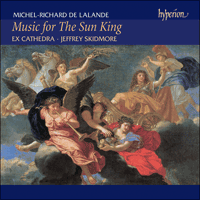


This resplendent CD introduces another outstanding 'early music' ensemble to Hyperion—Jeffrey Skidmore's Ex Cathedra, who will explore some of the lesser-known Baroque byways for us. They make their entrance with this programme of music by one of the four composers assigned to Louis XIV's Chapel in 1683. The disc gives us the opportunity to hear two of Lalande's 'grands motets' in full (substantial, sectional works in which episodes for vocal soloists are interspersed with passages for small ensembles and chorus, the orchestra providing both accompaniment and interludes), as well as a solo movement extracted from another one, and one of his instrumental pieces. This is music which was highly regarded both in the composer's own day and beyond, and performed throughout the eighteenth century.

For the king’s Mass, three [motets] are usually sung: a grand, a petit for the Elevation, and a Domine salvum fac regem (‘God save the king’). I have made the grands long enough that they can last a quarter of an hour … and occupy the beginning of the Mass up to the Elevation. Those of the Elevation are shorter and can last up to the Post-Communion where the Domine [salvum] begins.
As Perrin suggests, the main item in this ‘religious concert’ was the grand motet, a substantial, sectional work in which episodes for vocal soloists were interspersed with passages for small ensembles and chorus, while the orchestra provided both accompaniment and interludes. Although the model for the grand motet was created by Henry Du Mont, who served in the royal chapel for twenty years from 1663 to 1683, it was two of his younger contemporaries—Marc-Antoine Charpentier (1643-1704) and Michel-Richard de Lalande (1657-1726)—who took the genre to its height. The present disc gives the opportunity to hear two of Lalande’s grands motets in full, as well as a solo movement extracted from another, and one of his instrumental pieces.
Lalande became one of four composers assigned to Louis XIV’s chapel in 1683 following a well-documented competition. Much esteemed by the king, he was awarded an increasing number of official positions in the following years, eventually becoming the sole composer of the royal chapel, as well as composer and surintendant (director) of the musique de la chambre (music of the chamber). Although he began to relinquish his responsibilities after Louis XIV died in 1715, Lalande retained a position in the royal chapel until his own death in 1726.
Over the 43 years in which he was associated with the court, Lalande composed and reworked 77 grands motets. These were highly regarded, both in the composer’s own day and beyond; they were performed not only in the royal chapel throughout the eighteenth century, but were also an important part of the repertory at the Concert Spirituel, a series of concerts established in Paris in 1725 with the aim of performing sacred music during periods when the Opéra was closed. Nearly half a century after the composer’s death, Jean-Jacques Rousseau described Lalande’s grands motets as ‘masterpieces of the genre’, and in 1780 Laborde credited the composer with being the ‘creator of a new genre of church music’. Further evidence of the esteem in which the grands motets were held is the fact that they were known outside Paris: copies found their way into libraries elsewhere in France and abroad.
Te Deum laudamus
During the reigns of Louis XIV and XV, all royal events such as births, marriages and recovery from ill health, as well as military victories, were celebrated by the performance of a Te Deum. The prototype seems to have been Lully’s Te Deum, first performed in 1677, with subsequent settings by Charpentier, Clérambault and Campra, as well as by Lalande himself. Lalande’s setting originally dated from 1684, but his habit of constantly revising his works leaves us with several different versions. The one performed here is based on the composer’s autograph score which was prepared after the king’s death in 1715, and which underwent further revisions thereafter.
Lalande follows Lully’s lead in creating a celebratory mood from the outset by including trumpets and drums in his orchestra. He uses these in the opening rondeau and three further passages: ‘Te aeternum patrem’, ‘et laudamus nomen tuum’ and ‘In te Domine speravi’. As the text dictates, much of the rest of the work maintains this joyful mood. Lalande’s great achievement is that he manages to do this while also providing much variety of scoring, texture and musical ideas. Contrast, for example, the lively duos ‘Tibi omnes angeli’ and ‘Te gloriosus’, both of which tell of the praise bestowed on the Almighty: the former involves a pair of male voices in a mainly syllabic setting with string accompaniment, while the latter is scored for two dessus (sopranos) and continuo, the vocal lines much more melismatic and ornamental in character.
Elsewhere, Lalande takes advantage of the less overtly jubilant moments in the text by writing exquisitely expressive music. Of particular note is the movement ‘Tu ad liberandum’, where the lyrical solo dessus line and string accompaniment capture the gentle image of the Virgin described in the text. And in the following basse-taille (baritone) solo, ‘Tu devicto’, the ‘sting of death’ is depicted from the start by the switch to the tonic minor, a downward arpeggio figure, upbeat semiquavers and a dramatic diminished seventh chord. In the choral movement ‘Te ergo quaesumus’, the plea for mercy is likewise coloured by some expressive harmonies. And in the prayerful duo ‘Dignare Domine’, the vocal lines are underpinned by poignant dissonances. The trio that follows, ‘Miserere nostri’, is no less effective for its simplicity of texture.
A particularly interesting feature of Lalande’s score is the fact that he indicates at the end of movements how long they should last. The full title of the score leaves us in no doubt as to why Lalande took such care over this: Te Deum simple, le feu Roy ayant voulu qu’il ne dura guère plus que sa messe ordinaire (‘A simple Te Deum, the late king having wished that it should not last longer than his usual mass’). Though obviously originating from a desire not to upset the king, Lalande’s timings provide today’s performers with invaluable evidence about tempo. Again then, we are grateful for one of Louis XIV’s foibles.
Panis angelicus
Scored for a solo dessus, obbligato flute and continuo, Panis angelicus is taken from Lalande’s grand motet, Sacris solemniis. The composer may well have written the movement with one of his two daughters or wife in mind, since all three were fine and well-known singers. As at the opening of the motet and elsewhere, Lalande bases the music on the plainchant normally associated with the text, elaborating upon it in the vocal line and flute part with both written-out embellishments and ornament symbols.
La grande pièce royale
The subtitle of this piece—Deuxième Fantaisie ou Caprice que le Roi demandait souvent (‘Second Fantasy or Caprice which the king often requested’)—is testament to the fact that Lalande’s popularity was not restricted to his grands motets. Indeed, instrumental pieces by the composer were regularly performed during the suppers of Louis XIV and XV, and the present work would have been played in that context. Its six continuous movements are distinguished from each other both in tempo (Un peu lent – [Vite] – Doucement – Gracieusement – Gaiement – Vivement) and in character. Written for strings, oboes and continuo, the latter group of players includes a bassoon, which emerges on a number of occasions with a strikingly independent melodic line.
Venite, exsultemus
Like the Te Deum, Lalande’s setting of the psalm Venite, exsultemus was also subjected to extensive reworking in the two decades following its initial appearance in 1700. In the revised version performed here, Lalande finds numerous opportunities to mould his music to the text.
The opening movement, which makes use of an associated plainchant melody, effectively captures the optimistic mood of the text (‘O Come let us praise the Lord: let us joyfully sing to God our saviour’), with its combination of homophonic (chordal) and melismatic writing. In the second movement, Lalande is inspired by the reference to the singing of psalms; the beginning of the phrase ‘et in psalmis jubilemus ei’ (‘and make a joyful noise to Him, with psalms’) is set using long notes in the manner of a plainsong cantus firmus. This idea occurs not only in the vocal lines but also in the accompanying string parts. The extent of God’s greatness is the subject of the following verses ‘Quoniam non repellet’ and ‘Quoniam ipsius est mare’, and is underlined by Lalande’s decision to score these respectively for a solo and duo of basses-tailles. In the middle section of ‘Venite, adoremus’, where Lalande introduces the text ‘Ploremus coram Domino qui fecit nos’ (‘Let us weep before the Lord, our maker’), he paints the text expertly by a careful choice of scoring (a vocal trio accompanied by duo of flutes) and harmony laden with dissonance. In ‘Nos autem populus ejus’, Lalande draws on the traditional association of the oboe with things pastoral in his accompaniment of the words ‘We are the people of His pasture and the sheep of His hand’. ‘Hodie si vocem’ is an elaborate dessus aria with obbligato violin accompaniment, the style here demonstrating the influence of Italian music on Lalande’s later writing.
In the closing chorus Lalande draws on the same plainsong as the opening movement at the text ‘si introibunt in requiem meam’ (‘they shall not enter into my rest’). The use of a stepwise, slowly moving idea at this reference to peace contrasts effectively with the more lively, jerky figure used for the expression of anger in the phrase ‘quibus juravi in ira mea’ (‘unto whom I sware in my wrath’).
Shirley Thompson © 2002
[…] pour la messe du roi, […] l’on chante d’ordinaire trois [motets], un grand, un petit pour l’élévation et un Domine salvum fac regem. J’ai fait les grands de telle longueur, qu’ils peuvent tenir un quart d’heure […] et occuper depuis le commencement de la messe jusqu’à l’élévation. Ceux d’élévation sont plus petits, et peuvent tenir jusqu’à la post-communion, que commence le Domine [salvum].
Comme le suggère Perrin, l’élément principal de ce «concert religieux» est le grand motet, une œuvre importante structurée en sections où des «numéros» destinés aux chanteurs solistes alternent avec des passages pour ensembles vocaux et pour grand chœur. L’orchestre accompagne solistes et chœur tout en exécutant des interludes purement instrumentaux. Si le modèle du grand motet fut créé par Henry Du Mont, qui servit à la Chapelle royale pendant vingt ans, de 1663 à 1683, il revint à deux de ses cadets—Marc-Antoine Charpentier (1643-1704) et Michel-Richard de Lalande (1657-1726)—de porter le genre à son zénith. Ce disque nous permet de découvrir deux des grands motets de Lalande dans leur intégralité tout comme un solo extrait d’un autre motet et une de ses pièces instrumentales.
En 1683, à la suite d’un concours documenté en détail, Lalande devint un des quatre compositeurs assignés à la Chapelle royale de Louis XIV. Jouissant de l’estime du roi, il reçut un nombre croissant de charges officielles au cours des années qui suivirent pour finalement devenir le seul compositeur de la Chapelle royale, surintendant et maître de la musique de la chambre. S’il commença à se départir de certaines de ces fonctions après le décès du Roi Soleil, en 1715, il conserva un poste à la Chapelle royale jusqu’à sa mort, en 1726.
Durant les 43 ans où il fut associé à la Cour, Lalande écrivit et remania 77 grands motets qui furent prisés non seulement de son vivant, mais aussi bien après sa mort. Exécutés à la Chapelle royale durant tout le 18e siècle, ces motets formèrent également une partie importante du répertoire des Concerts Spirituels, une série de concerts établie à Paris en 1725 dont le but était d’exécuter de la «musique de chapelle» durant les jours où les représentations lyriques étaient suspendues à l’Opéra du fait du calendrier liturgique. Pratiquement un demi-siècle après la mort de Lalande, Jean-Jacques Rousseau décrivait ses grands motets comme des «chefs d’œuvre du genre». En 1780, Laborde le considérait comme le «créateur d’un nouveau genre de musique d’église». Le fait que ces grands motets soient connus en dehors de Paris—des copies ont été retrouvées dans des bibliothèques de province et de l’étranger—doit être interprété comme un autre gage de leur renommée.
Te Deum laudamus
Durant les règnes de Louis XIV et de Louis XV, tous les événements royaux tels les naissances, mariages, guérisons ou encore les victoires militaires, étaient célébrés par l’exécution d’un Te Deum. Le prototype semble avoir été le Te Deum de Lully exécuté pour la première fois en 1677. Suivirent ensuite les réalisations musicales de Charpentier, Clérambault, Campra et Lalande. Datant de 1684, la première version du Te Deum de Lalande fut soumise à de constantes révisions, selon son habitude, si bien que nous possédons différentes moutures de cette œuvre. Celle qui est présentement enregistrée s’appuie sur la partition autographe du compositeur préparée après le décès du roi, en 1715; celle-ci fut remaniée à plusieurs reprises par la suite.
Suivant l’exemple de Lully, Lalande crée d’emblée une atmosphère festive incorporant à son orchestre des trompettes et des timbales. Il s’en sert dans le rondeau initial et dans trois autres passages: «Te aeternum patrem», «Et laudamus nomen tuum» et «In te Domine speravi». Suivant les injonctions du texte, le reste de l’œuvre maintient pour l’essentiel cette atmosphère de gaieté. Là où Lalande excelle, c’est en préservant cette allégresse tout en offrant une immense variété de textures, de coloris orchestraux et d’idées musicales. Il suffit de contraster par exemple les duos animés «Tibi omnes angeli» et «Te gloriosus», tous deux faisant les louanges du Tout-Puissant: le premier est écrit pour deux voix d’hommes accompagnées des cordes dans une réalisation essentiellement syllabique tandis que le second est orchestré pour deux dessus et continuo, les lignes vocales étant nettement plus mélismatiques et ornées.
Ailleurs, Lalande tire parti des moments de moindre jubilation du texte en écrivant une musique d’une expressivité exquise. À noter plus particulièrement le mouvement «Tu ad liberandum» où la ligne lyrique du dessus associée à l’accompagnement des cordes saisit une image de la Vierge tout en douceur, telle que le texte la décrit. Et dans «Tu devicto», le solo suivant destiné à la basse-taille, la «blessure de la mort» est d’emblée illustrée par la modulation à la tonique mineure, en un motif arpégé descendant, une anacrouse de doubles croches et un accord de septième diminuée dramatique. Dans le mouvement pour chœur «Te ergo quaesumus», l’imploration de la pitié y est pareillement colorée par des harmonies expressives. Le duo «Dignare Domine», aux allures de prière, dévoile des lignes vocales étayées par de poignantes dissonances. Le trio qui suit, «Miserere nostri» est tout aussi efficace dans la simplicité de ses textures.
Détail particulièrement intéressant de la partition de Lalande, à la fin de chaque mouvement est indiquée quelle en est sa durée. Il est vrai que le titre complet de la partition ne nous laisse aucun doute de la raison d’un soin aussi minutieux: Te Deum simple, le feu Roy ayant voulu qu’il ne dura guère plus que sa messe ordinaire. Soucieux de répondre aux désirs du roi, Lalande a ainsi offert aux interprètes actuels un élément précieux qui leur permet d’apprécier la notion de tempo d’alors. Une fois encore, on ne peut que se féliciter des conséquences d’une autre manie de Louis XIV.
Panis angelicus
Orchestré pour dessus soliste, flûte obligée et continuo, le Panis angelicus est tiré d’un grand motet de Lalande, Sacris solemniis. Il se peut que Lalande ait songé à l’une de ses deux filles ou à son épouse lors de la composition de ce mouvement, puisque toutes les trois étaient des chanteuses renommées douées d’un talent certain. Comme ailleurs dans le motet, Lalande reprend à son compte le chant grégorien normalement associé au texte en élaborant une musique sur ce thème qu’il prend cependant soin d’orner à la voix et à la flûte, en des agréments qui sont à la fois notés intégralement ou indiqués par le biais des symboles conventionnels de l’époque.
La grande pièce royale
Le sous-titre de cette pièce—Deuxième Fantaisie ou Caprice que le Roi demandait souvent—témoigne du fait que la popularité de Lalande n’était pas limitée à ses grands motets. Effectivement, les pièces instrumentales du compositeur furent régulièrement exécutées durant les soupers de Louis XIV et de Louis XV. C’est dans ce contexte que cette œuvre fut exécutée. Ses six mouvements continus se distinguent les uns des autres par leur tempo (Un peu lent – [Vite] – Doucement – Gracieusement – Gaiement – Vivement) et leur caractère. La grande pièce royale est écrite pour cordes, hautbois et continuo, ce dernier comprenant notamment un basson dont la ligne mélodique étonnamment indépendante émerge de temps à autre.
Venite, exsultemus
Suivant l’exemple du Te Deum, Lalande soumit sa réalisation musicale du psaume Venite, exsultemus à d’importantes révisions au cours des deux décennies qui suivirent sa création, en 1700. Dans sa version révisée présentement enregistrée, Lalande exploite maints procédés permettant à sa musique de suivre le texte.
Ecrit sur le chant grégorien qui lui est associé, le mouvement initial cn embrasse avec efficacité l’atmosphère optimiste du texte («Venez, louons le Seigneur avec joie, chantons joyeusement à Dieu, notre sauveur») avec sa combinaison d’écriture mélismatique et homophonique (en accords). Dans le second mouvement, Lalande s’inspire de la référence au chant des psaumes; le début de la phrase «et in psalmis jubilemus ei» («et réjouissons-nous dans des chants d’allégresse») est exploité en se servant de notes de valeurs longues à la manière d’un cantus firmus de plain-chant. Cette idée transparaît non seulement dans les lignes vocales mais aussi dans les parties des cordes qui les accompagnent. La grandeur de Dieu est le sujet des strophes qui suivent «Quoniam non repellet» et «Quoniam ipsius est mare». Elle y est soulignée par la décision de Lalande de les orchestrer respectivement pour un solo et un duo de basses-tailles. Dans la section centrale de «Venite, adoremus» où Lalande introduit le texte «Ploremus coram Domino qui fecit nos» («Pleurons devant le Seigneur qui nous a faits»), il dépeint le texte magistralement en choisissant soigneusement sa formation (un trio vocal accompagné d’un duo de flûtes) et une harmonie chargée de dissonances. Dans «Nos autem populus ejus», Lalande exploite l’association traditionnelle entre le hautbois et l’élément pastoral dans son accompagnement des mots «Nous sommes le peuple de son pâturage, le troupeau que sa main conduit». «Hodie si vocem» est une aria élaborée pour dessus avec accompagnement de violon obligé. Le style illustre l’influence de la musique italienne qui allait ensuite s’exercer sur son écriture.
Dans le chœur final, Lalande s’inspire du même plain-chant que le premier numéro au texte «si introibunt in requiem meam» («Ils n’entreront pas dans mon repos»). L’emploi d’une idée évoluant lentement face à cette référence contraste efficacement avec le motif plus animé et angulaire utilisé pour l’expression de la colère dans la phrase « quibus juravi inira mea » («Je jurai dans ma colère»).
Shirley Thompson © 2002
Français: Isabelle Battioni
In der königlichen Messe werden meist drei [Motetten] gesungen: eine grand, eine petit während der Elevation und ein Domine salvum fac regem („Gott beschütze den König“). Ich habe grands gemacht, die bis zu einer Viertelstunde dauern … und vom Beginn der Messe bis zur Elevation andauern. Diejenigen für die Elevation sind kürzer und können bis zum Schluss des Abendmahls dauern, wo dann das Domine [salvum] einsetzt.
Wie Perrin schon andeutet, war die grand motet die Hauptnummer dieses „religiösen Konzerts“. Es handelte sich dabei um ein größeres Teilstück, in dem solistische Vokalepisoden mit Passagen für kleine Ensembles und Chor alternierten, während das Orchester für Begleitung und Zwischenspiele zuständig war. Obwohl die Form der grand motet von Henry Du Mont entworfen worden war, der der königlichen Kapelle zwanzig Jahre lang (1663-1683) gedient hatte, wurde das Genre erst von zwei seiner jüngeren Zeitgenossen zu seiner Blüte gebracht: Marc-Antoine Charpentier (1643-1704) und Michel-Richard de Lalande (1657-1726). Die vorliegende Aufnahme bietet zwei vollständige grand motets von Lalande, einen Solosatz aus einer weiteren motet sowie eines seiner Instrumentalstücke.
Lalande war einer von vier Komponisten, die im Jahre 1683 nach einem gut dokumentierten Wettbewerb an die Kapelle Ludwig XIV. berufen wurden. Der König schätzte Lalande sehr und in den folgenden Jahren wurde er mit mehreren offiziellen Posten betraut. Er war schließlich der einzige Komponist der königlichen Kapelle, sowie Komponist und surintendant der musique de la chambre. Obwohl er sich nach dem Tod Ludwigs XIV. im Jahre 1715 allmählich von seinen Aufgaben zurückzog, behielt er doch eine Anstellung an der könliglichen Kapelle bis zu seinem eigenen Tod 1726.
Während der 43 Jahre, in denen er bei Hofe angestellt war, komponierte und überarbeitete Lalande 77 grands motets. Diese wurden sowohl zu seinen Lebzeiten wie auch danach sehr hoch eingeschätzt; sie wurden nicht nur im ganzen 18. Jahrhundert an der königlichen Kapelle aufgeführt, sondern sie waren auch ein wichtiger Bestandteil des Repertoires des Concert Spirituel, einer Konzertreihe, die in Paris im Jahre 1725 gegründet wurde, um geistliche Musik während der Zeit aufzuführen, wenn die Opéra geschlossen war. Fast ein halbes Jahrhundert nach dem Tod des Komponisten beschrieb Jean-Jacques Rousseau die grands motets von Lalande als „Meisterstücke des Genres“ und im Jahre 1780 charakterisierte Laborde ihn anerkennend als den „Schöpfer eines neuen Genres der Kirchenmusik“. Außerdem ist die Tatsache, dass die grands motets auch außerhalb von Paris bekannt waren, ein Indiz für ihre große Wertschätzung: in verschiedenen Bibliotheken Frankreichs und auch im Ausland sind Abschriften der motets vorhanden.
Te Deum laudamus
Während der Regentschaft von Ludwig XIV. und Ludwig XV. wurden alle Anlässe bei Hofe, wie Geburten, Hochzeiten, Genesung nach Krankheiten und auch militärische Siege mit der Aufführung eines Te Deum gefeiert. Der Prototyp scheint Lullys Te Deum gewesen zu sein, dass 1677 uraufgeführt wurde, gefolgt von Vertonungen von Charpentier, Clérambault, Campra und Lalande selbst auch. Lalandes ursprüngliche Vertonung entstand im Jahre 1684, jedoch sind uns aufgrund seiner Angewohnheit, seine Werke ständig zu überarbeiten, mehrere Versionen überliefert. Die hier vorliegende Fassung basiert auf dem Autographen des Komponisten, das er nach dem Tod des Königs 1715 angefertigt hatte, und das später noch mehrmals überarbeitet wurde.
Lalande folgt zunächst dem Beispiel Lullys, der zu Beginn mit Hilfe von Trommeln und Trompeten eine feierliche Stimmung erzeugt. Lalande setzt diese in dem eröffnenden rondeau und auch in drei weiteren Passagen ein: in „Te aeternum patrem“, in „Et laudamus nomen tuum“ und in „In te Domine speravi“. Dem Diktat des Texts zufolge bleibt das restliche Werk überwiegend in dieser fröhlichen Stimmung. Es ist Lalandes große Leistung, dass ihm dies gelingt, während er gleichzeitig die Instrumentierung und die Textur immer wieder variiert und mit verschiedenen musikalischen Ideen arbeitet. Einen Kontrast stellen beispielsweise die beiden lebhaften Duette „Tibi omnes angeli“ und „Te gloriosus“ dar, die beide von der Lobpreisung des Allmächtigen berichten: das Erstere ist (hauptsächlich syllabisch) für zwei Männerstimmen mit Streicherbegleitung gesetzt, während das Letztere für zwei dessus (Soprani) mit Continuo steht, wobei die Singstimmen hier viel melismatischer und verzierter angelegt sind.
An anderen Stellen nutzt Lalande die weniger offensichtlich jubilierenden Momente im Text, um sehr exquisite und ausdrucksvolle Musik zu schreiben. Besonders fällt hierbei der Satz „Tu ad liberandum“ auf, in dem eine lyrische Sololinie eines dessus mit Streicherbegleitung das zarte Bild der Jungfrau einfängt, das im Text beschrieben wird. Im darauffolgenden basse-taille (Bariton) Solo, „Tu devicto“, wird die „Heftigkeit des Todes“ von Anfang an dargestellt, und zwar mit einem Wechsel in die Molltonika, einer abwärts gerichteten Arpeggiofigur, auftaktigen Sechzehnteln und einem dramatischen verminderten Septakkord. In dem Chorsatz „Te ergo quaesumus“ ist die Bitte um Gnade durch verschiedene Harmonien ebenso farbig illustriert und in dem gebetartigen Duo „Dignare Domine“ werden die Vokallinien durch ergreifende Dissonanzen untermauert. Das darauffolgende Trio „Miserere nostri“ ist trotz seiner Schlichtheit nicht weniger wirksam.
Interessanterweise vermerkt Lalande in seiner Partitur am Ende jeden Satzes die jeweilige Spieldauer. Der vollständige Titel der Partitur erklärt diese sorgfältige Vorgehensweise: Te Deum simple, le feu Roy ayant voulu qu’il ne dura guère plus que sa messe ordinaire („Ein schlichtes Te Deum, da der verstorbene König es nicht länger zu sein wünschte als seine normale Messe“). Obwohl diese Zeitangaben offensichlich notiert wurden, um den König nicht zu verärgen, sind sie doch heutzutage als verlässliche Tempoangaben von unschätzbarem Wert für Ausführende. Wiederum sind wir dankbar für eine Eigenheit Ludwigs XIV.
Panis angelicus
Panis angelicus ist für Solo-dessus, obligate Flöte und Continuo gesetzt und stammt aus Sacris solemniis, einer weiteren grand motet Lalandes. Möglicherweise war dieser Satz für die Ehefrau oder eine der beiden Töchter des Komponisten gedacht, da alle drei begabte und berühmte Sängerinnen waren. So wie am Anfang der Motette und auch anderswo, liegt der Musik der Cantus planus zugrunde, der normalerweise mit dem Text assoziiert wird. Hier wird er in der Singstimme und dem Flötenpart, die beide ausgeschriebene Verzierungen und Ornament-Symbole haben, kunstvoll erweitert.
La grande pièce royale
Der Untertitel dieses Stückes—Deuxième Fantaisie ou Caprice que le Roi demandait souvent („Zweite Fantasie oder Caprice, das der König oft verlangte“)—belegt die Vermutung, dass Lalandes Popularität nicht auf seine grands motets beschränkt war. Tatsächlich wurden Instrumentalstücke des Komponisten regelmäßig während der Diners von Ludwig XIV. und Ludwig XV. aufgeführt und auch das vorliegende Stück ist wahrscheinlich in einem solchen Rahmen gespielt worden. Die sechs Sätze folgen ohne Pause aufeinander und unterscheiden sich durch verschiedene Tempi (Un peu lent – [Vite] – Doucement – Gracieusement – Gaiement – Vivement) und durch verschiedene Charakteristika. Das Stück ist gesetzt für Streicher, Oboen und Continuogruppe mit Fagott, das mehrmals mit erstaunlich selbstständigen melodischen Linien hervorgehoben wird.
Venite, exsultemus
Ebenso wie das Te Deum überarbeitete Lalande auch seine Vertonung des Psalms Venite, exsultemus extensiv während der beiden Dekaden nach dem erstmaligen Erscheinen im Jahre 1700. Das Werk liegt hier in der überarbeiteten Version vor und Lalande gelingt es an vielen Stellen, seine Musik dem Text entsprechend zu gestalten.
Im ersten Satz wird eine Cantus planus-Melodie verwendet und die optimistische Stimmung des Texts („Kommt und lasst uns den Herrn mit Freuden lobpreisen: lasst uns ihm jauchzend singen, dem Hort unsres Heils“) wird durch die Kombination von homophoner und melismatischer Kompositionstechnik wiedergegeben. Im zweiten Satz wird Lalande durch den Hinweis auf das Singen von Psalmen inspiriert; der Anfang des Satzes „et in psalmis jubilemus ei“ („und singet jauchzend in Psalmen zu ihm“) ist im Stile eines Cantus firmus mit langen Noten vertont. Diese Idee kehrt nicht nur in den Singstimmen wieder, sondern auch in der Streicherbegleitung. Das Ausmaß von Gottes Größe ist das Thema der nächsten beiden Verse „Quoniam non repellet“ und „Quoniam ipsius est mare“ und wird zunächst mit einem solistischen basse-taille und dann mit einem basse-taille-Duett musikalisch dargestellt. Im Mittelteil des „Venite, adoremus“, wo Lalande den Text „Ploremus coram Domino qui fecit nos“ („Lasst uns weinen vor dem Herrn, der uns gemacht hat“) verarbeitet, zeichnet er den Text fachmännisch mit einer sorgfältigen Vertonung (ein Vokaltrio wird von zwei Flöten begleitet) und einer Harmonik voller Dissonanzen nach. In „Nos autem populus ejus“ bezieht sich Lalande bei seiner Begleitung der Worte „Wir sind das Volk seiner Weide und die Schafe seiner Hand“ auf die traditionelle Assoziation der Oboe mit der Pastorale. „Hodie si vocem“ ist eine kunstvolle dessus-Arie mit Begleitung einer obligaten Violine. Der Stil, in dem sie geschrieben ist, demonstriert den Einfluss der italienischen Musik auf Lalandes spätere Kompositionen.
Im Schlusschor verwendet Lalande bei der Textstelle „si introibunt in requiem meam“ („Sie sollen nicht zu meiner Ruhe kommen“) denselben Cantus planus wie im ersten Satz. Die Technik einer sich schrittweise und langsam bewegenden Idee bei dem Verweis auf Frieden steht im Gegensatz zu der lebhafteren und sprunghaften Figur, die den Zorn ausdrückt: „quibus juravi in ira mea“ („so dass ich schwor in meinem Zorn“).
Shirley Thompson © 2002
Deutsch: Viola Scheffel