Welcome to Hyperion Records, a British classical label devoted to presenting high-quality recordings of music of all styles and from all periods from the twelfth century to the twenty-first.
Hyperion offers both CDs, and downloads in a number of formats. The site is also available in several languages.
Please use the dropdown buttons to set your preferred options, or use the checkbox to accept the defaults.
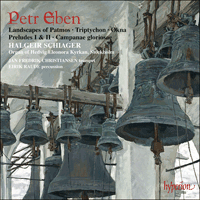

Those who have been following Halgeir Schiager’s pioneering survey of Petr Eben’s extraordinary organ works will find any words of recommendation for this new disc unnecessary; for the newcomer, the programme offers an array of accessible riches, including two works where the organ is combined with other instruments to thrilling effect.
Petr Eben is one of the foremost composers from the Czech Republic. Also known as an organist, he primarily performs his own works, but is also highly sought-after as an improviser on both the piano and the organ. His works for organ are among his most popular.

He was born in 1929 in Zamberk, north-eastern Bohemia, but his childhood years were spent in the historic South Bohemian town of Ceský Krumlov. Here he found his early keyboard talents pressed into service during the war, playing the organ of the church of St Vitus, even though initially his feet could not reach the pedal-board. Although the family was devoutly Catholic, the fact that his father was born a Jew meant that, in 1943, he was expelled from school and spent the rest of the war years in the concentration camp at Buchenwald. For such an intelligent lad, these formative and impressionable years brought an early maturity of thought and conscience, many aspects of which have remained with him to this day. On the musical side, one of these is his total understanding of the organ, both as a composer and performer, from the hours he spent alone exploring its wonders in the organ loft at Krumlov.
After the war, Petr Eben resumed his schooling and entered the Prague Academy of Music in 1948, studying piano with František Rauch and composition with Pavel Borkovec. After graduation in 1954 he was appointed a lecturer in the history of music at Charles University where his popularity and success with his students ensured that he was retained for thirty-five years, although all due and clearly deserved promotion was denied him because of his refusal to join the Communist Party and his open continuation of attending church with his family Sunday after Sunday. After the 1989 Velvet Revolution, he was immediately appointed professor of composition and President of the Prague Spring Festival among other important positions in Czech musical life. Awarded his country’s highest honour for artists, since his retirement and in spite of the onset of debilitating illness he has continued to compose, mainly works for organ and choral pieces for church festivals, while living quietly in the Motol district of Prague.
Landscapes of Patmos is one of a number of works where Petr Eben has successfully combined the organ in partnership with different instruments (other than with the fuller orchestra of his two organ concertos of 1954 and 1982), works which include Okna (with trumpet, 1976), Three Jubilations (with two trumpets and two trombones, 1987) and Two Invocations (with trombone, 1988). Landscapes of Patmos was written in 1984 and commissioned by the Heidelberg Bach-Gesellschaft for the 1985 Bachfest. It was given its first performance on 31 May 1985 in the Lutheran Church in Heidelberg by Wolfgang Dallmann with the percussionist Wieland Junge.
In his introduction to the score the composer has written:
The combination of organ and percussion is one of the ensembles in which the organ can display the whole richness of its sound with no restriction to the softer stops. On imagining the sound effect of this combination, an atmosphere both festive and dramatic came to mind. This in turn led me to the Book of Revelations but I soon became aware of the difficulties of expressing all the richness of its contents in a few movements for two players. Therefore I narrowed my horizon to some single images from the Apocalypse – hence the title ‘Landscapes’. These events and symbols, which are inspired by the abstract and expressed pictorially, are diffused by the music into an analogical representation rather than pictorial.
The main, solemn movement, Landscape with Temple, is placed centrally – the third of five movements. Two shorter movements frame it, both sharing the same thematic material and having as their subjects symbols that are close to the throne, i.e. the Elders and the Rainbow. The outer ‘animal’ movements – the Eagle and the Horses – provide the dramatic elements to the work. Only in the last movement have I used two plainsong quotations: the fateful Horses are characterized by the descending Dies Irae motif which eventually gives way to the redeeming Victimae Paschali at the end of the Finale which, with its ascending melody, appears almost as an inversion of the falling Dies Irae melody.
As for the percussion instruments, my choice has been determined by my appreciation of the difficulties, all too often encountered, of finding suitable spacious organ galleries, often approached by narrow winding staircases. Therefore I refrained from using bulky instruments such as timpani, vibraphone and marimba.
The three main movements concentrate on three contrasting timbres: the first the drum head with tom-toms and drums, the second on metallic sounds with the tam-tam, cymbals, bells and glockenspiel, and the last on wooden sounds with temple blocks and xylophone. In the other movements the colour range is mixed.
Although the short Prelude 1 carries the subtitle ‘Happy Birthday’, this was a misunderstanding on the part of the composer, since it was among a number of works written to mark the retirement of the American concert artists manager Karen McFarlane, when a number of her artists either wrote or performed works for that occasion. Nevertheless, it is a brilliant occasional piece, demonstrating the composer’s ability to condense into a comparative trifle an amazing variety of elements relevant to a more significant composition. It was given its first performance by Susan Landale, another of McFarlane’s artists, at the Peabody Conservatory, Baltimore, in September 2000.
Petr Eben’s devout catholicism has brought him, especially through his music, into contact with many figures, great and small, of the Catholic Church, particularly in the Czech Republic and Germany. This has resulted in many requests and commissions to mark special anniversaries of both churches and church leaders. The Gloria (Prelude 2) is one such work, written in 2000 to mark the sixty-fifth birthday of the Bishop of Mainz, Cardinal Karl Lehmann. Based on Gregorian chant, it was first performed at the cathedral in Mainz by the organist there on 16 October 2001.
Triptychon was written in 2000 to a commission from the Hofkirche in Lucerne on the initiative of its organist, Wolfgang Sieber. It was first performed there in the church of St Leodegar on 9 November 2001 by Astrid Ender. Wolfgang Sieber had introduced Petr Eben to the organ tablature of Johann Benn, who was born c1590 in or near Messkirch, Baden, where he worked as organist and choirmaster until 1638 when he was appointed organist of St Leodegar, Lucerne. In 1657 he entered the monastery of Muri in the Aargau region north of Lucerne and died there c1660.
Petr Eben took as his source for Triptychon Benn’s Three Ricercari which he found to be of particular thematic interest, setting this material in the context of his own contemporary musical style, at the same time being amused by the fact that ‘Eben’ was almost an anagram of ‘Benn’. Eben also commented that the themes that he chose appear in set intervals, yet not as overt statements but merged in a many-layered stream of his own harmonic language.
Campanae gloriosae was written in 1999 as the result of a commission from the Cathedral of Trier to mark the occasion of the twenty-fifth anniversary of the cathedral organ built by the distinguished firm of Johannes Klais of Bonn, an instrument of four manuals and sixty-seven stops. The work is a colourful fantasy based upon the notes of the five bells of the cathedral which strike the hours in a descending sequence a´, e´, f#´, c#´, a, plus the two small bells sounding a third – c´´´ and ab´´ – of the neighbouring church of St Gangolf. The work, dedicated by the composer to the Cathedral in Trier, was given its first performance on 11 May 1999 during the Trier International Organ Days, played by the cathedral organist Josef Still.
Of the considerable repertoire for trumpet and organ, Eben’s Okna (‘Windows’) remains the leading work of the twentieth century, finding a regular place in recital programmes. Petr Eben says that the listener may take the title to represent windows as the source of light. However, for him this cycle has deeper significance, from the impact on him of seeing pictures of Marc Chagall’s stained-glass windows, each of which has its composition dominated by a particular colour. He chose four of the twelve windows, representing the twelve tribes of Israel (Ruben, Issachar, Zebulon and Levi), which are in the Hadassah Medical Centre in Jerusalem, although it was not until some years later that he was able to go to see the windows at first hand for himself. In expressing the powerful spirituality of these windows, Eben chose to intensify their effect in sound by adding the brightness of a ‘real’ trumpet to the many colours available from the organ.
The Blue Window represents the ever-moving waves of the sea, with its richness of fish and circling bird life. The Green Window is pastoral in contrast, with the donkey (with the human expression so typical of Chagall’s animals) in the meadow, rich in flowers and vines. The Red Window blazes with sunlight, again the sea being central but now alive with leaping marine life. The Golden Window is rich in light, the candles of liturgical ceremony and the fruit of the earth. Eben sees this setting as more religious in content, marking also Chagall’s Russian and Jewish origins. This he does by introducing a hymn from the Russian Orthodox liturgy into the first part, given out on the organ’s 8-foot Principal stop. It can be recognized also as that which Tchaikovsky used in his festival overture 1812. The trumpet’s contribution, cantor-like, makes use of elements of the synagogue songs.
To compensate for the practical problems of the mechanical and acoustic delays often experienced between an organ playing with other instruments, Eben cleverly introduces a degree of improvisation or free rhythm which he also sees as something which ‘brings out a slight change of light with each new performance’, so ‘creating the same impression as that generated by stained-glass windows, varying according to the angle at which the glass is penetrated by the rays of sunlight during different parts of the day’. The first performance was given on 31 March 1977 in the Smetana Hall, Prague, with Vladislav Kozderka (trumpet) and Milan Šlechta (organ).
Graham Melville-Mason © 2006
Né à Zamberk, en Bohême nord-orientale, Eben passa son enfance dans la cité historique de Ceský Krumlov, en Bohême du Sud. Ce fut là, pendant la guerre, que ses talents précoces de claviériste furent mis à contribution: il toucha l’orgue de la cathédrale de Saint-Vitus, alors même que, au début, ses pieds n’atteignaient pas le pédalier. Sa famille était profondément catholique, mais les origines juives de son père lui valurent d’être expulsé de l’école en 1943, puis de passer le reste de la guerre au camp de concentration de Buchenwald. Ces années formatrices et décisives suscitèrent, chez ce garçon si intelligent, une maturité et une conscience précoces qui, par bien des aspects, ne l’ont jamais quitté depuis. Sur le plan musical, il en retira une totale compréhension de l’orgue, que ce soit comme compositeur ou comme interprète, fruit des heures passées à en explorer, seul, les merveilles à la tribune de Krumlov.
La guerre finie, Petr Eben reprit ses études et entra à l’Académie de musique de Prague (1948), où il étudia le piano avec František Rauch et la composition avec Pavel Borkovec. Diplômé en 1954, il fut nommé maître de conférences en histoire de la musique à l’université Charles (1955), où sa popularité et son succès auprès des étudiants firent qu’on le garda pendant trente-cinq ans, sans jamais lui accorder la moindre promotion, pourtant dûment et clairement méritée – une situation qui s’explique par son refus d’adhérer au Parti communiste et par son obstination manifeste à se rendre à l’église, en famille, dimanche après dimanche. Après la Révolution de velours (1989), il occupa d’importantes fonctions dans la vie musicale tchèque et fut, entre autre, immédiatement nommé professeur de composition et président du festival du Printemps de Prague. Récompensé des plus hauts honneurs décernés aux artistes de son pays, il a, depuis son départ à la retraite et malgré l’apparition d’une maladie débilitante, continué de composer, surtout des œuvres pour orgue et des pièces chorales destinées à des festivals de musique liturgique, tout en menant une vie paisible dans le quartier pragois de Motol.
Landscapes of Patmos est l’une de ces nombreuses œuvres où Petr Eben combina avec bonheur l’orgue à différents instruments (autres que l’orchestre plus étoffé de ses deux concertos pour orgue de 1954 et de 1982) – citons notamment Okna (avec trompette, 1976), Three Jubilations (avec deux trompettes et deux trombones, 1987) et Two Invocations (avec trombone, 1988). Commande de la Bach-Gesellschaft d’Heidelberg pour le Bachfest de 1985, Landscapes of Patmos (1984) fut créée le 31 mai 1985 par Wolfgang Dallmann et le percussionniste Wieland Junge, en l’église luthérienne d’Heidelberg.
Voici ce que le compositeur a écrit dans l’introduction de sa partition:
La combinaison de l’orgue et de la percussion fait partie de ces ensembles où l’orgue peut déployer toute sa richesse sonore, sans restriction sur les registres doux. En m’imaginant l’effet sonore de cette combinaison, une atmosphère tout à la fois festive et dramatique me vint à l’esprit, laquelle, à son tour, me conduisit vers l’Apocalypse. Mais, bientôt conscient des difficultés qu’il y avait à exprimer toute la richesse de ce livre en quelques mouvements pour deux interprètes, je restreignis mon horizon à quelques images tirées de l’Apocalypse – d’où le «Landscapes» («Paysages») du titre. Ces événements et ces symboles, inspirés par l’abstrait et exprimés picturalement, la musique les diffuse en une représentation plus analogique que picturale.
Le mouvement principal, solennel, Landscape with Temple, est au centre de l’œuvre – c’est le troisième des cinq mouvements. Les deux mouvements qui l’entourent, Elders (vieillards) et Rainbow (arc-en-ciel), partagent le même matériau thématique et ont pour sujet des symboles liés au trône. Les mouvements extrêmes «animaliers», Eagle (aigle) et Horses (chevaux), fournissent à l’œuvre ses éléments dramatiques. C’est seulement dans le dernier mouvement que j’ai utilisé deux citations en plain-chant: les fatidiques Chevaux sont caractérisés par le motif descendant du Dies Irae, qui fait place, à la fin du Finale, au Victimae Paschali rédempteur, lequel, avec sa mélodie ascendante, semble presque un renversement de la mélodie descendante du Dies Irae.
Concernant les intruments à percussion, mon choix a été dicté par mon appréciation des trop fréquentes difficultés à trouver des tribunes d’orgue spacieuses – l’accès se fait souvent par d’étroits colimaçons. Aussi me suis-je gardé d’utiliser des instruments encombrants, comme les timbales, le vibraphone et la marimba.
Les trois grands mouvements se concentrent sur trois timbres contrastés: le premier sur la peau de tambour (tom-toms et tambours), le deuxième sur les sonorités métalliques (tam-tam, cymbales, cloches et glockenspiel) et le dernier sur les sons du bois (Tempelblocks et xylophone). Les autres mouvements présentent une gamme de couleurs bigarrée.
Le sous-titre de Prelude 1, «Happy Birthday», résulte d’un malentendu de la part du compositeur, puisque cette œuvre brève fit en fait partie d’un ensemble de pièces écrites pour marquer le départ en retraite de la manager de concertistes américains, Karen McFarlane – à cette occasion, plusieurs de ses artistes composèrent ou interprétèrent des œuvres. Reste qu’il s’agit d’une brillante pièce de circonstance, preuve de l’aptitude d’Eben à condenser en un relatif petit rien une stupéfiante diversité d’éléments digne d’une composition plus conséquente. L’œuvre fut créée par Susan Landale, l’une des artistes de McFarlane, au Peabody Conservatory de Baltimore, en septembre 2000.
Catholique fervent, Petr Eben doit avant tout à sa musique d’être entré en contact avec maintes figures, grandes et moins grandes, de l’Église catholique, notamment en République tchèque et en Allemagne. D’où les multiples demandes et commandes pour marquer les anniversaires des églises comme des chefs religieux. Le Gloria (Prelude 2) fut ainsi écrit en 2000 pour les soixante-cinq ans de l’évêque de Mayence, le cardinal Karl Lehmann. Fondé sur le chant grégorien, il fut créé en la cathédrale de Mayence par l’organiste titulaire, le 16 octobre 2001.
Écrit en 2000 en réponse à une commande dont l’initiative revient à Wolfgang Sieber (organiste de la Hofkirche de Lucerne), Triptychon fut créé en l’église de Saint-Leodegar (Lucerne) par Astrid Ender, le 9 novembre 2001. Wolfgang Sieber a fait découvrir à Petr Eben la tablature d’orgue de Johann Benn, qui naquit vers 1590 à Messkirch (Baden) ou dans les environs. Là, il fut organiste et maître de chœur jusqu’en 1638, date à laquelle il fut nommé organiste de Saint-Leodegar. En 1657, il entra au monastère de Muri, dans la région d’Aargau (au nord de Lucerne), où il mourut vers 1660.
Pour son Triptychon, Petr Eben puisa dans les Trois Ricercari de Benn, auxquels il trouva un intérêt thématique particulier; il mit en musique ce matériau dans le cadre de son propre style contemporain, tout en s’amusant de ce que «Eben» soit presque une anagramme de «Benn». Eben souligna aussi que les thèmes retenus apparaissent dans des intervalles fixes – pas comme des énonciations ouvertes, cependant, mais fondus en un flot stratifié de son langage harmonique.
Campanae gloriosae fut écrite en 1999 suite à un commande de la cathédrale de Trèves pour les vingt-cinq ans de son orgue, un instrument à quatre manuels et soixante-sept registres fabriqué par l’éminente maison de Johannes Klais, à Bonn. Cette œuvre est une fantaisie colorée fondée sur les notes des cinq cloches de la cathédrale qui sonnent les heures en une séquence descendante (la3, mi3, fa3#, ut3#, la2), à laquelle s’ajoutent les deux petites cloches de l’église voisine de Saint-Gangolf, qui sonnent une tierce (ut5 et la4b). Dédiée à la cathédrale de Trèves, Campanae gloriosae fut créée le 11 mai 1999 par l’organiste titulaire, Josef Still, dans le cadre des Trier International Organ Days.
Dans un immense répertoire pour trompette et orgue, Okna («Vitraux»), régulièrement programmée en récital, demeure l’œuvre majeure du XXe siècle. Petr Eben le dit: l’auditeur peut croire que le titre symbolise les vitraux comme source de lumière. Mais, pour lui, ce cycle revêt une signification plus profonde, née de l’impact qu’eut sur lui la vision des vitraux de Marc Chagall, dont chaque tableau est dominé par une couleur particulière. Ces douze vitraux, qui représentent les douze tribus d’Israël, se trouvent au Hadassah Medical Centre de Jérusalem; Eben en choisit quatre (Ruben, Issachar, Zebulon et Levi), mais il dut attendre quelques années pour pouvoir les voir de ses propres yeux. Pour exprimer leur puissante spiritualité, il décida d’intensifier leur effet, sur le plan sonore, en ajoutant aux nombreuses couleurs offertes par l’orgue l’éclat d’une «vraie» trompette.
Le Blue Window évoque les vagues sans cesse mouvantes de l’océan, riche en poisson et au-dessus duquel tournoie tout un peuple d’oiseaux. A contrario, le Green Window est pastoral: l’âne (avec cette expression humaine si propre aux animaux de Chagall) est dans la prairie, pleine de fleurs et de vignes. Le Red Window, lui, flamboie dans la lumière du soleil: l’océan redevient central, mais il grouille, cette fois, d’une vie marine bondissante. Le Golden Window, enfin, regorge de lumière, avec les cierges de la cérémonie liturgique et le fruit de la terre. Pour Eben, cette mise en musique a un contenu davantage religieux et marque aussi les origines russo-juives de Chagall. Ce que traduit l’introduction, dans la première partie, d’une hymne de la liturgie orthodoxe russe énoncée au principal de 8', celle-là même que Tchaïkovsky utilisa dans 1812, son ouverture de fête. La contribution de la trompette, qui intervient à la manière d’un chantre, emprunte des éléments aux chants synagogaux.
Pour compenser les problèmes pratiques de décalages mécanico-acoustiques, fréquents lorsque l’orgue joue avec d’autres instruments, Eben introduit habilement un certain degré d’improvisation ou de rythme libre qui, dit-il, «apporte un léger changement de lumière à chaque nouvelle interprétation», «créant la même impression que celle engendrée par les vitraux, qui varient selon l’angle avec lequel le verre est pénétré par les rayons du soleil aux différents moments de la journée». Cette œuvre fut créée le 31 mars 1977 au Smetana Hall de Prague par Vladislav Kozderka (trompette) et Milan Šlechta (orgue).
Graham Melville-Mason © 2006
Français: Hypérion
Er wurde in Zamberk im Nordosten Böhmens geboren, verbrachte jedoch seine Kindheit in der geschichtsträchtigen südböhmischen Stadt Ceský Krumlov. Dort machte man sich sein frühes Talent an der Tastatur während des Krieges als Organist der Veitskirche zunutze, auch wenn seine Beine anfangs noch nicht bis zu den Pedalen herabreichten. Obwohl er einer Familie gläubiger Katholiken angehörte, bedeutete die Tatsache, dass sein Vater jüdischer Abstammung war, dass er 1943 von der Schule verwiesen wurde und die restlichen Kriegsjahre im Konzentrationslager Buchenwald verbringen musste. Einem so intelligenten Jungen wie ihm vermittelten diese prägenden Jahre eine frühe Geistes- und Gewissensreife, von der viele Aspekte ihm bis heute verblieben sind. In Bezug auf die Musik gehört dazu seine vollkommene Kenntnis der Orgel, als Komponist ebenso wie als Interpret, die auf die vielen Stunden zurückgeht, die er allein auf der Orgelempore von Krumlov damit verbrachte, sich all ihre Wunder einzuverleiben.
Nach dem Krieg nahm Petr Eben seine Ausbildung wieder auf und trat 1948 in die Prager Musikakademie ein, wo er bei František Rauch Klavier und bei Pavel Borkovec Komposition studierte. Nach seinem Studienabschluss in Jahre 1954 wurde er 1955 an der Karlsuniversität zum Dozenten für Musikgeschichte berufen, und dort war er wegen seiner Beliebtheit bei und erfolgreichem Umgang mit Studenten fünfunddreißig Jahre lang angestellt, obwohl ihm wegen seiner Weigerung, der Kommunistischen Partei beizutreten, und der Tatsache, dass er mit seiner Familie weiterhin ganz offen Sonntag um Sonntag in die Kirche ging, jegliche zu erwartende und eindeutig verdiente Beförderung versagt wurde. Unmittelbar nach der „Samtenen Revolution“ von 1989 wurde er zum Professor für Komposition und Leiter des Prager Frühlingsfestivals ernannt, außerdem wurden ihm weitere bedeutende Aufgaben im tschechischen Musikleben übertragen, und er wurde mit der höchsten tschechischen Auszeichnung für Künstler geehrt. Seit seinem Rückzug in den Ruhestand und trotz des Einsetzens einer schwächenden Krankheit komponiert er weiterhin, vorwiegend Orgelstücke und Chorwerke für Kirchenfeste; er lebt zurückgezogen im Prager Stadtteil Motol.
Landschaften von Patmos ist eines von mehreren Werken, in denen Petr Eben die Orgel erfolgreich mit anderen Einzelinstrumenten (statt mit den Orchestergruppen seiner beiden Orgelkonzerte von 1954 und 1982) kombinierte; dazu gehören Okna (mit Trompete, 1976), Tres Iubilationes (mit zwei Trompeten und zwei Posaunen, 1987) und Zwei Invokationen (mit Posaune, 1988). Landschaften von Patmos entstand 1984 im Auftrag der Heidelberger Bach-Gesellschaft für das Bachfest 1985. Die Uraufführung wurde am 31. Mai 1985 in der Heidelberger Lutherkirche von Wolfgang Dallmann mit dem Schlagzeuger Wieland Junge gegeben. In seiner Einführung zur Partitur schrieb der Komponist:
Die Kombination von Orgel und Schlagzeug ist eines jener Ensembles, in dem die Orgel ihren ganzen Klangreichtum entfalten kann, ohne auf die leiseren Register beschränkt zu sein. Als ich mir den Klangeffekt dieser Kombination vorstellte, kam ich auf eine sowohl festliche als auch dramatische Atmosphäre. Dadurch wurde ich wiederum auf die Offenbarung des Johannes gebracht, doch wurde mir bald klar, wie schwierig es sein würde, die ganze Fülle ihres Inhalts in wenigen Sätzen für zwei Interpreten zum Ausdruck zu bringen. Deshalb engte ich meinen Horizont auf einige einzelne Bilder aus der Apokalypse ein – daher der Titel „Landschaften“. Diese Ereignisse und Symbole, inspiriert vom Abstrakten und bildhaft ausgedrückt, werden von der Musik in eine eher analoge, weniger bildhafte Darstellung diffundiert.
Der feierliche Hauptsatz, Landschaft mit Tempel, steht an zentraler Stelle – als dritter von fünf Sätzen. Er wird von zwei kürzeren Sätzen umrahmt, die beide das gleiche Themenmaterial aufweisen und Symbole behandeln, die dem Thron nahe sind, d.h. Die Ältesten und Der Regenbogen. Die Ecksätze mit ihrer „Tierthematik“ – Adler und Pferde – liefern die dramatischen Elemente des Werks. Nur im letzten Satz habe ich zwei Choralzitate benutzt: Die schicksalhaften Pferde werden durch das absteigende Dies-Irae-Motiv charakterisiert, das schließlich am Ende des Finales dem erlösenden Victimae Paschali weicht, das mit seiner aufsteigenden Melodie fast wie eine Umkehrung der abfallenden Dies-Irae-Melodie erscheint. Was das Schlagzeug angeht, so war meine Auswahl vom Wissen um die allzu oft auftretenden praktischen Schwierigkeiten bestimmt, nämlich der Notwendigkeit, ausreichend geräumige Orgelemporen zu finden, die dann häufig auch nur über enge, gewundene Treppen zu erreichen sind. Darum habe ich auf den Einsatz sperriger Instrumente wie Pauken, Vibraphon und Marimba verzichtet.
Die drei Hauptsätze konzentrieren sich auf drei kontrastierende Klangfarben: im ersten auf das Trommelfell mit Tomtoms und Trommeln, im zweiten auf metallische Klänge mit Tamtam, Becken, Glocken und Glockenspiel, und im letzten auf hölzerne Klänge mit Holzblock und Xylophon. In den anderen Sätzen sind die Klangfarben gemischt.
Obwohl Präludium 1 (2000) den Untertitel „Happy Birthday“ trägt, war dies einem Missverständnis seitens des Komponisten zu verdanken, denn es gehört zu einer Anzahl Werke, die entstanden, als die amerikanische Künstlermanagerin Karen McFarlane in den Ruhestand trat – aus diesem Anlass erboten sich mehrere ihrer Künstler, Werke zu komponieren bzw. aufzuführen. Nichtsdestoweniger handelt es sich um eine brillante kurze Gelegenheitskomposition, die von der Fähigkeit ihres Urhebers kündet, in ein vergleichsweise geringfügiges Stück eine verblüffende Vielzahl von Elementen einzubauen, wie sie einer bedeutenderen Komposition angemessen wären. Die Uraufführung besorgte Susan Landale, ebenfalls eine von Karen McFarlane betreute Künstlerin, im September 2000 am Peabody-Konservatorium in Baltimore.
Petr Ebens frommer Katholizismus hat ihn insbesondere durch seine Musik mit vielen bekannten wie unbekannten Gestalten der katholischen Kirche zusammengeführt, insbesondere in der Tschechischen Republik und in Deutschland. Daraus ergaben sich viele Anfragen und Aufträge zur Feier besonderer Jubiläen, sowohl von Kirchengebäuden als auch von Kirchenfürsten. Das Gloria (Präludium 2) ist ein solches Werk, verfasst im Jahre 2000 zur Feier des fünfundsechzigsten Geburtstags des Bischofs von Mainz, Kardinal Karl Lehmann. Beruhend auf einem Gregorianischen Gesang, wurde das Werk am 16. Oktober 2001 im Mainzer Dom vom dortigen Organisten uraufgeführt.
Triptychon wurde 2000 von der Luzerner Hofkirche in Auftrag gegeben, auf Anraten ihres Organisten Wolfgang Sieber. Die Uraufführung gab Astrid Ender am 9. November 2001 in der Kirche St. Leodegar. Wolfgang Sieber hatte Petr Eben auf die Orgeltabulatur von Johann Benn aufmerksam gemacht, der um 1590 in or bei Messkirch in Baden geboren wurde und dort als Organist und Chorleiter tatig war, bis er 1638 zum Organisten von St. Leodegar in Luzern bestellt wurde. 1657 trat er ins Kloster Muri im Aargau ein und starb dort um 1660.
Petr Eben wählte als Quelle für Triptychon Benns Drei Ricercari, die er thematisch besonders interessant fand, und setzte dieses Material im Kontext seines eigenen zeitgenössischen Musikstils um – amüsant fand er, dass der Name „Eben“ beinahe als Anagram von „Benn“ gelten kann. Eben merkte auch an, dass die von ihm gewählten Themen in bestimmten Abständen vorkommen, jedoch nicht als unverhohlene Darlegungen, sondern eingebettet in den vielschichtigen Strom seiner eigenen Harmonik.
Campanae gloriosae entstand 1999 auf Grund eines Auftrags des Trierer Doms aus Anlass des fünfundzwanzigjährigen Jubiläums der Domorgel, gebaut von der namhaften Bonner Firma Johannes Klais, ein Instrument mit vier Maunalen und siebenundsechzig Registern. Die Komposition ist eine bunte Fantasie, die auf den Tönen der fünf Glocken des Doms beruht, die in der absteigenden Sequenz a´, e´, f#´, c#´, a, die Stunden schlagen; hinzu kommen die beiden kleinen Glocken der benachbarten Kirche St. Gangolf, die in der Terz c´´´ and ab´´ klingen. Das Werk, vom Komponisten dem Trierer Dom gewidmet, wurde am 11. Mai 1999 im Zuge der Trierer Internationalen Orgeltage vom Domorganisten Josef Still uraufgeführt.
Vom umfangreichen Repertoire für Trompete und Orgel ist Ebens Okna („Fenster“) nach wie vor das herausragende Werk des zwanzigsten Jahrhunderts, das regelmäßig in Recitals zur Aufführung kommt. Petr Eben sagt dazu, dass der Hörer den Titel so auffassen mag, dass Fenster als Lichtquelle dienen. Für ihn selbst hat der Zyklus jedoch tiefere Bedeutung, die aus dem Eindruck herrührt, den Bilder von Marc Chagalls Glasmalerei-Fenstern bei ihm hinterließen – die Fensterentwürfe sind jeweils von einer bestimmten Farbe bestimmt. Er wählte vier der zwölf Fenster im Hadassah Medical Centre in Jerusalem, die die zwölf Stämme Israel darstellen (Ruben, Issachar, Zebulon und Levi), obwohl er erst einige Jahre später Gelegenheit hatte, die Fenster vor Ort zu betrachten. Um die machtvolle Spiritualität der Fenster zum Ausdruck zu bringen, beschloss Eben, den klanglichen Effekt durch die Strahlkraft einer „echten“ Trompete zu verstärken und sie den vielfältigen Klangfarben hinzuzufügen, die auf der Orgel zur Verfügung stehen. Das blaue Fenster stellt die stets in Bewegung befindlichen Wellen des Meeres mit seinem Fischreichtum und kreisenden Seevögeln dar. Das grüne Fenster ist hingegen pastoral, mit dem Esel (mit dem für Chagall so typischen menschlichen Gesichtsausdruck) in der von Blumen und Ranken übersähten Wiese. Das rote Fenster erglüht vor Sonnenlicht – wieder steht die See im Mittelpunkt, nun jedoch belebt von emporspringenden Meerestieren. Das goldene Fenster ist reich an Licht, den Kerzen des liturgischen Zeremoniells und Feldfrüchten. Eben sieht diesen Satz als inhaltlich eher religiös bestimmt, auch im Sinne von Chagalls russischer und jüdischer Abstammung. Er setzt dies um, indem er in den ersten Teil einen Hymnus aus der russisch-orthodoxen Liturgie einfügt, dargeboten auf dem Achtfuß-Prinzipal der Orgel. Dies ist erkennbar das gleiche Thema, das Tschaikowski in seiner Festouvertüre 1812 zum Einsatz brachte. Der Beitrag der Trompete nutzt im Sinne eines Kantors Elemente der Synagogengesänge.
Um den praktischen Problemen mechanischer und akustischer Verzögerung entgegenzuwirken, die oft beim Zusammenspiel der Orgel mit anderen Instrumenten auftreten, führt Eben geschickt ein gewisses Maß an an Improvisation oder freier Rhythmik ein, das er auch als etwas ansieht, das „auf jede neue Aufführung ein wenig neues Licht wirft“ und so „den gleichen Eindruck erzeugt wie ein Buntglasfenster, wechselnd mit dem unterschiedlichen Einfallswinkel des Lichts, je nachdem, zu welcher Tageszeit das Fenster beschienen wird.“ Die Uraufführung erfolgte am 31. März 1977 im Prager Smetana-Saal, with Vladislav Kozderka (Trompete) und Milan Šlechta (Orgel).
Graham Melville-Mason © 2006
Deutsch: Anne Steeb/Bernd Müller