Welcome to Hyperion Records, a British classical label devoted to presenting high-quality recordings of music of all styles and from all periods from the twelfth century to the twenty-first.
Hyperion offers both CDs, and downloads in a number of formats. The site is also available in several languages.
Please use the dropdown buttons to set your preferred options, or use the checkbox to accept the defaults.
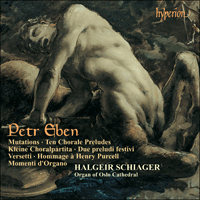

Here is the third instalment of our recordings of the complete organ music of the distinguished Czech composer Petr Eben, certainly one of the 20th century's most significant and prolific writers of organ music. We estimate that the series will eventually run to five discs. (Possibly six, since Mr Eben is currently working on another piece.) For this disc, Norwegian organist Halgeir Schiager has chosen the instrument of Oslo Cathedral. He is joined by a second organist, Kare Nordstoga, for the 'Mutations for One or Two Organs'.
These are all major works, most of them not available otherwise on CD.

Some of Purcell’s creative attributes have a particular appeal for me: his music is inventive and melodically interesting, and it includes many striking themes. The character of his music is joyful and often inspired by folk tunes (Scottish and Irish), yet at the same time one finds profoundly religious moods in his work. The harmonies are rich and original (sometimes one even finds parallel sevenths), and the vitality of his music is often strengthened by means of rhythmic devices, through the use of triplets and dotted rhythms.
I have used these qualities as my starting point in composing the Hommage. I have quoted three of Purcell’s themes: the clearest reference is to the ‘Dance of the Furies’ from the opera Dido and Aeneas, whose echo effects seemed to me to lend themselves very well to the use of organ manuals (Allegro, from bar 13).
The theme of the ‘Triumphant Dance’ from the same opera is concealed: quoted in the 4-foot pedal in regular crotchets, it appears here as a foundation below all the other musical activities (Più mosso, bar 69).
Purcell’s best-known theme, the ‘Trumpet Tune’, is only quoted in detail within the framework of my own theme, in bar 208, bar 212, and, split across different octaves, in bars 228 to 231.
My chief concern was to convey the sparkling quality of Henry Purcell’s music with the tools of our own modern musical vocabulary. The advice given as to the stops to be used should be read only as suggestions, depending, of course, on the organ in question. They are merely intended as indications of my thoughts on the mood of individual passages. Nor are the given metronome markings meant to be adhered to too strictly, since they too may have to be adjusted according to the acoustics of the building in which the organ is to be played.
Ten Chorale Preludes
These are moderately difficult preludes to Bohemian Brotherhood hymns that can be used as concert pieces or in church services. They were originally commissioned by the Bärenreiter Verlag, a German classical music publisher, who was responsible for the choice of preludes. The publisher’ s requirements were difficult to meet since they wanted compositions suitable for use in church services, which could be played by organists without formal training and at the same time could be used as stand-alone concert pieces. For this reason a score was written on two staves instead of the three that are commonly used in organ music. I wanted to communicate the different individual characters of the hymns. The arrangements do not follow the traditional hymn prelude model, but assume different forms (e.g. passacaglia, ostinati etc.)
Momenti d’Organo
These ten short compositions were originally commissioned by the Gesellschaft der Orgelfreunde (Society of Friends of the Organ) for its international symposium in Bremen in 1994. As the title suggests they are brief, technically intense compositions not exceeding two or three pages in length.
I have tried to build these short pieces around clearly defined themes and to create melodic, rhythmic and vibrant contrasts.
Versetti
The two Versetti were originally composed as organ interludes for my Missa cum populo for chorus, organ, wind instruments and congregation. They are, however, suitable for separate recital performance, although I conceived them as liturgical music to be played at those junctures in the Mass at which organ interludes can be inserted – thus particularly during the Offertory and the Communion. This is why the first movement makes use of the Gregorian Palm Sunday antiphon ‘Pueri habraeorum’ (English Hymnal 617) whose text contains the Hosanna and Benedictus and hence establishes a link with the following Sanctus. The prevailing mood of the five variations is that of a joyful procession, hence the sharply dotted rhythm of the ‘ben ritmico’ and the dance-like character of the ‘scherzando’ and ‘con gioia’.
The second movement is based on the Gregorian hymn ‘Adoro te devote’ (English Hymnal 331). In terms both of its content and of its liturgical character it is meditational, while the use of registration and dynamics is sparing. In the concert hall, however, both pieces may be played with a rather wider range of colour, and their performance in the reverse order would be preferable.
Kleine Choralpartita
I composed this small choral partita after completing a series of larger organ works (Sonntagsmusik, Laudes, 2 Choralphantasien) at the request of a number of different organists, who encouraged me to contribute towards producing an easier repertoire designed for church musicians and not to concentrate solely on works for concert performers.
Consequently, this composition, in addition to the Versetti, was conceived for liturgical use (where themes and the first 3 variations were intended as communion music, and variations IV and V as the finale and postlude).
However, this does not mean that it cannot be used in concert performances, which is why more focus has been given to contrast in the variation cycle, and a logical and satisfying progression.
Due preludi festivi per organo
These short fantasias in concerto form based on the Gregorian Ecce sacerdos magnus and I deo jure jurando were written for the visit of Pope John Paul II to Prague. These pieces of music are used as a standard processional for high-ranking church dignitaries and in keeping with this the solemn sound of the organ is favoured with joyful musical phrasing.
Mutationes for One or Two Organs
The idea of the alternation of two organs (‘mutationes’) came to me when I had the opportunity to play an instrument in the Polish town of Oliwa near Gdansk. Here it is possible to sit at one console and play three separate organs situated at different places in the interior of the church. I was enthralled by the tonal contrast and the spatial effect. The occasion for the composition of the present work was a commission by the Welsh Arts Council for an organ piece for the 1980 Cardiff Festival. The alternation of a full, large-scale organ sound and, as it were, a more chamber music, baroque sound is further emphasised by the stylistic contrast: the tonal opulence of the large organ goes hand in hand with a more volatile, tonally freer style, whereas the shorter pieces with their more restricted tonal scope are somewhat archaic in manner and have their tonal centre ‘in A’, as it were.
There are two possible versions of Mutationes:
1: For one player. In this case the first movement is repeated as the seventh and last movement in order to provide a framework for the cycle. If two organs – playable from one console – are not available, then the even-numbered movements (II, IV, VI) should be performed in a registration which imitates a small Baroque organ.
2: For two players on two organs. The two soloists having played the first six movements alternately, the ‘Duo’ is performed together as a finale. The registration of this movement will depend on the tonal balance of the two instruments, but obviously the natural difference between the large and the small organ must be preserved.
From a formal point of view the cycle is a centrally-planned structure. In both versions movements I and VII provide a clear framework, while the true centre of gravity lies in the golden section, in movement V.
Petr Eben © 2002
English: Julia Rushworth and Atlas Translations
Certaines des qualités créatrices de Purcell me sont très proches. Sa musique est pleine d’idées et d’une mélodie intéressante, elle comporte de nombreux motifs marquants. Le caractère de la musique est joyeux et souvent inspiré par des thèmes du folklore (écossaises, irlandaises). Mais on y trouve aussi, parallèlement, des atmosphères profondes et religieuses. L’harmonie est riche et originale (elle a parfois même des parallèles de septièmes) et la vitalité de sa musique est souvent soulignée, dans le domaine rythmique, par des triolets et des rythmes pointés.
C’est de ces caractères que je suis parti pour la composition de cet Hommage. J’ai cité trois thèmes: la citation la plus évidente est celle la « Danse des furies », extrait de I’opéra Dido and Aeneas (« Didon et Enée »), dont les moments d’écho m’ont paru fort adaptés pour les manuels de I’orgue (Allegro, a partir de la mesure 13).
Le thème de la « Danse triomphale », extrait du même opéra, est plutôt caché, cité avec des quarts de notes réguliers à la pédale de 4 pieds. II n’apparaît chez moi qu’à titre de fond de I’action musicale (Più mosso, mesure 69).
Son thème le plus connu, « Tune », n’est cité de manière détaillée que dans le cadre de mon propre thème, dans les mesures 208, 212, et, reparti en diverses octaves, dans les mesures 228 à 231.
Mon objectif principal était d’exprimer l’atmosphère pétillante d’étincelles de la musique d’Henry Purcell avec les moyens notre langue actuelle. Les remarques concernant le registre ne sont que des propositions, que dépendent bien évidemment du type d’orgue. Elles ne se veulent que montrer les conceptions de coloris que j’ai pour certains passages. Les chiffres de métronome sont tout aussi peu contraignants, étant donné qu’ils dépendent de l’acoustique de la salle.
Ten Chorale Preludes
Il s’agit de préludes aux chorale de la Confrérie de Bohème pour concerts et offices religieux. D’un niveau de difficulté moyenne, ces pièces sont le fruit d’une commande de la part des éditions Bärenreiter Verlag, qui ont également choisi les cantiques. Le commanditaire avait des exigences difficiles à concilier : il souhaitait des compositions destinées aux cérémonies religieuses, c’est-à-dire capables d’être jouées par des organistes de niveau moyen, mais pouvant, en même temps, être exécutées comme des pièces de concert à part entière ; c’est pourquoi l’édition comporte une écriture sur deux portées, au lieu des trois portées habituelles de la musique pour orgue. Je tenais à faire ressortir la différence de caractère entre les cantiques. L’arrangement musical ne suit pas le modèle traditionnel des préludes mais prend chaque fois une forme variée (passacaille, ostinato, etc.).
Momenti d’Organo
Cette suite de dix impromptus est le résultat d’une commande de la Société des amateurs d’orgue à l’occasion de leur rencontre internationale à Brême, en 1994. Comme leur nom l’indique, il s’agit de pièces courtes et de forme concentrée, dont la longueur ne dépasse pas deux à trois pages.
Je me suis efforcé de construire ces petites compositions autour de thèmes marquants, tout en créant des contrastes mélodiques et rythmiques colorés.
Kleine Choralpartita
J’ai composé cette petite chorale-partita, après mêtre consacré à une série d’œuvres pour orgue plus importantes (Sonntagsmusik, Laudes, 2 Choralphantasien), à la demande d'un certain nombre d’organistes qui m’ont encouragé à contribuer à la production d’un répertoire plus abordable conçu pour les musiciens d’église au lieu de me concentrer uniquement sur des œuvres pour concertistes.
Par conséquent, cette composition, en plus du Versetti, a été conçue pour une utilisation liturgique (les thèmes et les 3 premières variations étant prévues pour des musiques de communions et les variations IV et V comme finale et postlude).
Toutefois, cela ne veut pas dire qu’il est impossible de jouer cette chorale-partita en concert et c’est la raison pour laquelle j’ai apporté un plus grand soin au contraste dans le cycle de la variation et à une progression logique et satisfaisante.
Versetti
Les deux Versetti ont à l’origine été composés comme interludes d’orgue pour ma Missa cum populo pour chœur, orgue, vents et foule. Cependant, leur interprétation en concert est bien possible, même si je les ai conçus comme musique liturgique, à jouer aux endroits admettant des interludes d’orgue, soit notamment lors de l’Offertoire et de la Communion. C’est la raison pour laquelle l’antienne grégorienne « Pueri habraeorum » du dimanche de la Pentecôte sert de thème à variations au premier mouvement, étant donné que ce texte comporte le Hosanna et le Benedictus assurant le lien avec le Sanctus subséquent. L’ambiance est celle d’une procession joyeuse, d’où le rythme très pointé du « ben ritmico » et le caractère dansant du « scherzando » et du « con gioia ».
Le deuxième mouvement est basé sur l’hymne grégorien « Adoro te devote ». En ce qui concerne le contenu et la fonction liturgique, il s’agit en l’occurrence d’un mouvement méditatif et économe quant au choix des jeux et à la dynamique. L’exécution en concert des deux mouvements admet cependant plus de nuances, leur ordre pouvant aussi être inversé.
Due preludi festivi per organo
Les petites fantaisies concertantes sur le Ecce sacerdos magnus grégorien et I deo jure jurando ont été composées à l’occasion de la venue à Prague du pape Jean-Paul II.
Ces thèmes sont conçus pour accompagner l’entrée d’un haut dignitaire religieux dans l’église. Dans le même esprit, le compositeur a choisi d’imprégner les accents solennels de l’orgue d’une allégresse jubilatoire.
Mutations for One or Two Organs
L’idée d’un jeu alterné (« Mutationes ») entre deux orgues m’est venue en Pologne, à Oliwa, près de Gdansk (Danzig), en jouant sur les claviers d’une console reliée à trois orgues indépendants situés à différents endroits de l’église. A cette époque déjà, j’étais enthousiasme par l’effet acoustique, le contraste son ore de ces instruments. L’impulsion décisive vint du Welsh Arts Council qui me demanda d’écrire une œuvre pour orgue destinée à être jouée en 1980, lors du Festival de Cardiff. L’alternance entre une sonorité grandiose et une sonorité baroque, d’un genre plutôt ‘musique de chambre’ est mise en valeur par le contraste des styles : au grand orgue, un style plutôt éclatant, plus libre sur le plan tonal alors que, au petit orgue, les pièces de dimensions plus réduites et d’un volume sonore moindre présentent un caractère quelque peu archaïsant avec une tonalité « en la ».
Deux exécutions sont possibles :
1: Un seul exécutant. Le premier mouvement sera repris comme septième et dernier mouvement afin de donner un cadre à ce cycle. Si l’on ne dispose pas de deux orgues reliés à la même console, on jouera les mouvements II, IV, VI avec une régistration analogue à celle d’une orgue baroque de modeste proportion.
2: Deux exécutants à deux orgues différents. Les deux solistes joueront d’abord, chacun séparément et alternativement, et ensuite, ils joueront par contre simultanement le duo final. La régistration de ce mouvement dépend de l’équilibre sonore des instruments. De toute façon, il faudra tenir compte de la différence de nature entre le grand et le petit instrument.
Du point de vue de la forme, ce cycle s’ordonne autour d’une partie centrale. Les mouvements I et VII constituent dans les deux versions un cadre bien délimité dans lequelle mouvement V avec les proportions du nombre d’or est comme le centre de gravité de toute l’ouvre.
Petr Eben © 2002
Français: Martine Paulauskas and Atlas Translations
Bei Purcell sind mir einige seiner schöpferischen Eigenschaften sehr nahe. Seine Musik ist einfallsreich und melodisch interessant, sie hat viele markante Motive. Der Charakter der Musik ist freudig und oft inspiriert durch folkloristische Themen (Scotch Tunes, Irish Tunes), gleichzeitig findet man aber auch bei ihm tiefe religiöse Atmosphären. Die Harmonik ist reich und originell (sie hat sogar manchmal Septimenparallelen), und die Vitalität seiner Musik wird im rhythmischen Bereich oft durch Triolen und punktierte Rhythmen unterstützt.
Von diesen musikalischen Eigenschaften bin ich bei der Komposition de Hommage ausgegangen. Zitiert habe ich drei Themen: am deutlichsten den „Tanz der Furien“ aus der Oper Dido und Aeneas, bei dem mir dei Echo-Momente für die Manuale der Orgel sehr geeignet erschienen (Allegro, ab T. 13).
Eher verborgen ist das Thema des „Triumphalen Tanzes“ aus derselben Oper, im 4-Fuß-Pedal mit regelmäßigen Viertelnoten zitiert, es erscheint hier nur als Untergrund des musikalischen Geschehens (Più mosso, T. 69).
Sein bekanntestes Thema „Trumpet Tune“ ist detailhaft nur im Rahmen meines eigenen Themas zitiert, in T.208, T.212 und (in verschiedene Oktaven verteilt) in den Takten 228-231.
Mir ging es vor allem darum, die funkensprühende Atmosphäre der Musik Henry Purcells mit den Mitteln unserer heutigen Sprache auszudrücken. Die Anmerkungen zur Registrierung sind nur Vorschläge, die natürlich von der jeweiligen Orgel abhängen. Sie wollen in etwa anzeigen, welche Farb-Vorstellungen ich bei den einzelnen Passagen habe. Ebensowenig sind die Metronomzahlen verpflichtend, da auch sie von der Akustik des Raumes Abhängen.
Ten Chorale Preludes
Es handelt sich um mittelschwere Vorspiele zu den Chorälen der Böhmischen Brudergemeinschaft für den Konzert- und Gottesdienstgebrauch. Sie entstanden als Auftragswerk für den Bärenreiter Verlag, der auch die Auswahl der Choräle traf. Der Auftraggeber hatte schwer zu vereinende Ansprüche: er wünschte sich Kompositionen für den Gottesdienstgebrauch, die auch ungeschulte Organisten spielen könnten und zugleich selbständige Konzertstücke; daher auch die Auflage einer Niederschrift auf zwei Notenlinien anstelle der für die Orgel üblichen drei. Ich wollte die Stimmungsunterschiede der einzelnen Choräle zum Ausdruck bringen. Die Bearbeitungen orientieren sich nicht am Modell des klassischen Choralvorspiels, sondern wählen verschiedene Formen (z. B. eine Passacaglia, Ostinati u. a.).
Momenti d’Organo
Diese zehn kurze Kompositionen entstanden als Auftragswerk für die Gesellschaft der Orgelfreunde für das internationale Treffen in Bremen 1994. Wie der Titel bereits andeutet, handelt es sich um kurze, formal konzentrierte Kompositionen, deren Länge zwei bis drei Seiten nicht übersteigt.
Ich habe mich bemüht, diese kurzen Stücke auf markante Themen und melodischem, rhythmische und bunte Kontraste zu gründen.
Kleine Choralpartita
Ich schrieb die Kleine Choralpartita nach einer Reihe von größeren Orgelwerken (Sonntagsmusik, Laudes, 2 Choralphantasien) auf Ersuchen verschiedener Organisten, die in mich drangen, ich sollte auch zum leichteren Repertoire der Kirchenmusiker beitragen und nicht alle Werke ausschließlich für konzertierende Künstler konzipieren.
So entstand neben den Versetti auch diese Komposition mit dem Gedanken an den liturgischen Gebrauch (wobei Thema und die ersten 3 Variationen als Musik zur Kommunion gedacht waren, die IV. und V. Variation als Ausklang und Nachspiel). Dieser schließt aber die Möglichkeit einer Konzertaufführung nicht aus. Deshalb ist der Variationszyklus auf Kontraste ebenso bedacht, wie auf einen logischen und befriedigenden Formverlauf.
Versetti
Dei beiden Versetti sind ursprünglich als Orgel-Einlagen zu meiner Missa cum populo für Chor, Orgel, Bläser und Gemeindegesang entstanden. Ihre Verwendung in einem Konzertprogramm ist aber durchaus möglich, auch wenn ich sie als liturgische Musik gedacht habe, die an jenen Stellen zu spielen ist, wo noch Raum für Orgelinterludien bleibt, besonders also zum Offertorium und zur Kommunion. Deshalb dient dem ersten Satz die gregorianische Antiphon ‘Pueri hebraeorum’ vom Palmsonntag als Variationsthema, da ja in diesem Text das Hosanna und Benedictus enthalten und dadurch mit dem darauffolgenden Sanctus verbunden ist. Die Stimmung ist die einer freudigen Prozession, deshalb der scharf punktierte Rhythmus des „Ben ritmico“ und der tänzerische Charakter des „Scherzando“ und, „Con gioia“.
Dem zweiten Satz liegt der gregorianische Hymnus „Adoro te devote“ zugrunde. Er ist – vom Inhalt wie von der liturgischen Funktion her – meditativ gestaltet und sowohl in der Registerwahl als auch in der Dynamik sparsam gehalten. Bei einer Konzertaufführung dürfen jedoch beide Sätze etwas farbreicher gespielt werden und eher in der umgekehrten Reihenfolge.
Due preludi festivi per organo
Die kleinen konzertanten Phantasien über das gregorianische Ecce sacerdos magnus und I deo jure jurando wurden anlässlich des Besuches von Papst Johannes Paul II. in Prag geschrieben. Diese Themen finden beim Eintreten eines hohen kirchlichen Würdenträgers in den Kirchenraum ihr Verwendung. Im Einklang damit wurde auch eine jubelnde Musiksprache des festlichen Orgelklangs gewählt.
Mutations for One or Two Organs
Die Idee des Einander-Abwechselns („Mutationes“) zweier Orgeln war mir gekommen, als ich im polnischen Oliwa bei Gdansk von einem Spieltisch aus drei eigenständige und an verschiedenen Stellen stehende Orgeln spielen konnte. Der klangliche Kontrast und Raumeffekt hatten mich schon damals sehr begeistert.
Den Anstoß zur Komposition gab das Welsh Arts Council durch einen Bestellung eines Orgelwerkes für das Festival in Cardiff 1980. Das Abwechseln eines vollen, großen Orgelklanges mit eine eher „kammermusikalischen“ Barockklang ist noch durch den stilistischen Kontrast unterstrichen, der der Klangfülle der grossen Orgel einen brisanteren, tonal freieren Stil zuteilt, während die im Klangvolumen wie im Ausmaß kleineren Stücke etwas archaisierend und „in A“ tonal zentriert sind.
Zwei Versionen der Mutationes sind moglich:
(1) Für einen Spieler. In deisem Falle wird als siebenter, letzter Satz der erste Satz wiederholt, um dem Zyklus einen Rahmen zu geben. Falls nicht zwei Orgeln – von einem Spieltisch erreichbar – vorhanden sind, ist für die geradzahligen Sätze II, IV, VI die Registrierung einer kleineren Barockorgel nachzuahmen.
(2) Für zwei Spieler auf zwei Orgeln. Nach dem Abwechseln beider Solisten ist am Ende als Finale das „Duo“ gemeinsam zu spielen. Die Registrierung dieses Satzes wird vom Ausgleich des Klanges beider Instrumente abhängen, doch ist selbverständlich der natürliche Unterschied zwischen dem großen und dem kleinen Instrument zu respektieren.
Vom formalen Standpunkt aus geht es in diesem Zyklus um einen Zentralbau. I und VII bilden in beiden Versionen den klaren Rahmen, der eigentliche Schwerpunkt liegt im goldenen Schnitt auf Nr.V.
Petr Eben © 2002
Later, at every new town I visited, I always endeavoured to get to the organ in the local church and try it. It is a fact that every instrument has its own individuality: each has its characteristic sound within its own acoustics. I could almost say that I remember towns by their organs: a unique Renaissance instrument in the silver chapel – that’s Innsbruck; a mighty Baroque Schnitger – Hamburg; an organ with 64-stop pedal is Passau; an organ divided into two majestic towers right and left in Coventry Cathedral, and I should like to add to these the two instruments in Olomouc.
Thus I once also found my way to a big organ in Polish Oliva near Gdansk. And there sitting at one stool I was able to play three instruments at once: the big organ in the choir, the smaller Baroque one, standing in the front part of the church controlled from a distance, as well as a small Renaissance instrument down at the back of the church. Since this encounter I am not only enchanted by the individuality of every instrument but also by the spacious impression of their sound coming from all sides. And while before this experience every time I entered a church my sight was immediately caught by the mighty organ pipes at the back, ever since then I have always searched the nave and the aisles for another instrument.
Petr Eben © 2002
English: Julia Rushworth and Atlas Translations
Plus tard, dans chaque ville nouvelle que je visitais, je me suis toujours efforcé d’essayer l’orgue de l’église locale. Chaque instrument possède une identité propre, des caractéristiques sonores spécifiques au sein d’une acoustique personnelle. Je pourrais presque dire que je me souviens des villes en fonction de leurs orgues : un instrument unique Renaissance dans une chapelle argentée – c’est Innsbruck ; un puissant Schnitger baroque – c’est Hambourg ; un orgue avec un tuyau de 64 pieds, c’est Passau ; un orgue divisé en deux tours majestueuses sises à droite et à gauche, c’est la Cathédrale de Coventry. Et je voudrais ajouter les deux instruments d’Olomouc.
C’est ainsi qu’une fois je me suis retrouvé face à un orgue imposant dans Polish Oliva, près de Gdansk. Et en cette église, bien assis sur une chaise, j’étais en mesure de jouer trois instruments à la fois. Le grand orgue dans le chœur, le plus petit orgue baroque, situé plus en avant et contrôlé à distance, et un tout petit instrument renaissance situé à l’arrière de l’église. Depuis cette rencontre, je ne suis pas seulement enchanté par l’individualité de chaque instrument, mais aussi par l’impression spacieuse de leur sonorité, comme s’ils venaient de tous côtés à la fois. Et si avant cette expérience chaque fois que j’entrais dans une église mon regard était immédiatement attiré par les puissants tuyaux de l’orgue, depuis, j’ai toujours cherché à savoir s’il y avait d’autres instruments dans la nef et les bas-côtés.
Petr Eben © 2002
Français: Isabelle Battioni
Später legte ich großen Wert darauf, in jeder neuen Stadt, die ich besuchte, in der örtlichen Kirche die Orgel auszuprobieren. Tatsache ist, dass jedes Instrument eine eigene Individualität hat: Jedes besitzt, bedingt durch die Akustik seiner Umgebung, einen charakteristischen Klang. Ich könnte fast behaupten, dass mir Städte durch ihre Orgeln in Erinnerung geblieben sind: ein einzigartiges Renaissance-Instrument in der Silbernen Kapelle – das ist Innsbruck; eine mächtige barocke Schnitger-Orgel – Hamburg; eine Orgel mit 64 Pedalregistern ist Passau; eine Orgel, aufgeteilt in zwei majestätische Türme rechts und links steht in der Kathedrale von Coventry; und ich möchte die Aufzählung ergänzen durch die zwei Instrumente im mährischen Olomouc.
So habe ich auch einst im polnischen Oliva bei Gdansk eine besonders große Orgel aufgesucht und konnte auf einem Schemel sitzend gleich drei Instrumente auf einmal spielen: die große Orgel auf der Empore, die kleinere ferngesteuerte Barock-Orgel im vorderen Teil der Kirche und ein kleines Renaissance-Instrument im hinteren Teil. Seither bin ich nicht nur vom individuellen Charakter jedes dieser Instrumente verzaubert, sondern auch vom räumlichen Eindruck ihres Klangs, so als würde er von allen Seiten kommen. Und während ich vor diesem Erlebnis beim Betreten einer Kirche den Blick sogleich auf die hohen Orgelpfeifen an der Rückseite zu richten pflegte, halte ich nun im Mittelschiff und in den Seitenschiffen immer Ausschau nach einem weiteren Instrument.
Petr Eben © 2002
Deutsch: Anne Steeb/Bernd Müller