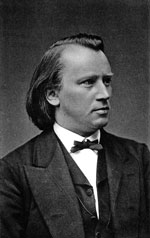
Johannes Brahms was born in Hamburg, the son of an impecunious musician; his mother later opened a haberdashery business to help lift the family out of poverty. Showing early musical promise he became a pupil of the distinguished local pianist and composer Eduard Marxsen and supplemented his parents’ meagre income by playing in the bars and brothels of Hamburg’s infamous red-light district. In 1853 Brahms presented himself to Robert Schumann in Düsseldorf, winning unqualified approval from the older composer. Brahms fell in love with Schumann’s wife, Clara, supporting her after her husband’s illness and death. The relationship did not develop as Brahms wished, and he returned to Hamburg; their close friendship, however, survived. In 1862 Brahms moved to Vienna where he found fame as a conductor, pianist and composer. The Leipzig premiere of his
German Requiem in 1869 proved a triumph, with subsequent performances establishing Brahms as one of the emerging German nation’s foremost composers.
Following the long-delayed completion of his First Symphony in 1876, he composed in quick succession the majestic Violin Concerto, the two piano Rhapsodies, Op 79, the First Violin Sonata in G major, and the Second Symphony. His subsequent association with the much-admired court orchestra in Meinigen allowed him freedom to experiment and develop new ideas, the relationship crowned by the Fourth Symphony of 1884. In his final years, Brahms composed a series of profound works for the clarinettist Richard Mühlfeld, and explored matters of life and death in his Four Serious Songs.
He died at his modest lodgings in Vienna in 1897, receiving a hero’s funeral at the city’s central cemetery three days later.
from notes by Andrew Stewart © 2013
Fils d’un musicien sans le sou, Johannes Brahms naquit à Hambourg; sa mère ouvrit ensuite une mercerie afin que la famille sorte de la pauvreté. Montrant un talent musical précoce, il devint l’élève d’un éminent pianiste et compositeur local, Eduard Marxsen, arrondissant les maigres revenus de ses parents en jouant dans les bars et les maisons closes du quartier chaud de Hambourg, un quartier mal famé. En 1853, il se présenta devant Robert Schumann à Düsseldorf, gagnant une estime sans limite de la part de son aîné. Brahms s’éprit de la femme de Schumann, Clara, et devint son soutien après la maladie, puis la mort de son mari. Leur relation ne prit jamais le tour qu’avait espéré Brahms, et il rentra à Hambourg; mais de cette relation demeura, toutefois, une amitié intime. En 1862, Brahms s’établit à Vienne, où il se fit connaître comme chef d’orchestre, pianiste et compositeur. La création à Leipzig d’
Un requiem allemand, en 1869, fut un triomphe, et les exécutions qui s’ensuivirent établirent Brahms comme l’un des compositeurs les plus en vue de la nation allemande naissante.
Après la longue gestation de la Première Symphonie,achevée en 1876, il composa dans le même élan le majestueux Concerto pour violon, les deux Rhapsodies pour piano op.79, la Première Sonate pour violon, en sol majeur, et la Deuxième Symphonie. Ensuite, sa collaboration avec l’orchestre très réputé de la cour de Meiningen lui offrit la liberté lui permettant d’expérimenter et de développer de nouvelles idées; ce lien fut couronnée par la Quatrième Symphonie en 1884. Dans ses dernières années, Brahms composa une série d’oeuvres profondes pour le clarinettiste Richard Mühlfeld, et explora le sujet de la vie et de la mort dans ses Quatre Chants sérieux.
Il mourut dans son modeste meublé de Vienne en 1897, recevant trois jours plus tard des funérailles nationales au cimetière central de la ville.
extrait des notes rédigées par Andrew Stewart © 2013
Français: Claire Delamarche
Johannes Brahms wurde als Sohn eines mittellosen Musikers in Hamburg geboren. Seine Mutter eröffnete später ein Kurzwarengeschäft, um die Armut der Familie zu lindern. Brahms erweckte schon früh Hoffnungen mit seinem musikalischen Talent. Er wurde Schüler des in der Gegend bekannten Pianisten und Komponisten Eduard Marxsen und trug zum bescheidenen Einkommen seiner Eltern bei, indem er in den Bars und Bordellen von Hamburgs berüchtigtem Rotlichtviertel spielte. 1853 stellte sich Brahms Robert Schumann in Düsseldorf vor, was dazu führte, dass ihm der ältere Komponist uneingeschränkte Anerkennung zuteil werden ließ. Brahms verliebte sich in Schumanns Frau Clara, die er nach der Krankheit und dem Tod ihres Mannes unterstützte. Die Beziehung entwickelte sich nicht, wie es sich Brahms gewünscht hätte, und er kehrte nach Hamburg zurück. Ihre enge Freundschaft bleib allerdings weiterhin bestehen. 1862 zog Brahms nach Wien, wo er als Dirigent, Pianist und Komponist berühmt wurde. Die Uraufführung seines
Requiems in Leipzig 1869 gestaltete sich zu einem Triumph, gefolgt von Aufführungen, durch die sich Brahms den Ruf eines der wichtigsten aufstrebenden Komponisten Deutschlands schuf.
Nach dem lang hinaus gezögerten Abschluss seiner 1. Sinfonie 1876 folgten in schneller Reihenfolge das majestätische Violinkonzert, die zwei Rhapsodien für Klavier, op. 79, die 1. Violinsonate in G–Dur und die 2. Sinfonie. Die spätere Verbindung zwischen Brahms und der weithin geschätzten Hofkapelle in Meiningen gab dem Komponisten die Freiheit, mit neuen Ideen zu experimentieren und sie zu entwickeln. Diese Beziehung gipfelte 1884 in der 4. Sinfonie. In seinen letzten Lebensjahren komponierte Brahms eine Reihe profunder Werke für den Klarinettisten Richard Mühlfeld. Zudem erkundete der Komponist in seinen Vier ernsten Gesängen Themen von Leben und Tod.
Er starb 1897 in Wien in bescheidenen Wohnverhältnissen. Drei Tage später setzte man ihn einem Helden gleich im Zentralfriedhof der Stadt bei.
aus dem Begleittext von Andrew Stewart © 2013
Deutsch: Elke Hockings