
Welcome to Hyperion Records, a British classical label devoted to presenting high-quality recordings of music of all styles and from all periods from the twelfth century to the twenty-first.
Hyperion offers both CDs, and downloads in a number of formats. The site is also available in several languages.
Please use the dropdown buttons to set your preferred options, or use the checkbox to accept the defaults.

Like the slow movement of No 50, the Adagio suggests a fantasia in its rhapsodic, richly ornamented style. But it is a more varied, far-reaching piece, more sonorously scored and more audacious in its harmony—as when the tonality veers dramatically towards a remote C major in the second half of the theme. A central episode in E minor develops the theme’s initial dotted phrase in music by turns stark and airily whimsical. Haydn has another tonal surprise up his sleeve at the start of the finale. After the E major Adagio, the unharmonized repeated Gs lead the ear to expect E minor; and when a sustained bass note in bar two establishes the key of E flat, we experience a sense of pleasurable shock. The whole movement is the consummation of Haydn’s Scarlatti-influenced toccata style, developing its irrepressible main theme with dazzling verve and chromatic sleight-of-hand: a coruscating ending to a work that, if not quite his last sonata, gloriously crowns a genre that Haydn, more than anyone, had raised from lightweight, divertimento origins to a status comparable with the exalted symphony and the string quartet.
from notes by Richard Wigmore © 2007
Comme le mouvement lent de la Sonate no 50, l’Adagio, par son style rhapsodique richement orné, suggère une fantaisie. Il s’agit, cependant, d’une pièce considérable, plus variée, à l’écriture plus sonore, à l’harmonie plus audacieuse—comme lorsque la tonalité vire dramatiquement vers un ut majeur reculé, dans la seconde moitié du thème. Un épisode central en mi mineur développe la phrase pointée initiale du thème en une musique tour à tour austère et désinvoltement fantasque. Haydn nous réserve une autre surprise tonale, au début du finale. Après l’Adagio en mi majeur, les sol répétés, non harmonisés, font que l’oreille s’attend à mi mineur; et quand une note de basse tenue, à la mesure deux, instaure la tonalité de mi bémol, nous ressentons un agréable choc. Ce mouvement, qui marque l’apogée du style de toccata haydnien d’influence scarlattienne, développe son irrésistible thème principal avec une verve étincelante et une dextérité chromatique: une coruscante conclusion pour une œuvre qui, si elle n’est pas tout à fait la dernière sonate de Haydn, couronne glorieusement un genre que ce compositeur a fait, plus que quiconque, passer du rang de divertimento léger à celui d’œuvres comme la symphonie de haut vol et le quatuor à cordes.
extrait des notes rédigées par Richard Wigmore © 2007
Français: Hypérion
Dieses Adagio klingt, wie auch der langsame Satz in Nr. 50, mit seinem rhapsodischen, reich verzierten Stil an eine Fantasie an. Aber dies ist ein vielfältigeres, weitreichenderes Stück mit größerer Klangfülle und waghalsigerer Harmonik—wie wenn die Tonalität in der zweiten Hälfte des Themas dramatisch in Richtung C-Dur steuert. Eine zentrale Episode in e-Moll verarbeitet die einleitende punktierte Phrase in abwechselnd kahler und sorglos-launischer Musik. Am Anfang des Finales schüttelt Haydn noch eine weitere tonale Überraschung aus dem Ärmel. Nach dem E-Dur-Adagio lassen die nicht harmonisierten repetierten Gs das Ohr e-Moll erwarten, und wenn eine angehaltene Bassnote im zweiten Takt die Tonart Es-Dur etabliert, fühlen wir einen Wonneschauer. Der Satz als Ganzes ist der Gipfelpunkt in Haydns von Scarlatti beeinflusstem Toccatenstil und entwickelt sein unwiderstehliches Hauptthema mit blendendem Elan und chromatischer Fingerfertigkeit: ein funkelnder Beschluss für ein Werk, das, wenn es auch nicht seine allerletzte Sonate ist, ein Genre krönt, das Haydn mehr als jeder andere von seinem leichtherzigen Divertimento-Ursprung zu einem Status erhob, der sich mit dem der Erhabenheit von Symphonie und Streichquartett vergleichen lässt.
aus dem Begleittext von Richard Wigmore © 2007
Deutsch: Renate Wendel
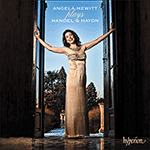 Handel & Haydn: Angela Hewitt plays Handel & Haydn Handel & Haydn: Angela Hewitt plays Handel & HaydnStudio Master: CDA67736Studio Master FLAC & ALAC downloads available  Recorded and released in the ‘anniversary year’ of both Handel and Haydn, this album is an effusive celebration of the two composers, performed by an artist whose renditions of seventeenth- and eighteenth-century keyboard works on the piano have r ...» More |
 Haydn: Piano Sonatas Haydn: Piano SonatasSIGCD097Download only  'For the richly experienced John Lill, Haydn's music is demonstatably of the highest quality, his quirkiness never toppling into facetiousness and oft ... 'In an age of vacuous wunderkinder, John Lill's playing stands out for its integrity and individuality … unmissable' (The Independent on Sunday)» More |
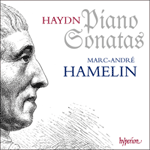 Haydn: Piano Sonatas, Vol. 1 Haydn: Piano Sonatas, Vol. 1CDA675542CDs for the price of 1 Epitomizing the evolution of the Classical sonata, Haydn’s iconic contributions to the genre, some sixty in total, have in some respects become victims of their own perfection, ignored by all but a handful of today’s leading pianists and relegated ...» More |