Welcome to Hyperion Records, a British classical label devoted to presenting high-quality recordings of music of all styles and from all periods from the twelfth century to the twenty-first.
Hyperion offers both CDs, and downloads in a number of formats. The site is also available in several languages.
Please use the dropdown buttons to set your preferred options, or use the checkbox to accept the defaults.

| Salomon Quartet» More |
The powerful minuet contrasts a strenuous forte statement with a plaintive piano answer which Mozart perhaps remembered in the minuet of his G minor String Quintet. In the second half Haydn prolongs and intensifies the forte statement and enhances the poignancy of the piano reply with a surprise harmonic deflection. After this almost unrelieved emphasis on F minor, the F major trio brings harmonic balm, though with its irregular phrase lengths it is not quite so innocent as it may first seem. F major returns in the limpid Adagio, whose guileless siciliano theme is freely varied with quasi-improvisatory arabesques from the first violin. Of the three fugal finales in Op 20, No 5’s double fugue, based on a common tag used by Handel in Messiah (‘And with his stripes we are healed’) and Mozart in the Kyrie of the Requiem, is the most austerely Baroque in flavour—though a Baroque fugue in F minor would not have modulated as far afield as A flat minor. Haydn here displays every contrapuntal trick of the trade: inversion, stretto (i.e. with thematic entries piling in on top of each other) and, near the end, a climactic fortissimo canon between first violin and cello, all the more dramatic after so much tense sotto voce.
from notes by Richard Wigmore © 2011
À une vigoureuse énonciation forte, le puissant menuet oppose une plaintive réponse piano dont Mozart se souvint peut-être dans le menuet de son Quintette à cordes en sol mineur. Dans la seconde moitié, Haydn prolonge et intensifie l’énonciation forte et accuse le caractère poignant de la réponse piano par une déviation harmonique surprise. Après que l’accent a ainsi été mis presque sans relâche sur fa mineur, le trio en fa majeur apporte un baume harmonique même s’il n’est pas, avec ses longueurs de phrase irrégulières, aussi innocent qu’il y paraît. Fa majeur revient dans le limpide Adagio, dont l’ingénu thème de siciliano est varié librement avec des arabesques presque improvisées au premier violon. Des trois finales fugués de l’op. 20, la double fugue du no 5, fondée sur un lieu commun utilisé par Haendel dans son Messie («And with his stripes we are healed») et par Mozart dans le Kyrie de son Requiem, est la plus austèrement baroque—encore que jamais une fugue baroque en fa mineur n’eût modulé jusqu’à la bémol mineur. Haydn recourt ici à toutes les vieilles ficelles contrapuntiques: inversion, strette (i.e. avec des entrées thématiques s’empilant les unes sur les autres) et, vers la fin, un canon paroxystique fortissimo entre le premier violon et le violoncelle, d’autant plus dramatique qu’il survient après tant de sotto voce tendu.
extrait des notes rédigées par Richard Wigmore © 2011
Français: Hypérion
Das eindruckendsvolle Menuett stellt einer energischen Eröffnung im Forte eine klagende Antwort im Piano gegenüber, an die sich Mozart im Menuett seines Streichquintetts g-Moll erinnert haben mag. In der zweiten Hälfte verlängert und intensiviert Haydn den Forte-Einsatz und steigert die Betrübtheit der Piano-Erwiderung durch eine überraschende harmonische Wende. Nach diesem geradezu unerbittlichen Beharren auf f-Moll bringt das Trio in F-Dur harmonische Linderung, auch wenn es mit seinen unregelmäßigen Phrasenlängen nicht ganz so unschuldig ist, wie es vielleicht zunächst scheint. Die F-Dur-Tonalität wird im durchsichtigen Adagio aufgegriffen, dessen argloses Siciliano-Thema von der ersten Geige mit improvisiert anmutenden Arabesken frei variiert wird. Von den drei Schlussfugen in op. 20 trägt die Doppelfuge von Nr. 5 die deutlichsten Züge barocker Strenge—obwohl eine Barockfuge in f-Moll nicht bis nach as-Moll moduliert hätte. Sie basiert auf einer gängigen Wendung, die auch Händel im Messias („And with his stripes we are healed“) und Mozart im Kyrie des Requiems verwenden. Haydn führt hier alle kontrapunktischen Kniffe vor: Umkehrung, Engführung (d.h. übereinander geschichtete Themeneinsätze) sowie gegen Ende als Höhepunkt einen Fortissimo-Kanon zwischen erster Geige und Cello, der nach so viel angestrengtem Sotto voce umso dramatischer wirkt.
aus dem Begleittext von Richard Wigmore © 2011
Deutsch: Arne Muus
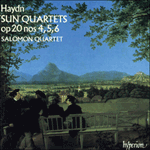 Haydn: Sun Quartets Nos 4, 5 & 6 Haydn: Sun Quartets Nos 4, 5 & 6CDA66622Download only  ‘The Salomon's beautiful playing of these important masterpieces make this set indispensable’ (Gramophone) «Je vous conseillerai de jeter un coup d'oreille sur cette version des Quatuors du Soleil. Elle vaut le détour!» (Répertoire, France)» More |
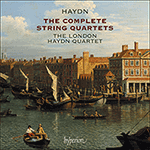 Haydn: The Complete String Quartets Haydn: The Complete String QuartetsCDS44651/7020CDs Boxed set (at a special price) Higher-value orders will be automatically discounted at check-out 10x double-CD sets presented in strikingly handsome double wallets throughout, each featuring opulent paintings by Samuel Scott on front and back. Each wallet offers a track listing, with many presenting facsimiles of the original scores and front ...» More |