
Welcome to Hyperion Records, a British classical label devoted to presenting high-quality recordings of music of all styles and from all periods from the twelfth century to the twenty-first.
Hyperion offers both CDs, and downloads in a number of formats. The site is also available in several languages.
Please use the dropdown buttons to set your preferred options, or use the checkbox to accept the defaults.

| Cédric Tiberghien (piano)» More |
Shéhérazade enchants its audience in a slow-moving dance-like narrative which builds to a pair of linked climaxes, each preceded by an escalation of tempo. Between comes a lengthy slower passage, in which D as tonal anchorage is unexpectedly announced via a cadence so conventional that, here, it sounds wholly new. D persists as an undertone to what follows, without ever consolidating its sovereignty. Ultimately the music returns to its openings. The pitch D is balanced by the monotone A heard at the outset, yet without ever suggesting a conventional tonic–dominant relationship. No explicit programme is suggested for this luminously sculptural music, but the context of 1001 Nights, where Shéhérazade’s survival depends upon keeping her new royal husband entertained, lends a subcontext of danger, like that supernatural heightening of sensory awareness heralding an expected extinction.
Tantris le Bouffon is derived from a parody of the Tristan legend by Ernst Hardt, published in 1908. In possibly conscious antithesis to Shéhérazade, who cannot escape the royal chambers, Tantris attempts to break into Isolde’s quarters but is recognized by the dogs, which give the game away. The fact that Isolde is later handed over naked by the King to the lepers is perhaps more than enough (never mind its explanation) to indicate the worm-in-the-rose ambivalence of Szymanowski’s aesthetic, and is of relevance here only because, rather than strictly narrating events, the composer sets out to contrast the coarsely knockabout (in an apparently ugly, rather than humorous, light) with the despairing and the helpless. Perhaps too strange to conjure pathos, this ferociously demanding music hints in its fast passages at odd melodic glimmers of Petrushka. Stravinsky was a recent discovery for Szymanowski at the time of the Masques. Their chosen title may well nod towards the commedia dell’arte tradition to which Petrushka and Russian puppeteering are more generally related.
Sérénade de Don Juan is essentially a rondo. As Alastair Wightman notes in his critical biography of Szymanowski, this is the perfect form for a piece about an egomaniac, since its recurrent theme can stand as the antihero’s ongoing love affair with himself. Moreover, the solitary note D flat (much laboured in the theme) may itself represent the ego of one unwilling to let attention rest elsewhere for very long—even though the theme does appear at other pitches later in the proceedings. If humour is in short supply elsewhere in these works, it is sardonically evident in this movement. The D flat makes a meal of itself in the introduction, like someone very consciously conjuring ‘an entrance’. Palmer notes a possible evocation of someone making a great kerfuffle of tuning up (although in fourths rather than fifths, affording the interesting possibility of a Don who plays double bass rather than violin). Later the music invites comparison with Debussy’s Violin Sonata and, in its repeated-note evocations of flamenco tradition, with the jester figure in Alborada del gracioso, from Ravel’s Miroirs. The gracelessly peremptory ending hints at a petulant flouncing out when initial attention has waned. Describing Scaramouch, an antecedent of Don Juan in English theatre (famously borrowed in music by Darius Milhaud), Brewer’s Dictionary resoundingly dismissed him as ‘very valiant in words, but a poltroon’, a description which fits Szymanowski’s feckless protagonist equally well.
from notes by Francis Pott © 2014
Shéhérazade enchante son auditoire par une narration proche d’une danse lente qui culmine avec deux sommets liés, précédés chacun d’une intensification du tempo. Entre les deux se déroule un passage assez long et plus lent, où l’ancrage tonal de ré majeur survient de façon inattendue par le biais d’une cadence si conventionnelle qu’elle semble ici totalement nouvelle. Ré majeur persiste comme un relent de ce qui suit, sans jamais consolider sa souveraineté. La musique revient finalement à ses débuts. Le ré est compensé par le la monotone du début, mais sans jamais suggérer une relation conventionnelle tonique–dominante. Cette musique lumineusement sculpturale ne comporte aucun programme explicite, mais le contexte des Mille et Une Nuits, où la survie de Shéhérazade dépend de sa capacité à divertir son nouvel époux royal, crée une atmosphère de danger, comme cet accroissement surnaturel de conscience sensorielle annonçant une extinction attendue.
Tantris le Bouffon provient d’une parodie de la légende de Tristan d’Ernst Hardt, publiée en 1908. Dans une antithèse peut-être consciente de Shéhérazade, qui ne peut s’enfuir des appartements royaux, Tantris tente d’entrer dans les appartements d’Isolde mais est reconnu par les chiens, qui vendent la mèche. Le fait qu’Isolde soit ensuite livrée nue aux lépreux par le roi suffit peut-être largement (peu importe son explication) à souligner l’ambivalence délétère de l’esthétique de Szymanowski, et il n’a d’incidence qu’ici car, au lieu de raconter rigoureusement les événements, le compositeur cherche à faire ressortir le contraste qui existe entre la grosse farce (sous une lumière apparemment menaçante plutôt qu’humoristique) d’une part, le désespéré et la malheureuse d’une autre. Peut-être trop étrange pour faire apparaître le pathétique, cette musique terriblement difficile fait allusion dans ses passages rapides à des échos mélodiques surprenants de Pétrouchka. Stravinski était une découverte récente pour Szymanowski à l’époque des Masques. Le titre qu’il a choisi est peut-être un coup de chapeau à la tradition de la commedia dell’arte à laquelle Pétrouchka et le théâtre de marionnettes russes sont plus généralement apparentés.
La Sérénade de Don Juan est essentiellement un rondo. Comme le note Alastair Wightman dans sa biographie critique de Szymanowski, c’est la forme parfaite pour une pièce consacrée à un égocentrique, car son thème récurrent peut se présenter comme l’histoire d’amour continue de l’antihéros avec lui-même. En outre, le ré bémol solitaire (largement répété dans le thème) peut lui-même représenter l’ego de quelqu’un qui ne souhaite pas voir l’attention se détourner de lui pendant très longtemps—même si le thème réapparaît ensuite à d’autres tessitures. Si l’humour est peu présent dans ces œuvres, il est sardoniquement évident dans ce mouvement. Le ré bémol fait tout un plat de lui-même dans l’introduction, comme quelqu’un conjurant consciemment «une entrée». Palmer note l’évocation possible de quelqu’un faisant bien des histoires pour s’accorder (mais en quartes plutôt qu’en quintes, ce qui laisse une option intéressante d’un Don Juan jouant de la contrebasse plutôt que du violon). Ensuite, la musique fait penser à la Sonate pour violon et piano de Debussy et, dans ses évocations en notes répétées de la tradition flamenco, au bouffon de l’Alborada del gracioso des Miroirs de Ravel. La conclusion inélégamment péremptoire évoque une sortie brusque et irritée dans un mouvement de colère lorsque l’attention initiale a diminué. Décrivant Scaramouche, ancêtre de Don Juan dans le théâtre anglais (mis en musique, comme chacun sait, par Darius Milhaud), le Brewer’s Dictionary lui refusa sévèrement toute considération, le qualifiant de «très courageux en paroles, mais [de] poltron», description qui correspond tout aussi bien au protagoniste maladroit de Szymanowski.
extrait des notes rédigées par Francis Pott © 2014
Français: Marie-Stella Pâris
Shéhérazade bezaubert ihr Publikum mit einer langsamen, tänzerischen Schilderung, in der sich zwei miteinander verbundene Höhepunkte aufbauen, denen jeweils eine Tempobeschleunigung vorangeht. Dazwischen erklingt eine lange und langsamere Passage, in der D als tonaler Anker unerwartet über eine so konventionelle Kadenz angekündigt wird, dass sie hier völlig neu wirkt. Das D erhält sich im Folgenden als Unterton, ohne je seine Souveränität zu untermauern. Schließlich kehrt die Musik zu ihrem Beginn zurück. Die Tonhöhe D wird durch das monotone A ausgeglichen, das ganz zu Anfang zu hören war, ohne jedoch jemals eine konventionelle Tonika–Dominante-Beziehung anzudeuten. Zwar wird in dieser leuchtend plastischen Musik kein explizites Programm ausgedrückt, doch sorgt der Kontext von Tausendundeiner Nacht, wo Scheherazades Überleben davon abhängt, ob sie ihren frisch angetrauten königlichen Ehemann weiterhin zu unterhalten vermag, für eine mitschwingende Gefahr, ebenso wie jene übernatürliche Steigerung sinnlicher Wahrnehmung, die eine erwartete Vernichtung ankündigt.
Tantris le Bouffon entstammt einer Parodie der Tristan-Legende von Ernst Hardt, die 1908 veröffentlicht wurde. Möglicherweise als bewusstes Gegenbild zu Scheherazade, die den königlichen Gemächern nicht entkommen kann, unternimmt Tantris den Versuch, in Isoldes Gemächer einzudringen, wird jedoch von den Hunden erkannt, die ihn verraten. Die Tatsache, dass Isolde später nackt vom König an die Aussätzigen übergeben wird, verdeutlicht die Mehrdeutigkeit von Szymanowskis Ästhetik in diesem Falle zur Genüge, und ist hier nur deshalb relevant, da der Komponist sich nicht mit einer lediglich berichtenden Rolle begnügt, sondern das Derbe und Vulgäre (in offensichtlich hässlichem und nicht humorvollem Licht) dem Verzweifelten und Hilflosen gegenübersetzt. Diese äußerst anspruchsvolle Musik ist möglicherweise zu seltsam, als dass sie pathetisch wirken könnte und erinnert in den schnellen Passagen an gewisse melodische Funken aus Petruschka. Zur Entstehungszeit der Masques hatte Szymanowski Strawinsky gerade erst entdeckt. Es ist gut möglich, dass der Titel des Werks ein Wink in Richtung der Tradition der Commedia dell’arte ist, mit der Petruschka und das russische Puppenspiel zumeist in Verbindung gebracht werden.
Die Sérénade de Don Juan ist im Wesentlichen ein Rondo. Alastair Wightman weist in seiner kritischen Szymanowski-Biographie darauf hin, dass es sich hierbei um die vollendete Form für ein Stück über einen Egomanen handelt, da das wiederkehrende Thema als andauernde Liebesaffäre des Antihelden mit sich selbst gelten kann. Zudem mag das einzelstehende Des (welches im Thema immer wieder erscheint) selbst das Ego eines Menschen darstellen, der die Aufmerksamkeit nicht gern woanders als bei sich weiß—selbst wenn das Thema später in anderen Tonlagen wiederkehrt. Wenn der Humor anderswo in diesen Stücken nicht weiter vertreten ist, so ist eine gehörige Prise Häme hier nicht zu überhören. Das Des macht in der Einleitung viel Aufhebens um sich selbst, wie jemand der sehr bewusst in Erscheinung tritt. Palmer stellt eine mögliche Darstellung eines Musikers fest, der mit viel Wirbel sein Instrument stimmt (jedoch in Quarten und nicht in Quinten, so dass sich hier die interessante Möglichkeit eines Don Juans auftut, der Kontrabass und nicht Violine spielt). Später lädt die Musik zu einem Vergleich mit Debussys Violinsonate ein und, in den Tonrepetitionen, die an den Flamenco erinnern, zu einem Vergleich mit der Figur des Narren in Alborada del gracioso aus Ravels Miroirs. Das reizlos gebieterische Ende deutet ein verdrießliches Herausstolzieren an, wenn sich die anfängliche Aufmerksamkeit verflüchtigt hat. Das Brewer’s Dictionary bezeichnet Scaramouch, ein Vorgänger Don Juans im englischen Theater (der in der Musik bekanntermaßen bei Darius Milhaud vorkam), wegwerfend als „sehr kühn mit Worten, ansonsten jedoch ein feiger Wicht“—eine Beschreibung, die auf Szymanowskis nutzlosen Protagonisten ebenso gut passt.
aus dem Begleittext von Francis Pott © 2014
Deutsch: Viola Scheffel
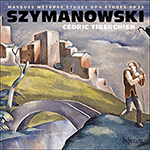 Szymanowski: Masques, Métopes & Études Szymanowski: Masques, Métopes & ÉtudesStudio Master: CDA67886Studio Master FLAC & ALAC downloads available  Cédric Tiberghien embraces the sensual, crepuscular sound-world of Szymanowski’s most celebrated piano works, Masques, Métopes and the complete Études, his expressive, quicksilver playing making him an ideal performer of this repertoire.» More |