Welcome to Hyperion Records, a British classical label devoted to presenting high-quality recordings of music of all styles and from all periods from the twelfth century to the twenty-first.
Hyperion offers both CDs, and downloads in a number of formats. The site is also available in several languages.
Please use the dropdown buttons to set your preferred options, or use the checkbox to accept the defaults.

However, the set of Three Fantastic Dances (which is dedicated to a fellow student, Joseph Schwarz) received its first performance in Moscow on 20 March 1925 at an all-Shostakovich recital (which also included the first performances of the Suite for Two Pianos opus 6, the First Piano Trio Opus 8 and the Three Pieces for cello and piano opus 9).
The opening March is reasonably firmly anchored to C major, and via the leading-note (B) tends to gravitate towards the flat supertonic, producing piquant cadences. G major, the key of the central Waltz, is initially approached obliquely, and this curiously haunting little fragment is the first of many highly un-Viennese waltzes Shostakovich wrote throughout his career. The final Polka is another ‘first’, as this also later became a much-favoured dance form for the composer. But already, this is the fully formed musical character of Shostakovich, one of the most distinctive voices in twentieth-century music.
from notes by Robert Matthew-Walker © 1992
Toutefois la série des Trois Danses Fantastiques (qui est dédiée à un camarade de conservatoire, Joseph Schwarz) fut jouée pour la première fois à Moscou le 20 mars 1925 à l’occasion d’un récital exclusivement Chostakovitch (qui comprenait aussi la première exécution en public de la Suite pour Deux Pianos opus 6, du Premier Trio pour Piano opus 8 et des Trois Morceaux pour violoncelle et piano opus 9).
La marche d’ouverture est raisonnablement bien ancrée en ut majeur et tend à se diriger vers le supertonique en bémol par la note sensible (si) pour produire des cadences piquantes. Le sol majeur, la tonalité de la valse centrale, est abordé au départ d’une manière oblique et ce petit fragment curieusement obsédant est la première des nombreuses valses non viennoises que Chostakovitch écrivit tout au long de sa carrière. La polka finale est une autre «première» car elle devait aussi devenir plus tard une autre forme de danse favorite du compositeur. Mais la personnalité musicale complètement formée de Chostakovitch, l’un des compositeurs les plus remarquables de la musique du vingtième siècle, y est déjà présente.
extrait des notes rédigées par Robert Matthew-Walker © 1992
Français: Martine Erussard
Die Erstaufführung der Serie „Drei Fantasietänze“ (der einem Mitstudenten, Joseph Schwarz, gewidmet ist) fand jedoch in Moskau am 20. März 1925 statt, bei einem nur aus Werken von Schostakowitsch bestehenden Konzert (darunter befanden sich auch die Erstaufführungen der Suite für zwei Klaviere Opus 16, das erste Klaviertrio Opus 8 und die drei Stücke für Cello und Klavier Opus 9).
Der Eröffnungsmarsch ist recht beständig in C-Dur verankert und strebt über den Leitton (B) nach der erniedrigten zweiten Stufe, wobei pikante Kadenzen entstehen. G-Dur, die Tonart des mittleren Walzers, wird anfänglich indirekt angegangen, und dieses kurios sehnsüchtige kleine Fragment ist der erste von vielen äußerst unwienerischen Walzern, die Schostakowitsch immer wieder im Laufe seines Schaffens schrieb. Die Schlußpolka ist wiederum ein „Erstling“, denn später wurde die Polka unter allen Tänzen eine bevorzugte Form des Komponisten. Doch schon hier tritt Schostakowitschs völlig geformter musikalischer Stil hervor, eine der charakteristischsten Stimmen der Musik des zwanzigsten Jahrhunderts.
aus dem Begleittext von Robert Matthew-Walker © 1992
Deutsch: Isolde Hedegaard
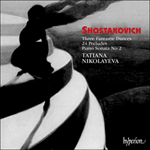 Shostakovich: Three Fantastic Dances, 24 Preludes & Piano Sonata No 2 Shostakovich: Three Fantastic Dances, 24 Preludes & Piano Sonata No 2CDA66620Download only  ‘The affectionate warmth, humour and vitality of her playing, the stunning virtuosity … make this CD a winner’ (CDReview) ‘Never less than magnificent’ (San Francisco Examiner)» More |
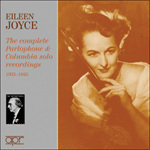 Eileen Joyce - The complete Parlophone & Columbia solo recordings Eileen Joyce - The complete Parlophone & Columbia solo recordingsAPR75025CDs Download only  ‘Listening to Joyce is strangely addictive. One cannot wait, as it were, to read the next chapter. She shares with Kreisler and Tauber the same unteac ... ‘The quality that comes across in these performances is the sheer joy of playing. Joyce possessed a formidable technique and an interpretative mind th ...» More |
