
Welcome to Hyperion Records, a British classical label devoted to presenting high-quality recordings of music of all styles and from all periods from the twelfth century to the twenty-first.
Hyperion offers both CDs, and downloads in a number of formats. The site is also available in several languages.
Please use the dropdown buttons to set your preferred options, or use the checkbox to accept the defaults.

The sombre, spacious first movement is the most searching sonata-structure Brahms had yet written. The outer spans of exposition and development, with their almost reckless expansion and length of themes, are held in balance by the ruthless concentration on the one-bar motif that is the foundation of the very first theme, continually raising the level of tension, in the development. The way the recapitulation reshuffles the principal elements is unparalleled in a major sonata-style work, even introducing a completely new idea. The coda, beginning hopefully with sweet tranquillo-writing for strings alone, blazes up in a passion only to gutter out quietly in implied frustration.
Brahms calls the C minor second movement an Intermezzo: one of the first examples of the species of (sometimes deceptively) gentle scherzo he was to make his own. A delicate, moderate-paced, rather subdued interlude full of expressive half-lights, its poignant understatement throws the larger movements into relief. It refers, obliquely, to his love for Clara Schumann: the main theme is a haunting version of Robert Schumann’s ‘Clara-motif’ (a characteristic five-note falling–rising melodic shape), which Brahms took over in several works for his private symbolism.
The E flat slow movement begins as a full-hearted song, but develops into a strutting, almost military march in C major. This colourful parade somehow resolves the expressive tensions that have shadowed the work up to this point, making possible the sheer animal vitality of the concluding Rondo alla Zingarese. Startlingly extending a tradition of ‘gypsy’ finales that goes back to Haydn, this is the most unbuttoned episode in Brahms’s long love-affair with the popular and exotic Hungarian idioms he had imbibed from his violinist friends Reményi and Joachim. The movement’s devil-may-care abandon, with its extremes of pulse, virtuosity and emotional affliction, suggest his tongue was at least half in his cheek; and the extravagant piano cadenza that forestalls the whirlwind coda seems to parody Liszt himself.
from notes by Calum MacDonald © 2006
Jamais encore Brahms n’avait écrit une structure de sonate plus pénétrante que ce premier mouvement sombre, spacieux. Les volets extrêmes de l’exposition et du développement, avec leur expansion et leur longueur de thèmes presque irréfléchies, sont tenus en équilibre par le développement qui, implacablement concentré sur le motif d’une mesure fondateur du tout premier thème, hausse constamment le niveau de tension. Mais la façon dont la réexposition remanie les éléments principaux est sans équivalent dans une œuvre de style sonate—elle va même jusqu’à introduire une idée complètement nouvelle. La coda, s’ouvrant avec optimisme sur une douce écriture tranquillo pour cordes seules, brûle de passion pour mieux s’éteindre paisiblement dans une frustration implicite.
Brahms qualifie le deuxième mouvement en ut mineur d’Intermezzo—l’un des premiers exemples de scherzo doux (une douceur parfois trompeuse), un genre qu’il allait faire sien. Interlude délicat que celui-ci, au tempo modéré, assez sobre et gorgé de clairs-obscurs expressifs, dont le poignant caractère contenu met en relief les mouvements plus imposants. Il renvoie indirectement à l’amour de Brahms pour Clara Schumann: le thème principal est une version lancinante du «motif de Clara» de Robert Schumann (un caractéristique modèle mélodique ascendant– descendant de cinq notes), que le compositeur reprit comme symbole personnel dans plusieurs de ses œuvres.
Le mouvement lent en mi bémol commence comme un lied effusif, mais se mue en une marche presque militaire, fanfaronne, en ut majeur. Cette parade colorée résout un peu les tensions expressives qui ont assombri l’œuvre jusqu’alors, rendant possible l’absolue vitalité animale du Rondo alla Zingarese conclusif. Prolongeant étonnamment une tradition de finales «tziganes» instaurée par Haydn, c’est l’épisode le plus déboutonné de la longue histoire d’amour qui lia Brahms à ces idiomes hongrois, populaires et exotiques, assimilés auprès de ses amis violonistes Reményi et Joachim. La désinvolture insouciante de ce mouvement, avec son rythme, sa virtuosité et son affliction émotionnelle extrêmes, est à demi ironique; et l’extravagante cadenza pianistique qui anticipe la coda tourbillonnante semble parodier Liszt en personne.
extrait des notes rédigées par Calum MacDonald © 2006
Français: Hypérion
Der düstere, großräumige erste Satz repräsentiert die am stärksten erweiterte Sonatenstruktur, die Brahms bis dahin komponiert hatte. Die äußeren Ausmaße der Exposition und Durchführung, in denen man auf eine fast leichtsinnige Ausdehnung und Länge der Themen stößt, werden durch die unbarmherzige Konzentration auf das dem allerersten Thema zugrunde liegende eintaktige Motiv in der Durchführung im Gleichgewicht gehalten. Dabei steigt ständig der Spannungspegel. Die Art, mit der die Reprise die Hauptelemente vermischt und sogar völlig neue Gedanken einführt, findet in keinem anderen gewichtigen sonatenförmigen Werk eine Entsprechung. Die hoffnungsvoll und ausschließlich mit süßen, tranquillo spielenden Streichern beginnende Coda entbrennt leidenschaftlich, nur um dann Enttäuschung andeutend aufzugeben.
Brahms nannte den zweiten Satz in c-Moll ein Intermezzo. Es stellt einen der ersten Versuche des Komponisten in dieser Form eines (manchmal täuschend) sanften Scherzos dar, das so charakteristisch für Brahms werden sollte. Der Satz ist ein delikates, mäßig fortschreitendes, eher zurückhaltendes Zwischenspiel voller ausdrucksstarker Unbestimmtheiten. Die beredte Zurückhaltung lässt die gewichtigeren Sätze deutlicher hervortreten. Unauffällig verweist der Satz auf Brahms’ Liebe zu Clara Schumann: Das Hauptthema ist eine beklemmende Version von Robert Schumanns „Clara-Motiv“ (eine prägnante auf- und absteigende melodische Gestalt aus 5 Noten), die Brahms in diversen Werken für seinen eigenen Symbolismus übernahm.
Der langsame Satz in Es-Dur beginnt wie ein selbstsicheres Lied, entwickelt sich dann aber zu einem stolzierenden, fast militanten Marsch in C-Dur. Diese farbenfrohe Parade löst irgendwie die expressiven Spannungen auf, die das Werk bis dahin überschattet hatten, und liefert damit die Voraussetzung für die schier animalische Lebhaftigkeit des abschließenden Rondo alla Zingarese. Dieser Schlusssatz erweitert Aufsehen erregend die bis auf Haydn zurückgehende Tradition der „Zigeunerfinale“ und erweist sich somit als die ungenierteste Episode in Brahms’ langer Liebesaffäre mit dem beliebten und exotischen ungarischen Idiomen, die der Komponist durch seine Violine spielenden Freund Reményi und Joachim kennen gelernt hatte. Die sich einen Teufel scherende Wildheit des Satzes mit ihren Extremen hinsichtlich Puls, Virtuosität und emotionaler Beteiligung weckt den Verdacht, Brahms habe es hier zumindest teilweise nicht ganz ernst gemeint. Die extravagante Klavierkadenz, die der stürmischen Coda zuvorkommt, scheint den großen Meister Liszt zu parodieren.
aus dem Begleittext von Calum MacDonald © 2006
Deutsch: Elke Hockings
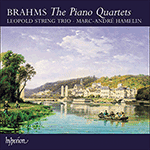 Brahms: Piano Quartets Brahms: Piano QuartetsCDA67471/22CDs  Here we have electrifying performances of the three Brahms piano quartets as the celebrated Leopold String Trio is joined by Marc-André Hamelin: ‘I doubt we will ever hear better recorded performances of the three piano quartets than we have here ...» More |
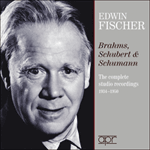 Edwin Fischer - The complete Brahms, Schubert & Schumann studio recordings, 1934-1950 Edwin Fischer - The complete Brahms, Schubert & Schumann studio recordings, 1934-1950APR73143CDs Download only  |