
Welcome to Hyperion Records, a British classical label devoted to presenting high-quality recordings of music of all styles and from all periods from the twelfth century to the twenty-first.
Hyperion offers both CDs, and downloads in a number of formats. The site is also available in several languages.
Please use the dropdown buttons to set your preferred options, or use the checkbox to accept the defaults.


| Emmanuel Despax (piano), Chineke! Chamber Ensemble» More |
| Garrick Ohlsson (piano), Warsaw Philharmonic Orchestra, Kazimierz Kord (conductor)» More |
| Benjamin Grosvenor (piano), Royal Scottish National Orchestra, Elim Chan (conductor)» More |
| Nikolai Demidenko (piano), Philharmonia Orchestra, Heinrich Schiff (conductor)» More |
Op 11 has a lengthy orchestral exposition (twice as long as that of Op 21) marked Allegro maestoso. The touching second subject is archetypal Chopin and its first appearance a moment of exquisite beauty. The second movement, labelled Romanza, consists of a yearning nocturne-like theme in E major contrasted with a second subject in B major. He was still working on the Concerto when he wrote a letter dated 15 May 1830 in which he described his thoughts about this movement. It is one of the rare occasions that he made any allusion to the programme behind the music: ‘It is not meant to be loud, it’s more of a romance, quiet, melancholy; it should give the impression of gazing tenderly at a place which brings to mind a thousand dear memories. It is a sort of meditation in beautiful spring weather, but by moonlight. That is why I have muted the accompaniment.’ The final movement (Vivace) is a lively rondo with some resemblance to the krakowiak, a popular Polish folk dance. Despite the Concerto’s key signature, it is, like the Romanza, written in the key of E major. Chopin was the soloist in the first performance, heard privately on 22 September 1830, and again in the work’s public premiere in Warsaw Town Hall on 11 October. It was the last concert he gave before leaving Poland for good.
from notes by Jeremy Nicholas © 2008
L’op. 11 a une très longue exposition orchestrale (deux fois plus longue que celle de l’op. 21) marquée Allegro maestoso. L’apparition du touchant second sujet, archétypique de Chopin, est un moment d’exquise beauté. Le deuxième mouvement, étiqueté Romanza, est un languide thème en mi majeur façon nocturne auquel s’oppose un second sujet en si majeur. Le 15 mai 1830, Chopin travaillait encore à ce Concerto lorsqu’il précisa dans une lettre ce qu’il pensait de ce mouvement—c’est l’une des rares fois où il fait allusion à un programme caché derrière sa musique: «Il n’est pas fait pour être fort; c’est plus une romance, paisible, mélancolique; il faudrait qu’il donne l’impression de contempler tendrement un lieu rappelant mille souvenirs chers. C’est une espèce de méditation par un splendide temps de printemps, mais au clair de lune. Voilà pourquoi j’ai étouffé l’accompagnement.» Le mouvement final (Vivace) est un rondo enjoué ressemblant un peu à la populaire danse folklorique polonaise appelée krakowiak. Malgré le signe de la mesure du Concerto, il est, comme la Romanza, écrit en mi majeur. Chopin tint le piano lors de la création de cette œuvre donnée d’abord en privé le 22 septembre 1830, puis en public, à l’Hôtel de ville de Varsovie, le 11 octobre. Ce fut son dernier concert en Pologne.
extrait des notes rédigées par Jeremy Nicholas © 2008
Français: Hypérion
Op. 11 beginnt mit einer etwas langatmigen Orchestereinleitung (doppelt so lang wie bei op. 21) mit der Satzbezeichnung Allegro maestoso. Das anrührende zweite Thema ist echter Chopin und sein erstes Erscheinen ein Moment von auserlesener Schönheit. Der zweite Satz mit der Überschrift Romanza besteht aus einem sehnsuchtsvollen, nocturneartigen Thema in E-Dur, das in Kontrast zu einem zweiten Thema in H-Dur steht. Er arbeitete noch am Konzert, als er einen Brief mit dem Datum vom 15. Mai 1830 schrieb, in dem er seine Gedanken zu diesem Satz darlegte. Es ist einer der seltenen Momente, in denen er eine Andeutung zum Programm hinter der Musik machte: „Er sollte nicht zu laut sein; es ist mehr wie eine Romanze, ruhig und melancholisch. Es sollte der Eindruck entstehen, dass man zärtlich auf eine Stelle schaut, die tausend liebe Erinnerungen ins Gedächtnis ruft. Es ist eine Art Meditation bei wundervollem Frühlingswetter, und zwar bei Mondlicht. Das ist auch der Grund, warum ich die Begleitung leise gehalten habe.“ Der letzte Satz (Vivace) ist ein munteres Rondo mit Ähnlichkeit zu einem Krakowiak, einem volkstümlichen polnischen Tanz. Trotz der Tonartbezeichnung des Konzertes in e-Moll, steht er, wie auch die Romanza, in E-Dur. Chopin spielte sowohl bei der Uraufführung am 22. September 1830 im privaten Rahmen als auch bei der öffentlichen Premiere in der Stadthalle in Warschau am 11. Oktober den Solopart. Es sollte das letzte Konzert sein, das er gab, bevor er Polen für immer verließ.
aus dem Begleittext von Jeremy Nicholas © 2008
Deutsch: Ludwig Madlener
 The Hyperion Romantic Piano Concerto Edition - 1991-2007 The Hyperion Romantic Piano Concerto Edition - 1991-2007CDS44701/5050CDs Boxed set (at a special price) Available Friday 10 April 2026  The first of two box sets celebrating one of the most ambitious, and successful, series in the history of classical recording. This volume features 130 works from 59 composers, performed by 19 different pianists, and all luxuriously presented with ...» More |
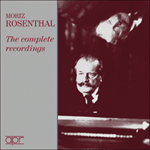 Moriz Rosenthal - The complete recordings Moriz Rosenthal - The complete recordingsAPR75035CDs Download only  ‘Rosenthal had an inimitably seductive manner of playing … with Ward Marston’s superb restoration and remastering, APR’s exemplary annotation and ... ‘The artistry of Moriz Rosenthal (1862-1946) arguably stands head and shoulders above all recorded Liszt pupils’ (Classics Today)» More |
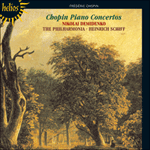 Chopin: Piano Concertos Chopin: Piano ConcertosCDH55180Download only ‘In a class of their own. This is great Chopin playing’ (CDReview) 'Demidenko nos propone los dos conciertos … en unas versiones de exquisito lirismo, de ideal trazo orquestal' (CD Compact, Spain)» More |
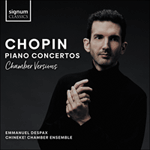 Chopin: Piano Concertos Chopin: Piano ConcertosStudio Master: SIGCD700Download onlyStudio Master FLAC & ALAC downloads available  Chopin's two piano concertos may have divided opinion at the time of their writing—a case, perhaps, of 'too much, too early'—but they played no small part in defining the genre for the future. Yet for many early listeners, their exposure to them w ...» More |
 Chopin: Piano Concertos Chopin: Piano ConcertosStudio Master: 4850365Download onlyStudio Master FLAC & ALAC downloads available  Benjamin Grosvenor performs the two Chopin piano concertos with the Royal Scottish National Orchestra and conductor Elim Chan. These are works which played a central role in defining the piano concerto genre for the future, and it's clear from thi ...» More |
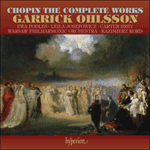 Chopin: The Complete Works Chopin: The Complete WorksCDS44351/6616CDs Boxed set (at a special price) — Download only Since his triumph as winner of the 1970 Chopin International Piano Competition, Garrick Ohlsson has established himself worldwide as a musician of magisterial interpretive and technical prowess. This monumental recording project—first instigated by t ...» More |