
Welcome to Hyperion Records, a British classical label devoted to presenting high-quality recordings of music of all styles and from all periods from the twelfth century to the twenty-first.
Hyperion offers both CDs, and downloads in a number of formats. The site is also available in several languages.
Please use the dropdown buttons to set your preferred options, or use the checkbox to accept the defaults.

| Davitt Moroney (organ)» More |
Surprisingly, the first statement of the melody is preceded by four bars of introduction, at a lower octave. Then the 12-bar melody itself is heard, an octave higher, followed by eight further variations which alternate 2-part, 3-part and sometimes 4-part imitative passages. In the closing variation, the chordal texture reaches six parts and a satisfying descant is placed above the melody, following the procedure usually found at the end of Byrd’s sets of variations. It is easy to see why this constantly inventive and playful piece was popular in the sixteenth century. It must also have been frequently used as a teaching piece since six of the seven known sources have fingerings. I here play the work entirely at 4’ pitch, an octave higher than usual, a reference to the whistling carman (or carter) of the title; on sixteenth- and seventeenth-century organs and harpsichords the 4’ stop was intended to be occasionally used on its own.
from notes by Davitt Moroney © 1999
Le premier énoncé de la mélodie est précédé, inhabituellement, de quatre mesures d’introduction. Vient ensuite la mélodie principale elle-même, une phrase de douze mesures, une octave plus haut, suivie de huit variations qui alternent l’écriture à deux, trois et parfois quatre voix. Dans la dernière variation, la texture en accords est enrichie jusqu’à six voix, et un déchant est placé au-dessus de la mélodie, comme le fait Byrd presque toujours à la fin de ses variations. Il est aisé de comprendre pourquoi cette pièce, si inventive et d’humeur joyeuse, a été populaire au XVIe siècle. Elle a dû être souvent utilisée comme pièce pédagogique car six des sept sources donnent des doigtés. Je la joue ici entièrement à l’octave supérieure, au “quatre pieds”, une référence au “charretier sifflotant” du titre. Au XVIe et XVIIe siècles, les jeux de quatre pieds sur les orgues et les clavecins étaient conçus pour pouvoir être joués seuls, à l’occasion.
extrait des notes rédigées par Davitt Moroney © 1999
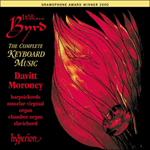 Byrd: The Complete Keyboard Music Byrd: The Complete Keyboard MusicCDS44461/77CDs Boxed set (at a special price) — Download only  An authentic complete survey of this music. This unique recording won the Gramophone’s Early Music Award in 2000.» More |