
Welcome to Hyperion Records, a British classical label devoted to presenting high-quality recordings of music of all styles and from all periods from the twelfth century to the twenty-first.
Hyperion offers both CDs, and downloads in a number of formats. The site is also available in several languages.
Please use the dropdown buttons to set your preferred options, or use the checkbox to accept the defaults.


from notes by Jessica Duchen © 2023
extrait des notes rédigées par Jessica Duchen © 2023
Français: Marie-Stella Pâris
aus dem Begleittext von Jessica Duchen © 2023
Deutsch: Friedrich Sprondel
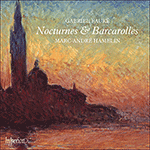 Fauré: Nocturnes & Barcarolles Fauré: Nocturnes & BarcarollesStudio Master: CDA68331/22CDsStudio Master FLAC & ALAC downloads available  The Nocturnes and Barcarolles demonstrate Fauré’s art at its most personal, progressing from early lyricism to the elusive, rarefied style of the later works. Marc-André Hamelin’s performances are predictably fine, and combine exceptional subtlety ...» More |