
Welcome to Hyperion Records, a British classical label devoted to presenting high-quality recordings of music of all styles and from all periods from the twelfth century to the twenty-first.
Hyperion offers both CDs, and downloads in a number of formats. The site is also available in several languages.
Please use the dropdown buttons to set your preferred options, or use the checkbox to accept the defaults.

The singer wakes, by God’s goodness, to see another day, his first slow actions pictured in gently-moving harmony. His hymn is offered up through the scale, and the key brightens as he offers his ‘best morning sacrifice’, but humility quickly returns with ‘may it be gracious’, harmonically uncertain in its first statement, melodically unsure on its second in only reaching the seventh note of the scale. The ‘bed of sin’ is suitably gravelly, contrasted by the heights of ‘And do I live to see another day’ and the glorious melisma of ‘And sing thy praise’. But after brief optimism, regret quickly returns as the poet remembers ‘the time I have mis-spent in sinful merriment’ (Fuller writes ‘in senseless scenes of merriment’), and the pitch rises as he sings that if he could, he would undo the offences of the past. The innocent are pictured at the lowest end of the voice, the author’s crimes richly harmonised. ‘With joy I’d sing away my breath’ is set to a short burst of lilting arioso, but the breath is, quite literally, stopped to usher in the final desolate question.
from notes by Robert King ©
Grâce à la bonté divine, le chanteur s'éveille pour voir un autre jour, ses premières actions dépeintes par une harmonie aux doux mouvements. L'offrande de son hymne s'élève le long de la gamme, et le ton s'éclaircit quand il offre 'his best moming sacrifice' (meilleure offrande matinale), mais l'humilité revient vite avec 'may it be gracious' (que ta miséricorde), dont l'harmonie est incertaine dans sa première exposition, et dont la mélodie manque d'assurance dans sa seconde, en n'atteignant que la septième note de la gamme. "The bed of sin' (couche d'iniquité) a la gravité nécessaire, contrastée par les sommets de 'And do I live to see another day' (Et vivrai-je pour voir un autre jour) et le magnifique mélisme de 'And sing thy praise' (Et chanter tes louanges). Cependant, après un bref optimisme, le regret revient rapidement quand le poète se rappelle 'the time have mis-spent in sinful merriment' (le temps gaspillé en coupable gaîté) (Fuller écrit 'in senseless scènes of merriment' - en moments insensés de gaîté), et le ton s'élève quand il chante que s'il pouvait, il réparerait les péchés du passé. Le registre le plus bas de la voix dépeint les innocents, et les crimes de l'auteur sont richement harmonisés. 'With joy l'd sing away my breath' (Je mourrais en chantant de joie) est mis en musique sur un bref jaillissement d'arioso rythmé, mais le souffle est, littéralement, coupé pour introduire la sombre question finale.
extrait des notes rédigées par Robert King © 1993
Français: Alain Midoux
Der Sänger erwacht durch Gottes Güte, um einen neuen Tag zu erleben, und seine ersten bedächtigen Handlungen werden durch sacht fließende Harmonien geschildert. Seine Hymne durchläuft die Tonleiter, und der Grundton hellt sich auf, wenn er sie als 'best moming sacrifice' [morgendliche Huldigung] bezeichnet. Gleich darauf setzt bei 'may it be gracious' [möge sie Gnade finden] wieder Demut ein, harmonisch unsicher die erste Darbietung, melodisch insofern unsicher die zweite, als sie es nur bis zur siebten Note der Tonleiter schafft. Das Bett der Sünde ['bed of sin'] ist gebührend rauh und wird abgesetzt von der Erhabenheit von 'And do I live to see another day' [ist mir ein weitrer Tag beschieden] und dem herrlichen Melisma von 'And sing thy praise' [und preise dich mit Gesang], Doch nach kurzem Optimismus stellt sich gleich wieder Reue ein, wenn sich der Dichter an die Zeit erinnert, die er mit sündiger Belustigung ['in sinful merriment'] vergeudet hat (bei Füller heißt es 'in senseless scenes of merriment' [mit sinnlos ungestümer Belustigung]), und die Tonhöhe steigert sich, wenn er davon singt, daß er die Vergehen der Vergangenheit ungeschehen machen würde, wenn er nur könnte. Die Darstellung der Unschuldigen erfolgt am untersten Rand des Stimmumfangs, und die Missetaten des Verfassers werden üppig harmonisiert. 'With joy I'd sing away my breath' [mit Freuden sänge ich, bis mir der Atem stockt] ist als kurzes, heftiges, melodisches Arioso vertont, dem jedoch buchstäblich die Luft genommen wird, um die abschließende untröstliche Frage nach dem Tode einzuführen.
aus dem Begleittext von Robert King © 1993
Deutsch: Anne Steeb/Bernd Müller
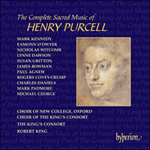 Purcell: The Complete Sacred Music Purcell: The Complete Sacred MusicCDS44141/5111CDs Boxed set (at a special price) — SOLD OUT!  ‘It is hard to speak too highly of this enterprise … much enjoyment to be had’ (Gramophone) ‘The performances from The King’s Consort and its Choir, the Choir of New College and a starry line-up of soloists have such qualities of concentratio ...» More |