
Welcome to Hyperion Records, a British classical label devoted to presenting high-quality recordings of music of all styles and from all periods from the twelfth century to the twenty-first.
Hyperion offers both CDs, and downloads in a number of formats. The site is also available in several languages.
Please use the dropdown buttons to set your preferred options, or use the checkbox to accept the defaults.

| Westminster Cathedral Choir, James O'Donnell (conductor)» More |
| Tenebrae, Nigel Short (conductor)» More |
| Armonico Consort, Christopher Monks (conductor)» More |
| Contrapunctus, Owen Rees (conductor)» More |
| The Bevan Family Consort, Graham Ross (conductor)» More |
| King's College Choir Cambridge, Sir Stephen Cleobury (conductor), Dónal McCann (organ)» More |
Lotti also composed twenty-eight stage works. He was granted leave in 1717 to go to Dresden to write an opera, completing three in a period of two years. When he returned after his final trip to that city in 1719, he kept the carriage and horses given to him for his return trip to remind him of his success. After this he remained in Venice. As composer he was clearly able to adapt to the stylistic demands placed upon him. He wrote in the Baroque idiom of the late seventeenth century, adjusting his style to the new, leaner harmony of the approaching Classical era. Above all, his love and mastery of contrapuntal and imitative writing dominates in his later years, and the composer became very highly regarded. Burney was moved to tears on hearing his music at St Mark’s in 1770, and reported that ‘Hasse regarded Lotti’s compositions as the most perfect of their kind’. That ‘kind’ is perhaps best regarded as a stile antico in which the composer imitated the style of a bygone age.
Lotti wrote many versions of the Crucifixus, for 4-, 5-, 6-, 7-, 8-, 9- and 10-part choirs. This version is written in 8 parts; the basses begin and the music unfolds organically towards an impressive cadence. The pungency of the music is obtained through the suspension, dissonance and resolution of the long slow lines. This gives way to quaver movement before moving back to the slow sustained harmonies of the opening.
from notes by William McVicker © 1997
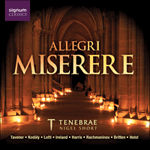 Allegri: Miserere Allegri: MiserereStudio Master: SIGCD085Download onlyStudio Master FLAC & ALAC downloads available  Allegri's haunting Miserere is the central point in a journey through music of longing and entreaty, hope and faith. These works spanning the centuries are chosen from the heart of Tenebrae's concert repertoire. The present album contains works by ...» More |
 Attende Domine Attende DomineStudio Master: SIGCD892Download onlyStudio Master FLAC & ALAC downloads available “Recording an album with the family is always moving, but this one was especially so because of the theme of the music. Like previous albums, this one contains well-worn family favourites beside newly discovered or unrecorded rarities, thanks to o ...» More |
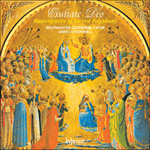 Exultate Deo Exultate DeoCDA66850Download only  ‘The answer to many prayers; a blockbusting survey of choral masterpieces performed by a choir of exceptional calibre’ (Classic FM Magazine) ‘For anyone eager to sample varied music from the Golden Age of polyphony this is a perfect disc’ (Classic CD)» More |
 Harmonies of Devotion Harmonies of DevotionStudio Master: SIGCD914Download onlyStudio Master FLAC & ALAC downloads available Fourteen tracks of high loveliness, and a fascinating collection which makes time for some classic favourites amid a programme of largely forgotten delights (a five-part 'Lotti Crucifixus', anyone?).» More |
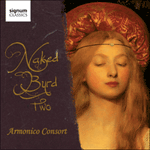 Naked Byrd, Vol. 2 Naked Byrd, Vol. 2SIGCD235Download only Tavener, Purcell, Barber and Byrd, were 3 composers who wore their hearts on their sleeves, and whose art saw their emotions laid bare, in an atmospheric concert with the Armonico Consort, where magical musical moments are intertwined with sublime ...» More |
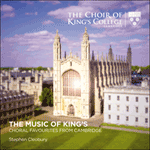 The music of King's The music of King'sStudio Master: KGS0034-DDownload onlyStudio Master FLAC & ALAC downloads available  This new recording presents nineteen opulently recorded treasures from the immense repertoire of this most august of choirs, everything from Baroque and Renaissance masterpieces to fresh arrangements of American and Chinese folk songs.» More |