
Welcome to Hyperion Records, a British classical label devoted to presenting high-quality recordings of music of all styles and from all periods from the twelfth century to the twenty-first.
Hyperion offers both CDs, and downloads in a number of formats. The site is also available in several languages.
Please use the dropdown buttons to set your preferred options, or use the checkbox to accept the defaults.

The work begins with a slow introduction foreshadowing the main theme of the Allegro. Its sense of groping towards the light surely reflects Schumann’s study of the string quartets of Beethoven; and as Beethoven so often does in his late quartets, Schumann brings back the introduction at its original slow tempo at strategic points during the later course of the movement—notably at the end of the exposition and immediately before the coda. These moments of reflection punctuate what is one of Schumann’s most exhilarating pieces—one whose pulsating rhythm scarcely lets up for an instant.
The fleeting Scherzo is scored with Mendelssohnian lightness. Its delicately ‘tripping’ subject recurs intermittently in both trio sections—the first of them based on a smoothly moving phrase which clearly arises out of the same impulse as the Scherzo’s subject; the second, a thoroughly Schumannesque series of sustained, syncopated chords in contrasting registers. At the end, the music disappears in a puff of smoke, with the aid of the first trio’s initial phrase.
If the slow movement is perhaps less impressive than its counterpart in the Op 44 Quintet (its main melody, with its sequential ‘drooping’ phrases, can sound uncharacteristically mawkish), it is more than redeemed by the broad theme of its fine middle section, as well as by the striking originality of its coda. For the latter passage the cellist is instructed to tune his lowest string down a whole-tone, to B flat, on which note he provides a long drone which lends an air of hushed mystery to the closing bars of the movement. Above this note, the remaining players pre-echo, as if in slow motion and from afar, the opening motif of the finale. This was the first but by no means the only occasion on which Schumann carried out a procedure of this kind. At the end of the slow movement of the ‘Spring’ Symphony (No 1) the trombones solemnly anticipate the theme of the following Scherzo; while the Scherzo of the late Violin Sonata in D minor Op 121 culminates in a triumphant chorale whose theme is immediately taken up at the start of the delicate intermezzo-like third movement. These moments have little to do with so-called ‘cyclic’ form; rather, they represent a deliberate attempt on Schumann’s part to dissolve the boundaries between successive movements.
It is likely that Schumann borrowed this idea of anticipation from the famous link between the slow movement and finale of Beethoven’s ‘Emperor’ Concerto, where the soloist plays a halting version of the rondo’s theme above a long-held note on the horns. The Intermezzo and finale of Schumann’s own Piano Concerto are similarly linked, except that—perhaps in order to avoid too close a parallel with the Beethoven—Schumann constructs his join out of a reminiscence of the opening movement’s theme rather than a premonition of the concluding rondo. Schumann’s procedure, especially as exemplified in the ‘Spring’ Symphony, seems to have left a deep impression on Mahler, who retained a lifelong fondness for momentarily opening a window onto a forthcoming movement.
Schumann’s finale is largely based on a running contrapuntal ‘tag’ of the kind Beethoven had used for the colossal fugue of his ‘Hammerklavier’ Sonata. The motif is preceded by three skipping chords—an extrovert reminiscence, perhaps, of the Scherzo’s second trio; while a second theme features a series of lyrical, syncopated phrases on the piano, very similar in shape to one of the variations from the slow movement. Such ‘hidden’ elements of unification may not have been consciously intended on the composer’s part. They were, rather, his reward for concentrated inspiration: by the time he completed this work, on 26 November 1842, he had produced no fewer than five large-scale chamber works in the space of six months. In the circumstances it is hardly surprising that as the year drew towards its close, Schumann was suffering from what he described as ‘nervous weakness’. He continued to compose, but clearly he found it an effort. ‘Worked on the Trio—too much—feeling unwell in the evening’, reads a diary entry for 16 December. The trio in question was a much less ambitious project than his preceding works, and Schumann managed to finish it before the year was out. All the same, he appears not to have been satisfied with it, and he almost certainly took the opportunity to make revisions prior to its publication in 1850. Its modest scope led him to issue it under the title of ‘Fantasy Pieces’.
from notes by Misha Donat © 2000
Le Quatuor s’ouvre sur une lente introduction préfigurant le thème principal de l’allegro. Son tâtonnement vers la lumière reflète assurément l’étude des quatuors à cordes beethovéniens; et, comme Beethoven le fait si souvent dans ses derniers quatuors, Schumann ramène l’introduction à son tempo lent originel lors de moments stratégiques du mouvement—notamment à la fin de l’exposition et juste avant la coda. Ces instants de réflexion ponctuent ce qui constitue l’une des pièces les plus exaltantes de Schumann, une pièce dont le rythme lancinant ne faiblit guère.
Le fugace Scherzo, écrit avec une légèreté mendelssohnienne, voit son sujet, délicatement leste, revenir par intermittences dans les deux sections en trio—la première fondée sur une phrase se mouvant en douceur et résultant à l’évidence de la même impulsion que le sujet du Scherzo; la seconde, une série profondément schumannesque d’accords tenus, syncopés, dans des registres contrastés. À la fin, la musique s’évanouit dans un nuage de fumée, avec l’aide de la phrase initiale du premier trio.
Si le mouvement lent est peut-être moins impressionnant que celui du Quintette, op.44 (sa mélodie principale, avec ses phrases séquentielles qui «s’abaissent», peut sembler d’une mièvrerie atypique), il est plus que racheté et par l’ample thème de sa belle section centrale, et par l’originalité saisissante de sa coda. Pour ce dernier passage, le violoncelliste doit baisser l’accord de sa corde la plus grave d’un ton entier, jusqu’à si bémol, note sur laquelle il fournit un long bourdon qui prête un air de profond mystère aux mesures conclusives du mouvement. Par-dessus cette note, les autres instrumentistes font entendre, comme au ralenti et de loin, le motif d’ouverture du finale. Ce fut la première fois, mais en rien la dernière, que Schumann recourut à ce genre de procédé. À la fin du mouvement lent de la Symphonie «Le Printemps» (nº 1), les trombones anticipent ainsi solennellement le thème du Scherzo suivant, tandis que le Scherzo de la tardive Sonate pour violon en ré mineur, op.121 culmine en un triomphant choral dont le thème est immédiatement repris au début du délicat troisième mouvement, de type intermezzo. Ces moments ont peu à voir avec la forme dite «cyclique» et représentent davantage une tentative délibérée du compositeur de dissoudre les frontières entre les mouvements successifs.
Schumann emprunta probablement cette idée d’anticipation au fameux lien entre le mouvement lent et le finale du Concerto «L’Empereur» de Beethoven, où le soliste joue une version heurtée du thème du rondo par-dessus une longue note tenue des cors. L’intermezzo et le finale du Concerto pour piano de Schumann sont reliés à l’identique, si ce n’est que Schumann—peut-être pour éviter un parallèle trop étroit avec le Concerto de Beethoven—construit son lien à partir d’une réminiscence du thème du mouvement d’ouverture, et non d’une prémonition du rondo conclusif. Ce procédé schumannien, particulièrement illustré dans la Symphonie «Le Printemps», semble avoir profondément impressionné Mahler qui, toute sa vie, gardera un penchant pour l’ouverture momentanée d’une fenêtre sur un mouvement à venir.
Le finale de Schumann repose essentiellement sur un «slogan» contrapuntique ininterrompu, semblable à celui employé par Beethoven pour la colossale fugue de sa Sonate «Hammerklavier». Le motif est précédé de trois accords sautillants—une possible réminiscence extravertie du second trio du Scherzo—, cependant qu’un second thème présente une série de phrases pianistiques lyriques syncopées, dont la forme évoque beaucoup l’une des variations du mouvement lent. De tels éléments d’unification «cachés» ne furent peut-être pas consciemment voulus par le compositeur, mais vinrent plutôt récompenser son inspiration concentrée: lorsqu’il acheva cette pièce, le 26 novembre 1842, il avait produit pas moins de cinq œuvres de chambre à grande échelle en l’espace de six mois. Guère surprenant, dès lors, que, lorsque l’année toucha à sa fin, Schumann souffrît de ce qu’il décrivit comme une «faiblesse nerveuse». Il continua de composer, mais ce lui fut manifestement difficile. «Travaillé au Trio—tropê—me suis senti souffrant le soir», lit-on au 16 décembre de son journal. Le trio en question était un projet bien moins ambitieux que les œuvres précédentes et Schumann parvint à l’achever avant la fin de l’année, apparemment sans en avoir été satisfait, puisqu’il est presque certain qu’il profita de sa publication, en 1850, pour le réviser. Son envergure modeste le conduisit à l’intituler «Pièces de fantaisie».
extrait des notes rédigées par Misha Donat © 2000
Français: Hypérion
Das behende Scherzo ist mit Mendelssohnscher Leichtigkeit gesetzt. Sein behutsam „trippelndes“ Thema taucht in Abständen in beiden Triopassagen wieder auf—die erste stützt sich auf eine geschmeidig verlaufende Phrase, eindeutig aus dem gleichen Impuls hervorgegangen wie das Thema des Scherzos, während die zweite eine durch und durch Schumannsche Folge ausgehaltener synkopierter Akkorde in kontrastierender Stimmlage ist. Am Ende geht die Musik mit Hilfe der einleitenden Phrase des ersten Trios gewissermaßen in Rauch auf.
Wenn der langsame Satz vielleicht weniger eindrucksvoll als sein Gegenstück im Quintett Op. 44 ist (seine Hauptmelodie mit den sequenzierend „hängenden“ Phrasen kann uncharakteristisch rührselig klingen), so wird dies durch das breite Thema seines gelungenen Mittelteils und die verblüffende Originalität seiner Coda mehr als nur wettgemacht. Bei der Ausführung der letztgenannten Passage ist das Cello angewiesen, die unterste Saite einen Ganzton tiefer auf B zu stimmen, und auf dieser Note spielt es einen anhaltenden Bordun, der den Schlußtakten des Satzes eine gespannt geheimnisvolle Stimmung verleiht. Über diesem Ton bringen die übrigen Musiker wie im Zeitlupentempo und aus weiter Ferne das Eröffnungsmotiv des Finales dar. Dies war die erste, aber keineswegs die letzte Gelegenheit, bei der Schumann ein solches Verfahren angewandt hat. Am Ende des langsamen Satzes der „Frühlingssinfonie“ (Nr. 1) nehmen die Posaunen feierlich das Thema des anschließenden Scherzos vorweg, und das Scherzo der späten Violinsonate in d-Moll Op. 121 gipfelt in einem triumphierenden Choral, dessen Thema gleich zu Beginn des raffinierten, an ein Intermezzo erinnernden dritten Satzes aufgegriffen wird. Momente wie diese haben mit der sogenannten „zyklischen“ Form wenig zu tun; vielmehr sind sie der bewußte Versuch Schumanns, die Grenzen zwischen aufeinanderfolgenden Sätzen aufzulösen.
Wahrscheinlich hat Schumann die Idee des Vorgreifens dem berühmten Übergang zwischen langsamem Satz und Finale in Beethovens Klavierkonzert Op. 73 in Es-Dur entlehnt, wo der Solist über einen lang ausgehaltenen Ton auf den Hörnern eine stockende Version des Rondothemas spielt. Intermezzo und Finale von Schumanns Klavierkonzert sind ähnlich verknüpft, außer daß Schumann—vielleicht um eine allzu enge Parallele zu Beethovens Konzert zu vermeiden—die Verbindung mittels einer Reminiszenz des Themas aus dem ersten Satz herstellt, statt mit einer Vorahnung des abschließenden Rondos. Schumanns Verfahrensweise, veranschaulicht insbesondere durch die „Frühlingssinfonie“, hat bei Mahler offenbar einen tiefen Eindruck hinterlassen, der sein Leben lang eine Vorliebe dafür hatte, kurz ein Fenster zu einem noch bevorstehenden Satz zu öffnen.
Schumanns Finale beruht im wesentlichen auf einer durchgehenden kontrapunktischen Wendung, wie sie Beethoven für die kolossale Fuge seiner „Hammerklavier“ -Sonate benutzt hatte. Dem Motiv gehen drei springende Akkorde voraus—womöglich eine beschwingte Erinnerung an das zweite Trio im Scherzo; ein zweites Thema zeichnet sich im Klavier durch eine Reihe lyrischer, synkopierter Phrasen aus, deren Form große Ähnlichkeit mit einer der Variationen aus dem langsamen Satz hat. Solche „verborgenen“ vereinheitlichenden Elemente mögen vom Komponisten gar nicht bewußt eingesetzt worden sein. Vielmehr waren sie der Lohn konzentrierter Inspiration: Zum Zeitpunkt der Fertigstellung des Werks am 26. November 1842 hatte er innerhalb von sechs Monaten nicht weniger als fünf großangelegte Kammermusikwerke hervorgebracht. Unter diesen Umständen kann es kaum verwundern, daß Schumann gegen Ende des Jahres unter einer von ihm so genannten „Nervenschwäche“ litt. Er komponierte weiter, doch es kostete ihn sichtliche Anstrengung. Einem Tagebucheintrag vom 16. Dezember zufolge führten die Belastungen der Arbeit am neuen Klaviertrio dazu, daß der Komponist sich unwohl fühlte. Das fragliche Trio war ein viel weniger ehrgeiziges Projekt als das vorausgegangene Werk, und Schumann konnte es vor Jahresende vollenden. Dennoch scheint er nicht damit zufrieden gewesen zu sein und hat mit ziemlicher Sicherheit die Gelegenheit wahrgenommen, es vor der Veröffentlichung im Jahre 1850 noch einmal zu überarbeiten. Sein bescheidener Umfang veranlaßte ihn, es unter dem Titel Fantasiestücke herauszugeben.
aus dem Begleittext von Misha Donat © 2000
Deutsch: Anne Steeb/Bernd Müller
 Schumann, Farrenc & Durosoir: Resonance Schumann, Farrenc & Durosoir: ResonanceStudio Master: SIGCD937Download onlyStudio Master FLAC & ALAC downloads available  Louise Farrenc’s spirited piano quintet of 1851 makes an inspired introduction to Robert Schumann’s piano quartet, among the most refined of his glorious chamber works. The Piattis and Emmanuel Despax conclude their programme with three rarely hea ...» More |
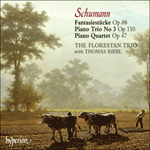 Schumann: Fantasiestücke, Piano Trio & Piano Quartet Schumann: Fantasiestücke, Piano Trio & Piano QuartetStudio Master: CDA67175Download onlyStudio Master FLAC & ALAC downloads available  ‘Revelatory performances from the Florestan. Excellently recorded, this welcome disc should win all three works a new lease of life’ (Gramophone) ‘The Florestan Trio plays all these works with characteristic thoughtfulness and intelligence. It is difficult to find fault with its performances. A ...» More |
 Schubert, Schumann & Hummel: Piano Quintets Schubert, Schumann & Hummel: Piano QuintetsCDD220082CDs Dyad (2 for the price of 1) — SOLD OUT! ‘Wonderfully fresh and minutely sensitive performances, unreservedly recommended’ (Soundscapes, Australia)» More |