
Welcome to Hyperion Records, a British classical label devoted to presenting high-quality recordings of music of all styles and from all periods from the twelfth century to the twenty-first.
Hyperion offers both CDs, and downloads in a number of formats. The site is also available in several languages.
Please use the dropdown buttons to set your preferred options, or use the checkbox to accept the defaults.


| Steven Isserlis (cello), Sir Stephen Hough (piano)» More |
It was written in the first half of 1843 when Mendelssohn’s life was full of demanding projects, some in the process of failing, others just coming into being. He had accepted from King Wilhelm an invitation to direct the Music Division of the new Academy of Arts in Berlin, an institution designed to secure Berlin’s place as Germany’s cultural centre. If it had succeeded as originally planned, Mendelssohn would have become the most powerful musician in the land, as his appointment made him director of the Music Faculty, composer for the Royal Theatre, director of the Royal Orchestra, and conductor and organiser of the Cathedral Choir. In 1841 the Mendelssohns moved to Berlin where Felix began to outline his ideas to the king, only to find himself thwarted by a mass of court beaurocracy and a monarch who, having initiated the idea, was losing interest in its practical realisation. After two frustrating years in Berlin, Mendelssohn persuaded the king to release him from many of his duties, and he moved back to Leipzig to undertake a project dear to his heart for some years – the creation of a Music Conservatory, which opened in the Gewandhaus in April 1843. Mendelssohn himself taught piano, ensemble and composition; Schumann taught piano and composition, and after a while they were joined on the staff by Clara Schumann, the pianist/composer Moscheles, and the Danish composer Niels Gade. In the midst of that year’s domestic upheaval, responsibilities and publicity, Mendelssohn somehow found time to write some of his best music: the Variations Sérieuses for piano, the incidental music for A Midsummer Night’s Dream, and the D major cello Sonata. The New Grove Dictionary says of it that the Sonata ‘communicates a concentrated impression of the dramatic tensions and contradictions through which he lived during those years’.
from notes by Susan Tomes © 1991
Elle date de la première moitié de 1843, période où la vie de Mendelssohn débordait de projets accaparants, dont certains étaient sur le point d’échouer, et d’autres voyaient juste le jour. Il avait accept‚ du roi de Prusse, Frédéric-Guillaume IV, le poste de directeur général de la musique à la nouvelle Académie des Arts de Berlin, institution visant à faire de Berlin le centre culturel de l’Allemagne. Si le projet avait réussi tel qu’il avait été conçu, Mendelssohn serait devenu le musicien le plus puissant du pays, car sa nomination en faisait à la fois le directeur de la Faculté de musique, le compositeur du Théâtre royal, le directeur de l’Orchestre royal, et le chef et organisateur du chœur de la cathédrale. En 1841 les Mendelssohn s’installèrent à Berlin où Félix commença à exposer ses idées au roi, ses plans furent cependant contrariés par l’écrasante bureaucratie de la cour et un monarque qui, après avoir lancé l’idée, se désintéressait complètement de sa réalisation. Après deux années frustrantes à Berlin, Mendelssohn persuada le roi de réduire sa charge, et il retourna à Leipzig réaliser un projet qui lui tenait à cœur depuis plusieurs années – la création d’un Conservatoire de Musique, inauguré au Gewandhaus en avril 1843. Mendelssohn y enseignait le piano, la musique pour ensemble et la composition; Schumann y enseignait également le piano et la composition, et peu après Clara Schumann, le pianiste et compositeur Moscheles, et le compositeur danois Niels Gade, se joignirent à eux. Malgré les bouleversements domestiques, les responsabilités et les activités publiques de cette année, Mendelssohn parvint à trouver le temps de composer des œuvres qui figurent parmi ses plus belles: les Variations sérieuses pour piano, la musique de scène du Songe d’une nuit d’été, et la Sonate en ré majeur pour violoncelle. Pour le New Grove Dictionary, la Sonate «communique une impression concentrée des tensions et contradictions dramatiques vécues par le compositeur pendant ces années…»
extrait des notes rédigées par Susan Tomes © 1991
Français: Elisabeth Rhodes
Geschrieben wurde die Sonate in D-Dur in der ersten Jahreshälfte 1843, als Mendelssohns Leben mit anspruchsvollen Projekten angefüllt war, darunter einige, die kurz vor dem Fehlschlag standen, während andere eben erst Gestalt annahmen. Er war der Aufforderung König Wilhelms nachgekommen, die Musikabteilung der neuen Akademie der Künste in Berlin zu leiten, einer Institution, die den Rang Berlins als kulturelles Zentrum Deutschlands sichern sollte. Wenn alles so verlaufen wäre, wie ursprünglich geplant, wäre Mendelssohn zum einflussreichsten Musiker des Landes geworden, da ihn seine Ernennung zum Direktor der musikalischen Fakultät, zum Komponisten des Königlichen Theaters, zum Leiter des Königlichen Orchesters sowie zum Dirigenten und Organisator des Kirchenchors erhob. 1841 zog das Ehepaar Mendelssohn nach Berlin um, wo Felix begann, dem König seine Pläne auseinanderzusetzen, nur um sie durchkreuzt zu sehen durch massive Eingriffe der höfischen Bürokratie und durch einen Monarchen, der zwar die Idee ins Leben gerufen, jedoch das Interesse an ihrer praktischen Umsetzung verloren hatte. Nach zwei frustrierenden Jahren in Berlin überredete Mendelssohn den König, ihn von der Mehrzahl seiner Pflichten zu entbinden, und zog wieder nach Leipzig, um ein Projekt anzugehen, das ihm schon einige Jahre am Herzen lag – die Gründung des Konservatoriums, das im April 1843 im Gewandhaus eröffnet wurde. Mendelssohn selbst lehrte Klavier- und Ensemblespiel sowie Komposition; Schumann erteilte Klavier- und Kompositionsunterricht und nach einer Weile schlossen sich Clara Schumann, der Pianist und Komponist Moscheles und der dänische Komponist Niels Gade dem Lehrkörper an. Inmitten der häuslichen Umwälzungen dieses Jahres, zahlreicher Verantwortungen und öffentlicher Verpflichtungen fand Mendelssohn irgendwie Zeit, einige seiner besten Kompositionen zu schreiben: die Variations sérieuses für Klavier, die Bühnenmusik zum Sommernachtstraum und die Cellosonate in D-Dur. Im Musiklexikon New Grove ist über die Sonate zu lesen, dass sie „einen komprimierten Eindruck von den dramatischen Spannungen und Widersprüchen vermittelt, die er während jener Jahre durchlebte“.
aus dem Begleittext von Susan Tomes © 1991
Deutsch: Anne Steeb/Bernd Müller
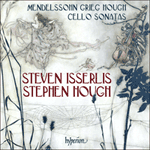 Mendelssohn, Grieg & Hough: Cello Sonatas Mendelssohn, Grieg & Hough: Cello SonatasStudio Master: CDA68079Studio Master FLAC & ALAC downloads available  Three passionately romantic cello sonatas—two familiar, one less so—recorded by the finest of duos.» More |