
Welcome to Hyperion Records, a British classical label devoted to presenting high-quality recordings of music of all styles and from all periods from the twelfth century to the twenty-first.
Hyperion offers both CDs, and downloads in a number of formats. The site is also available in several languages.
Please use the dropdown buttons to set your preferred options, or use the checkbox to accept the defaults.

| Sir Stephen Hough (piano), Dallas Symphony Orchestra, Andrew Litton (conductor)» More |
The first documented mention of the Concerto seems to be on 26 March 1891, in a letter to another of his numerous cousins, and its completion followed on 6 July, after a month of near-solitude at Ivanovka. Rachmaninov compensated for his ongoing lassitude, or so he claimed, by composing the second and third movements in a two-and-a-half day burst, working from five o’clock in the morning until eight in the evening. The score carried a dedication to Ziloti.
Rachmaninov performed the first movement at a student concert on 17 March 1892, in the Small Room of the Hall of Nobility. On that occasion the student orchestra was conducted by Vasily Safonov—by then Director of the Conservatoire—who was used to making corrections and cuts in his students’ work. This time, however, Safonov found himself bowing to the will of the fledgling composer. It is not entirely clear when, or even if, Rachmaninov played the work in its entirety (though others certainly did so) before he shelved it for revision. It was to be September 1917 before he finally got round to that task. Rachmaninov set the finishing date to the revised score on 10 November, just weeks after the storming of the Winter Palace and the enthronement of the Bolshevik regime, whose baleful effects he would flee six weeks later (though he had been laying plans even before the October Revolution), never to return to Russia. He first performed the new work on 29 January 1919 in New York with the Russian Symphony Society Orchestra, conducted by Modest Altschuler.
Rachmaninov was an inveterate rewriter. But he took the red pen to his First Piano Concerto more radically than to any other of his works (the case of the Fourth Concerto runs it close). The central tutti of the first movement and the first half of the cadenza were newly composed, and the finale was just as extensively recast. Among the excised material was much that openly declared a debt to Grieg’s Piano Concerto.
That model can still be detected behind the opening orchestral fanfare and pianistic flourishes. This is an amplified version of Grieg’s straightforward tonics and dominants, Nordic candour traded in for Slavonic melodrama. The orchestra then launches into one of Rachmaninov’s signature swooning lyrical themes, immediately picked up by the piano. Still shadowing the Grieg Concerto, the piano continues with darting figurations, before giving way to another orchestral song-theme. The largely sequentially constructed development section with rhapsodic breaks, the piano-led reprise, and the hypertrophic cadenza all fall into the pattern established by Grieg. But the devil is in the detail, and especially in its revised version this movement asserts its individuality by means of its ecstatic waywardness.
One of Grieg’s closing slow movement ideas supplies Rachmaninov with the opening of his comparatively modest Andante. This is marked by the piano’s improvisatory dreaminess, the quintessence of Romantic rhapsody: healing, as it were, all past longings and allowing the hero of the Concerto—the music’s personality, mediated by the soloist, with which we are invited to identify—to shake off the fetters of the past. Rachmaninov’s instinct for decorative passagework and for inspired harmonic deflections and balancing returns shines through. Now only the final cadences remind us of the music’s Griegian paternity.
Concerto finales are by tradition brilliant, physically exhilarating affairs, which is one reason why the symphonic scherzo is usually dispensable. This finale is no different. But perhaps compensating for the fact that the opening ideas are flashy and rather empty, it is the lyrical second subject that brings the movement into focus. Once again it is Rachmaninov’s genius for variation and renewal that keeps the structure alive, rather than any deeper-lying compositional strategies. And by 1917, when he was putting the Concerto into its definitive shape, he was unrivalled in his ability to ratchet up audience excitement over the last pages.
from notes by David Fanning © 2004
Rachmaninov n’avait pas dix-huit ans quand il commença à travailler à son premier concerto pour piano. A l’époque, il avait encore un an d’étude à accomplir au Conservatoire durant lequel il devait composer son premier opéra et sa première symphonie, les conditions requises par Arensky pour passer rapidement ses examens finaux. La symphonie sera en fait retardée de plusieurs années, mais le soutien de Tchaïkovski pour son opéra (Aleko) lui permit d’aboutir à un contrat d’édition et de s’ouvrir rapidement aux opportunités réservées aux professionnels.
Le premier document à faire mention du Concerto semble dater du 26 mars 1891, dans une lettre à un de ses nombreuses cousines. Il semble avoir été achevé le 6 juillet, après un mois de solitude quasi totale à Ivanovka. Rachmaninov compensa sa lassitude permanente en écrivant les deuxième et troisième mouvements en un élan créateur de deux jours et demi – du moins c’est ce qu’il dit – travaillant de cinq heures du matin jusqu’à huit heures du soir. La partition est dédiée à Ziloti.
Rachmaninov exécuta le premier mouvement lors d’un concert estudiantin, le 17 mars 1892, dans le salon de la Salle de la Noblesse. A cette occasion, l’orchestre d’étudiants était dirigé par Vasily Safonov – alors Directeur du conservatoire – qui avait l’habitude de faire des corrections et des coupes dans l’œuvre de ses étudiants. Cette fois là, cependant, Safonov se trouva contraint de s’incliner devant la volonté du compositeur en devenir. Ce n’est pas tout à fait clair quand ou même si Rachmaninov joua cette œuvre dans son intégralité (même s’il est presque certains que d’autres le firent) avant qu’il ne la mette de côté pour la réviser. Ce n’est qu’en septembre 1917 qu’il la ressortit de ses cartons. Marquant l’achèvement de la révision, Rachmaninov inscrivit la date du 10 novembre sur la partition, quelques semaines seulement après l’assaut du palais d’Hiver et le couronnement du régime bolchevique, dont il devait fuir les sinistres effets quelques six semaines plus tard (même s’il avait considéré le faire avant même la Révolution d’octobre) pour ne plus jamais revenir en Russie. Il donna la première de cette nouvelle version le 29 janvier 1919 à New York avec l’Orchestre de la Société symphonique russe dirigé par Modest Altschuler.
Rachmaninov était un compositeur qui revisitait ses œuvres de manière invétérée. Mais avec le Concerto pour piano no1, il se servit de son crayon rouge bien plus radicalement que dans ses autres œuvres (même si le cas du Concerto no4 s’en approche). Le tutti central du premier mouvement et la première moitié de la cadence furent complètement recomposés tandis que le finale subit un important remaniement. Parmi le matériau expurgé figure une grande partie de la dette ouverte contractée envers le Concerto pour piano de Grieg.
Derrière la fanfare orchestrale du début et les figurations du piano, on peut cependant toujours déceler ce modèle. Voici effectivement une version amplifiée des toniques et dominantes de Grieg où le mélodrame slave est substitué aux candeurs nordiques. L’orchestre se lance ensuite dans un des thèmes lyriques extatiques caractéristiques de Rachmaninov, repris immédiatement au piano. Toujours faisant écho au Concerto de Grieg, le piano poursuit ses figurations haletantes, avant de laisser place à un autre thème d’allure mélodique à l’orchestre. La section de développement élaborée essentiellement en séquences ponctuées par des interruptions rhapsodiques, la réexposition amenée par le piano et la cadence hypertrophique, sont autant d’éléments qui reprennent à leur compte le cadre établi par Grieg. Mais c’est dans le détail qu’il faut trouver les difficultés diaboliques. Ce mouvement affirme son individualité grâce à ses humeurs capricieuses et extatiques, plus particulièrement dans sa version remaniée.
Une des idées conclusives du mouvement lent de Grieg donna à Rachmaninov le début de son Andante qui demeure modeste par comparaison. Celui-ci se caractérise par la rêverie de nature improvisée du piano, la quintessence de la rhapsodie romantique: il semblerait soigner toutes les langueurs et nostalgies du passé afin de permettre au héros du Concerto – la personnalité de la musique transmise par le soliste avec qui nous sommes invités à nous identifier – de secouer les chaînes du passé. De bout en bout, on peut apprécier l’instinct dont Rachmaninov fait preuve pour les traits décoratifs et les décalages harmoniques inspirés, ainsi que les reprises équilibrées. Ce n’est qu’alors que les cadences finales nous rappellent qu’il faut trouver dans Grieg la paternité de cette musique.
Les finales de Concerto sont traditionnellement des pages brillantes douées d’une exubérance physique indéniable, ce qui constitue une des raisons indiscutables à la nécessité du scherzo symphonique. Ce finale n’est pas différent. Compensant peut-être le fait que les idées initiales sont plutôt creuses et tape-à-l’œil, c’est le second thème lyrique qui est incisif dans ce mouvement. Encore une fois, c’est le génie de Rachmaninov pour la variation et le renouveau qui permet à cette structure de rester vivante, et non une stratégie d’écriture reposant sur la texture. En 1917, alors qu’il remaniait ce concerto pour lui donner sa forme définitive, Rachmaninov faisait montre d’une aptitude à susciter l’excitation du public dans les dernières pages à nulle autre pareille.
extrait des notes rédigées par David Fanning © 2004
Français: Isabelle Battioni
Rachmaninow hatte sein 18. Lebensjahr noch nicht vollendet als er mit der Arbeit an seinem Ersten Klavierkonzert begann. Zu jenem Zeitpunkt lag noch ein Jahr Studium am Konservatorium vor ihm, in dem er seine erste Oper und seine erste Symphonie komponieren sollte – es waren dies die Bedingungen Arenskys für einen frühzeitigen Studienabschluss. Die Symphonie wurde letztendlich erst mehrere Jahre später fertiggestellt, doch wurde die Oper (Aleko) dank der Unterstützung Tschaikowskys publiziert, was dem jungen Komponisten sehr bald eine Reihe von Möglichkeiten bot, sich beruflich zu etablieren.
Von dem Klavierkonzert ist nachgewiesenermaßen erstmals am 26. März 1891 in einem Brief an einen seiner vielen Cousins die Rede; fertiggestellt wurde das Werk am 6. Juli, nach einem Monat von fast völliger Einsamkeit in Ivanovka. Rachmaninow erklärte, dass er seine anhaltende Energielosigkeit damit ausgeglichen habe, dass er den zweiten und den dritten Satz in nur zweieinhalb Tagen komponiert habe, an denen er von fünf Uhr morgens bis acht Uhr abends gearbeitet habe. Die Partitur trug eine Widmung an Ziloti.
Rachmaninow führte den ersten Satz bei einem Studenten-Konzert am 17. März 1892 in dem Kleinen Saal der Adelshalle auf. Zu dem Anlass wurde das Studentenorchester von Vasily Safonow – zu jenem Zeitpunkt der Direktor des Konservatoriums – dirigiert, der häufig Veränderungen und Kürzungen in den Werken seiner Studenten vornahm. Bei dieser Aufführung beugte sich Safonow jedoch dem Willen des Jungkomponisten. Es ist nicht bekannt, wann oder ob Rachmaninow das vollständige Werk aufführte (obwohl andere es freilich taten), bevor er es beiseite legte, um es zu überarbeiten. Es sollte bis September 1917 dauern, bis er diese Aufgabe schließlich erledigte. Rachmaninow gab an, die Überarbeitung der Partitur am 10. November abgeschlossen zu haben, nur wenige Wochen nach der Stürmung des Winterpalasts und der Einsetzung des bolschewistischen Regimes, deren bösen Folgen er sechs Wochen später entfloh (obwohl er solche Pläne bereits vor der Oktoberrevolution geschmiedet hatte), um nie wieder nach Russland zurückzukehren. Er führte das neue Werk erstmals am 29. Januar 1919 in New York zusammen mit dem Russian Symphony Society Orchestra unter der Leitung von Modest Altschuler auf.
Rachmaninow war ein unermüdlicher Überarbeiter. Doch war er bei seinem Ersten Klavierkonzert mit dem Rotstift radikaler als anderswo (das Vierte Klavierkonzert steht wohl an zweiter Stelle). Das zentrale Tutti im ersten Satz und die erste Hälfte der Kadenz wurden ganz neu komponiert und im Finale nahm er Änderungen von einer ähnlichen Größenordnung vor. Unter den gestrichenen Passagen befand sich ein beträchtlicher Anteil, indem sich Rachmaninow offen an das Klavierkonzert von Grieg anlehnte.
Der Grundriss kann hinter der Orchesterfanfare am Anfang und den eröffnenden Gesten des Klaviers noch immer ausgemacht werden. Es handelt sich dabei um eine verstärkte Version der elementaren Toniken und Dominanten Griegs; nordische Offenheit wird hier gegen slawische Melodramatik eingetauscht. Darauf begibt sich das Orchester in eines jener typischen, lyrischen und überschwänglichen Themen Rachmaninows, das sofort vom Klavier aufgegriffen wird. Noch immer befindet sich das Griegsche Klavierkonzert im Hintergrund und das Klavier fährt mit umherflitzenden Figurationen fort, bevor ein weiteres liedhaftes Thema im Orchester erklingt. Der Durchführungsteil besteht hauptsächlich aus Sequenzen mit rhapsodischen Zwischenspielen und ebenso wie die vom Klavier dominierte Reprise und die hypertrophe Kadenz ist wiederum die Anlage Griegs erkennbar. Jedoch steckt der Teufel im Detail: besonders in der überarbeiteten Version wird die Individualität dieses Satzes durch die ekstatische Eigenwilligkeit zum Ausdruck gebracht.
Eines der Motive des langsamen Satzes von Grieg ist die Inspirationsquelle für den Beginn von Rachmaninows vergleichsweise bescheidenem Andante. Es zeichnet sich durch die improvisatorische Träumerei des Klaviers, die Quintessenz der romantischen Rhapsodie, aus: alle vergangenen Sehnsüchte werden sozusagen ausgeheilt und sie erlaubt dem Helden des Konzerts – die Persönlichkeit der Musik, die vom Solisten meditiert wird und mit der wir uns identifizieren dürfen – die Fesseln der Vergangenheit abzuschütteln. Rachmaninows Gespür für verzierte Fingerfertigkeit, inspirierte harmonische Wendungen und Ausgewogenheit wird erkennbar. Hier erinnern uns lediglich die Schlusskadenzen an den Griegschen Einfluss auf die Musik.
Die Finalsätze von Solokonzerten sind traditionsgemäß brillante und physisch belebende Angelegenheiten, weshalb unter anderem das symphonische Scherzo oft entbehrlich sein kann. Dieses Finale macht da keine Ausnahme. Doch möglicherweise werden die glitzerigen und recht leeren Anfangsmotive durch das lyrische zweite Thema gewissermaßen kompensiert: hiermit wird der Satz in den Brennpunkt gerückt. Hier ist es wiederum Rachmaninows einzigartige Gabe der Variation und Erneuerung, und nicht tiefer liegende kompositorische Strategien, die die Struktur aufrechterhält. Und als er 1917 dem Konzert seine endgültige Form verlieh, war er in seiner Fähigkeit unübertroffen, die Begeisterung des Publikums noch auf den letzten Seiten zu intensivieren.
aus dem Begleittext von David Fanning © 2004
Deutsch: Viola Scheffel
Причину здесь не удается ясно объяснить, и едва ли она состоит в том, что после переделки «играть /Концерт/ стало легче» (слова Рахманинова). Думается, что при очень сложных жизненных обстоятельствах Сергей Васильевич искал знаки «утраченного времени» в своих ранних сочинениях и делал эти сочинения духовной опорой для себя. Ведь переделку Первого концерта он завершил 10 ноября 1917 года – через три дня после Октябрьской революции в России. Месяц спустя композитор уехал в эмиграцию и, судя по второй редакции Концерта, прощался со своим композиторским прошлым и готовил себя к иным реальностям жизни.
Хотя многие особенности его фортепианного стиля остаются неизменными: например, полнозвучие аккордовой фактуры – как в начальном соло первой части (Vivace). В той же части отметим ориентальный колорит побочной темы с ее магическими повторами – и энергичный, почти маршевый импульс ритма, пронизывающий всю часть. Во второй части (Andante) сугубо по-рахманиновски звучат валторны во вступительной теме; широкая мелодическая волна сочетается с пряными гармониями, которые мы находим, пожалуй, лишь у позднего Рахманинова. Наконец, в финале (Allegro vivace) черты позднего стиля выходят вперед: имеем в виду аккордовые параллелизмы и «плывущие» хроматические подголоски у фортепиано (особенно в эпизоде Andante). Что касается концовки или, если угодно, развязки Концерта с ее мелодической близостью к католической секвенции «Dies irae» («День гнева»), то ничто лучше не скажет о неизменности идей и настроений Рахманинова-композитора, ибо в его поздних сочинениях мотив «Dies irae» появляется с поразительным постоянством.
Говорит ли все это, что рахманиновская музыка осталась, по существу, без «опуса 1», поскольку на большой эстраде его вторая редакция вытеснила первую? Едва ли так, ибо свежесть юношеского сочинения удивительным образом сохранилась в той его версии, которая, как сообщают свидетели, дописывалась «при стеариновой свечке» последних предреволюционных ночей.
Leonid Gakkel © 2015
 Rachmaninov: The Piano Concertos - Vinyl Edition Rachmaninov: The Piano Concertos - Vinyl EditionLPA675013LPs NEW  These performances from Stephen Hough, the Dallas Symphony Orchestra and Andrew Litton are widely regarded as the finest available, wininng a Gramophone Award and the coveted ‘No 1’ slot in the Classic FM Hall of Fame.» More |
 The Hyperion Romantic Piano Concerto Edition - 1991-2007 The Hyperion Romantic Piano Concerto Edition - 1991-2007CDS44701/5050CDs Boxed set (at a special price) Higher-value orders will be automatically discounted at check-out The first of two box sets celebrating one of the most ambitious, and successful, series in the history of classical recording. This volume features 130 works from 59 composers, performed by 19 different pianists, and all luxuriously presented with ...» More |
 Hyperion sampler - May 2026 Vol. 2 Hyperion sampler - May 2026 Vol. 2FREE DOWNLOADHYP202605BDownload-only sampler NEW |
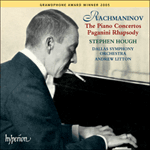 Rachmaninov: The Piano Concertos Rachmaninov: The Piano ConcertosCDA67501/22CDs These performances from Stephen Hough, the Dallas Symphony Orchestra and Andrew Litton are widely regarded as the finest available, winning a Gramophone Award and the coveted ‘No 1’ slot in the Classic FM Hall of Fame.» More |
 Rachmaninov: The Piano Concertos Rachmaninov: The Piano ConcertosThis album is not yet available for downloadSACDA67501/22CDs Super-Audio CD — SOLD OUT! |