Welcome to Hyperion Records, a British classical label devoted to presenting high-quality recordings of music of all styles and from all periods from the twelfth century to the twenty-first.
Hyperion offers both CDs, and downloads in a number of formats. The site is also available in several languages.
Please use the dropdown buttons to set your preferred options, or use the checkbox to accept the defaults.


The first song of the set, Chanson de la mariée, was correctly retitled by Ravel when he orchestrated it some thirty years later as Le réveil de la mariée, what might vulgarly be termed ‘The bride’s wake-up call’. The Phrygian modality of the original tune (G minor with A flat) suggested to Ravel not just the occasional A flat major chord, but a succession of five chords in which the frisson between A flat and G minor is intensified by chromatic harmonies. Là-bas, vers l’église, also on a Phrygian tune, celebrates villagers buried in the local cemetery, and the final words, ‘Du monde tous les plus braves!’, intimate that they were killed in battle. Here the spread chords evoke bells with wonderful economy. The final song, Tout gai!, is in a tonal A flat major with not an accidental in sight, while the slight variations in the second verse are just enough to preclude predictability.
from notes by Roger Nichols © 2009
La première chanson du recueil, Chanson de la mariée, a été réintitulée avec raison par Ravel Le réveil de la mariée lorsqu’il l’a orchestrée une trentaine d’années plus tard. La modalité phrygienne de la mélodie d’origine (sol mineur avec la bémol) a suggéré à Ravel non seulement l’accord occasionnel de la bémol majeur, mais une succession de cinq accords dans lesquels le frisson entre la bémol et sol mineur est intensifié par des harmonies chromatiques. Là-bas, vers l’église, également sur un motif phrygien, célèbre des villageois enterrés dans le cimetière local, et les derniers mots, «Du monde tous les plus braves!», laissent entendre qu’ils ont été tués au combat. Ici les accords dispersés évoquent des cloches avec une merveilleuse économie. La dernière chanson, Tout gai!, est écrite dans un la bémol majeur tonal sans le moindre accident à l’horizon, mais les légères variations dans le deuxième vers suffisent juste à éviter toute prévisibilité.
extrait des notes rédigées par Roger Nichols © 2009
Français: Marie-Stella Pâris
Ravel benannte das erste Lied des Zyklus, Chanson de la mariée, zurecht um, als er es etwa dreißig Jahre später als Le réveil de la mariée orchestrierte—etwas vulgär könnte das als „Der Weckruf der Braut“ übersetzt werden. Den phrygischen Modus der Originalmelodie (g-Moll mit As) verarbeitete Ravel nicht nur mit gelegentlichen As-Dur-Akkorden, sondern mit einer Folge von fünf Akkorden, in der die Reibung zwischen As-Dur und g-Moll durch chromatische Harmonien intensiviert wird. In Là-bas, vers l’église, das ebenfalls im phrygischen Modus steht, wird der Dorfbewohner gedacht, die auf dem Friedhof bei der Dorfkirche begraben liegen; die letzten Worte, „Du monde tous les plus braves!“, geben zu verstehen, dass sie in einem Kampf gefallen sind. Hier stellen die weit auseinander liegenden Akkorde mit wunderbarer Sparsamkeit die Glocken dar. Das letzte Lied, Tout gai!, steht in einem tonalen As-Dur mit weit und breit keinen Vorzeichen, während die kleinen Variationen in der zweiten Strophe gerade noch ausreichen, einer Vorhersagbarkeit vorzubeugen.
aus dem Begleittext von Roger Nichols © 2009
Deutsch: Viola Scheffel
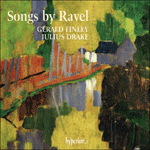 Ravel: Songs Ravel: SongsCDA67728  The award-winning partnership of Gerald Finley and Julius Drake continue their musical explorations with this beautiful and thought-provoking disc. Gerald Finley’s lustrous tones, extraordinary gift for characterisation, and direct, unaffected utt ...» More |
 Ravel: The Complete Songs Ravel: The Complete SongsStudio Master: SIGCD8702CDs Download onlyStudio Master FLAC & ALAC downloads available  A double album presenting—in chronological order of composition—all forty-seven mélodies by Maurice Ravel, Malcolm Martineau accompanying a small army of the finest soloists. (Listeners should be aware: these recordings were set down over a number ...» More |