
Welcome to Hyperion Records, a British classical label devoted to presenting high-quality recordings of music of all styles and from all periods from the twelfth century to the twenty-first.
Hyperion offers both CDs, and downloads in a number of formats. The site is also available in several languages.
Please use the dropdown buttons to set your preferred options, or use the checkbox to accept the defaults.
I am enormously excited with the idea of your Second Sonata; it reminds me of so many happy as well as painful hours. I love it, as I do you. Your whole being is so clearly expressed in it, and besides, it’s not too obscure.
Only one thing. Do you want to leave the last movement as it was before? Better to change it and make it a bit easier because it is much too difficult. I understand it and can play it alright, but people, the public, even the connoisseurs for whom one actually writes, don’t understand it. You won’t take this badly, will you?
Robert didn’t take it badly, and wrote another finale which he felt also went better with the first movement.
Of his three piano sonatas, the G minor is by far the most concise. It is a work of great sweep and passion, typically combining dramatic urgency with moments of rapt tenderness. Schumann doesn’t wait to get our attention—he demands it in the first bar with that sudden, broken G minor chord. The first challenge he throws at the player is to mark the opening ‘As fast as possible’, only to urge him or her to go ‘faster’ and ‘still faster’ before the end is reached. The opening theme, which is imitated in the bass, uses the partial descending scale that became Clara’s motto in many of his piano works—a ‘cry from the heart’ for her when they were unable to be together. The beautiful slow movement, marked getragen (solemn), was originally a song that Robert wrote when he was eighteen years old. The calm doesn’t last for long, though. With the Scherzo comes the one bit of humour in the sonata: in its episodes in the major mode there is certainly a twinkle in his eye. The ‘new’ finale makes extensive use of broken octaves to express its restlessness, and the Clara motto appears in the lyrical second subject. The music works up to a feverish climax and a dramatic pause over a diminished seventh chord. The ensuing cadenza goes like the wind, never once letting up. Clara certainly got what she wanted.
from notes by Angela Hewitt © 2010
Je suis terriblement excitée à l’idée de ta seconde Sonate; elle me rappelle tant d’heures heureuses, douloureuses aussi. Je l’aime, comme je t’aime. Tout ton être y est si clairement exprimé et, en plus, elle n’est pas trop obscure.
Une seule chose. Veux-tu laisser le dernier mouvement comme il était avant? Mieux vaut le changer et le rendre un peu plus facile, car il est bien trop difficile. Je le comprends et j’arrive à bien le jouer, mais les gens, le public et même les connaisseurs pour qui, en réalité, on écrit, ne le comprennent pas. Tu ne vas pas le prendre mal, dis?
Robert ne le prit pas mal et rédigea un nouveau finale qui, il en convint, allait mieux avec le premier mouvement.
De ses trois sonates pour piano, celle-ci est, et de loin, la plus concise. C’est une œuvre ample et passionnée, combinant comme toujours urgence dramatique et moments de tendresse ravie. Schumann ne tarde pas à nous demander notre attention: il le fait dès la première mesure, avec ce brusque accord brisé en sol mineur. Le premier défi qu’il lance à l’interprète, c’est quand il marque l’ouverture «aussi vite que possible», pour aussitôt ordonner d’aller «plus vite» et «encore plus vite» avant la fin. Le thème inaugural, imité à la basse, utilise la gamme descendante partielle qui devint la devise de Clara dans maintes œuvres pianistiques de Robert—un «cri du cœur» pour elle, quand ils ne pouvaient être ensemble. Le splendide mouvement lent, marqué getragen (triste), était au départ un lied écrit par Robert quand il avait dix-huit ans. Mais ce calme ne dure pas. Avec le Scherzo survient le seul moment d’humour de la sonate: dans ses épisodes en mode majeur, Schumann avait sûrement les yeux pétillants. Pour dire toute sa nervosité, le «nouveau» finale fait un usage poussé des octaves brisées, et la devise de Clara apparaît dans le second sujet. La musique en vient à un fiévreux apogée et à une pause tragique par-dessus un accord de septième diminuée. La cadenza qui s’ensuit file comme le vent, sans jamais dételer. Clara a certainement obtenu ce qu’elle voulait.
extrait des notes rédigées par Angela Hewitt © 2010
Français: Hypérion
Auf die zweite Sonate freue ich mich unendlich, sie erinnert mich an viele glückliche und auch schmerzliche Stunden. Ich liebe sie, so wie Dich; Dein ganzes Wesen drückt sich so klar darin aus, auch ist sie nicht allzu unverständlich.
Doch eins. Willst Du den letzten Satz ganz so lassen, wie er ehemals war? Ändere ihn doch lieber etwas und erleichtere ihn, denn er ist doch gar zu schwer. Ich verstehe ihn schon und spiele ihn auch zur Noth, doch die Leute, das Publikum, selbst die Kenner, für die man doch eigentlich schreibt, verstehen das nicht. Nicht wahr, Du nimmst mir das nicht übel?
Robert nahm es nicht übel und schrieb ein neues Finale, von dem er glaubte, dass es auch besser zum ersten Satz passe.
Von seinen drei Klaviersonaten ist die g-Moll-Sonate bei weitem die prägnanteste. Es ist ein Werk mit großer Gestik und Leidenschaft, in dem charakteristischerweise dramatisches Drängen mit Momenten verzückter Zartheit verbunden wird. Schumann wartet nicht auf die Aufmerksamkeit des Hörers, sondern verlangt sie gleich von Anfang an im ersten Takt mit dem plötzlichen, gebrochenen g-Moll-Akkord. Die erste Herausforderung, die er dem Interpreten stellt, besteht in der Anweisung zu Beginn, „So rasch wie möglich“ zu spielen, nur um später zu verlangen, dass „Schneller“ und, kurz vor Ende, „Noch schneller“ gespielt werden möge. Im Anfangsthema, das im Bass imitiert wird, erklingt der absteigende Tonleiterausschnitt, der in vielen seiner Klavierwerke Claras Motto wurde—ein „Ruf vom Herzen“ nach ihr, wenn sie nicht zusammen sein konnten. Der wunderschöne langsame Satz, der mit „getragen“ markiert ist, war ursprünglich ein Lied, das Robert im Alter von 18 Jahren komponiert hatte. Doch hält die Ruhe nicht lang an. Mit dem Scherzo kommt das humorvolle Element der Sonate: in den Durpassagen ist ein gewisses Augenzwinkern zu spüren. Im „neuen“ Finale werden gebrochene Oktaven verstärkt eingesetzt, um die Ruhelosigkeit auszudrücken, und Claras Motto erklingt in dem lyrischen zweiten Thema. Die Musik steuert auf einen fieberhaften Höhepunkt mit einer dramatischen Pause über einem verminderten Septakkord zu. Die darauffolgende Kadenz bewegt sich rasant und lässt nicht einmal nach. Clara hatte zweifellos bekommen, was sie wollte.
aus dem Begleittext von Angela Hewitt © 2010
Deutsch: Viola Scheffel
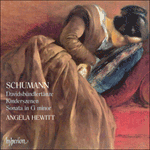 Schumann: Davidsbündlertänze, Kinderszenen, Sonata No 2 Schumann: Davidsbündlertänze, Kinderszenen, Sonata No 2CDA67780  Angela Hewitt has earned a richly deserved reputation for her interpretations of Bach and the Baroque, and something of that characteristic clarity illuminates her Schumann performances. Her first disc of this repertoire was praised for its ‘seemi ...» More |
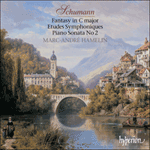 Schumann: Piano Music Schumann: Piano MusicStudio Master: CDA67166Studio Master FLAC & ALAC downloads available ‘Hamelin brings a transcendental technique and passionate romantic temperament to music that, more often than not, is the preserve of pianistic intellectuals and poets. But his performances of the great C major Fantasy and the Symphonic Studies ar ...» More |
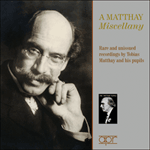 A Matthay Miscellany - Rare and unissued recordings by Tobias Matthay and his pupils A Matthay Miscellany - Rare and unissued recordings by Tobias Matthay and his pupilsAPR60142CDs for the price of 1 — Download only  This final volume of 'The Matthay Pupils' presents most of his remaining students who left recordings, as well as the few discs Matthay himself made. Of particular interest is a selection from the almost unknown AFMC label which was affiliated to ...» More |
