Fauré read Albert Samain’s collection of poems entitled
Au jardin de l’infante on the strong recommendation of Emma Bardac, a fine singer, his mistress for a time and dedicatee of
La bonne chanson (not to mention the future second wife of Debussy). The first fruit of this discovery of a new poet was
Soir, composed in 1894. This remarkable duet followed two years later. The title of Samain’s poem is
Larmes, but Fauré had already given this title to the Richepin setting. He omits the poet’s last three lines that are even more highly perfumed than the rest of the poem. The flowing triplets of this 12/8 Andante quasi allegretto suggest the flow of water music, but this is water, almost holy water, in a state of suspension. Off-the-beat crotchets in the accompaniment are distilled drop by drop – mezzo staccato dew on the rose-petalled surface of the music. These golden tears are turned into something audible in the sounds of different kinds of bell and of veiled flutes; they are transfigured as pinpricks of stars in the heavens. There is a luxurious sensuality in this music; the entwined vocal lines swoon as if responding to a caress, a touch of Massenet perhaps. The sentiment of the work is that of the second period; the harmonic progressions are recherché without having embraced the pudeur of the third period. The composer would soon retreat from this opulence which, even in his skilful hands, threatens to cloy. The duet was first published by the British firm of Metzler; its first performance was in London at a time when Fauré and his music were exceedingly popular in the English capital.
from notes by Graham Johnson © 2005
Fauré lit
Au jardin de l’infante, le recueil de poèmes d’Albert Samain, sur la vive recommandation d’Emma Bardac, une remarquable chanteuse qui fut un temps sa maîtresse et à qui il dédia
La bonne chanson (sans compter qu’elle allait être, aussi, la seconde femme de Debussy). Le premier fruit de cette découverte d’un nouveau poète fut
Soir, composée en 1894, soit deux ans avant le présent duo, splendide. Le poème de Samain s’intitule
Larmes, mais Fauré avait déjà utilisé ce titre pour la mise en musique du poème de Richepin. De plus, il omet les trois derniers vers de Samain, encore plus raffinés que les autres. Les triolets fluides de cet Andante quasi allegretto à 12/8 évoquent le flot de la musique de l’eau, mais d’une eau presque bénite, comme en suspension. Les noires des temps faibles de l’accompagnement sont distillées goutte à goutte – une rosée mezzo staccato posée à la surface musicale, semée de pétales de roses. Les pleurs d’or, matérialisés par diverses sortes de cloches et de flûtes voilées, sont transfigurés en petits points stellaires dans les cieux. Cette musique déborde de sensualité; les lignes vocales entrelacées se pâment comme sous une caresse – peut-être une touche de Massenet. Le sentiment qui se dégage de l’œuvre est du Fauré deuxième manière: les progressions harmoniques, recherchées, n’ont pas encore embrassé la pudeur de la troisième manière. Le compositeur allait bientôt se départir de cette opulence qui, même en ses mains expertes, menace d’écœurer. Ce duo, publié pour la première fois par la maison britannique Metzler, fut créé à Londres, alors que Fauré et sa musique jouissaient d’une immense popularité dans la capitale anglaise.
extrait des notes rédigées par Graham Johnson © 2005
Français: Hypérion

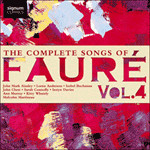 Fauré: The Complete Songs, Vol. 4
 Songs to the moon