Welcome to Hyperion Records, a British classical label devoted to presenting high-quality recordings of music of all styles and from all periods from the twelfth century to the twenty-first.
Hyperion offers both CDs, and downloads in a number of formats. The site is also available in several languages.
Please use the dropdown buttons to set your preferred options, or use the checkbox to accept the defaults.

The overture, like so many of Purcell’s works, is in the French style, with a grand introduction (using the pairs of trumpets and oboes particularly effectively) followed by an imitative section in triple time. The solo alto’s first entry finds Purcell’s imagination stirred by D’Urfey’s text, as indeed it is again later on for the same voice at ‘See how the glitt’ring ruler of the day’ where, over an eight-bar ground bass in minuet style, the sun summons the planets to ‘Dance in a solemn ball’. Opportunities for pathetic texts are obviously limited in joyous Odes, but the section ‘But ah, I see Eusebia drown’d in tears’ enables Purcell to show genuine emotion, despite the fact that ‘Eusebia’ refers to the Anglican Church, regretting the fact that William III has to champion her cause in Ireland. Nonetheless, the piece ends in triumphant manner, with the text exhorting the illustrious Prince not to leave his work unfinished.
from notes by Robert King © 2010
Comme si souvent chez Purcell, l’ouverture est à la française, avec une introduction grandiose où trompettes et hautbois par deux sont utilisés avec une singulière efficacité avant une section imitative en mesure ternaire. À la première entrée de la voix d’alto solo, l’imagination de Purcell est stimulée par le texte de D’Urfey, comme elle le sera de nouveau, pour la même voix, à «See how the glitt’ring ruler of the day» quand, par-dessus un ground bass de huit mesures en style de menuet, le soleil somme les planètes de «danser en un bal solennel» («Dance in a solemn ball»). Les occasions d’écrire un texte pathétique sont, bien sûr, limitées dans les Odes joyeuses; pourtant, la section «But ah, I see Eusebia drown’d in tears» permet à Purcell de montrer une authentique émotion, même si «Eusebia» fait référence à l’Église anglicane, déplorant que Guillaume III eût à défendre sa cause en Irlande. L’œuvre ne s’en conclut pas moins de manière triomphante, le texte exhortant l’«illustrious Prince» à ne pas laisser sa tâche inachevée.
extrait des notes rédigées par Robert King © 2010
Français: Hypérion
Die Ouvertüre ist, wie so viele Werke Purcells, im französischen Stil komponiert und hat eine prachtvolle Einleitung (in der die Trompeten und Oboen besonders wirkungsvoll eingesetzt sind), worauf ein imitativer Abschnitt im Dreiertakt folgt. D’Urfeys Text inspirierte Purcell offenbar besonders bei der Stelle, wenn der Solo-Alt seinen ersten Einsatz hat, genauso wie dort, wo dieselbe Stimme „See how the glitt’ring ruler of the day“ singt und die Sonne über einem achttaktigen Basso ostinato im Menuett-Stil die Planeten dazu auffordert, „in einem feierlichen Ball zu tanzen“ („Dance in a solemn ball“). Freudvolle Oden bieten natürlich nicht besonders viel Gelegenheit für gefühlvolle Texte, doch ermöglicht der Abschnitt „But ah, I see Eusebia drown’d in tears“ („Aber ach, ich sehe Eusebia von Tränen überströmt“) es Purcell, Emotionen zu zeigen, obwohl mit „Eusebia“ die anglikanische Kirche gemeint ist, die es bedauert, dass Wilhelm III. sich in Irland für ihre Sache einsetzen muss. Trotzdem endet das Stück in triumphaler Stimmung und der Text ermahnt den „erlauchten Prinzen“ („illustrious Prince“), sein Werk nicht unbeendet zu lassen.
aus dem Begleittext von Robert King © 2010
Deutsch: Viola Scheffel
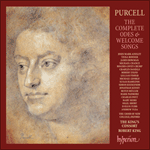 Purcell: The Complete Odes & Welcome Songs Purcell: The Complete Odes & Welcome SongsCDS44031/88CDs Boxed set (at a special price)  ‘A treasure house of shamefully neglected music. Over nine hours of wonderful invention … this major recording achievement must be an irresistibl ... ‘By any yardstick these are life-enhancing works’ (CDReview)» More |