
Welcome to Hyperion Records, a British classical label devoted to presenting high-quality recordings of music of all styles and from all periods from the twelfth century to the twenty-first.
Hyperion offers both CDs, and downloads in a number of formats. The site is also available in several languages.
Please use the dropdown buttons to set your preferred options, or use the checkbox to accept the defaults.

For Pärt, however, it was more than just a technical challenge or the possibility of ritual-like musical repetition. The attraction to this text (in its ‘traditional and authoritative’ translation, according to Pärt) came bound up with the nature of the commission itself—the singers the piece was for and the country it was premiered in.
Pärt was asked to write a work for the youth choir Voices of Europe, gathered in Reykjavík in 2000 to celebrate its status as European Capital of Culture that year. The choir featured ten singers each from the nine previous Cultural Capitals, aged between 18 and 23. Pärt’s first decision, therefore, was to set a text in English, Europe’s de facto ‘lingua franca’ as it were.
Pärt had visited Iceland previously, and was impressed by the country’s highly educated population, their high levels of interest in European literature and, he noted, the unusually large number of writers amongst them. Add to that the composer’s interest in the deep-rooted Icelandic tradition of passing on names from one generation to generation, and his wish to impart this biblical ‘story of civilisation’ to young people, and verses 23 to 38 of Luke 3 became a compelling text. To him, one senses, this is not merely a fabulous list of ancient names, a biblical truth since challenged by Darwin; there is something germinal and sacred about it—gospel indeed.
Needless to say, Pärt ensures this text avoids monotony through variance of character and a distinct climax along the way. After an opening whose sprung rhythms give it the assuredness of a French-style baroque ouverture, the piece takes off with the same narrative urgency of Dopo la vittoria. Basses are answered by the upper three voices—shades of folksiness and Spirituals here?—and after about a third of the text is deftly dispatched in this way, a more mellifluous section in 9/8 takes over. A fluid interchange of 4/4 and 9/8 sections takes us right through the climactic trio of Jacob, Isaac and Abraham—wondrous C major emphasis on the last of these. And through use of the surprisingly familiar ‘cycle of fifths’ harmonic sequence, the oldest ancestors of Jesus are ever more quickly revealed, almost breathlessly to reach the ultimate, fundamental truth—‘which was the son of Adam, which was the son of …’—and here Pärt sets it all out with respectful simplicity and resolution—‘… God.’
from notes by Meurig Bowen © 2003
Pour Pärt, pourtant, ce projet dépassait le simple défi technique ou l’éventualité d’une répétition musicale aux allures de rite. Avec sa traduction «traditionnelle qui fait autorité», selon Pärt, ce texte le séduisit en regard de la nature de la commande même—à la fois les chanteurs à laquelle cette œuvre était destinée et le pays où elle fut créée.
On demanda à Pärt d’écrire une œuvre pour le jeune chœur Voix d’Europe, réuni à Reykjavík en 2000 pour célébrer son statut de Capitale européenne de la culture cette année-là. Le chœur comprenait dix chanteurs venus des neuf capitales culturelles précédentes âgés entre 18 et 23 ans. La première décision de Pärt fut donc de mettre en musique ce texte en anglais, de facto la «lingua franca» de l’Europe pour ainsi dire.
Au cours de son précédent séjour en Islande, Pärt avait été impressionné par le haut degré d’éducation de la population islandaise qui manifestait de surcroît un intérêt prononcé pour la littérature européenne et possédait en son sein un nombre exceptionnellement important d’écrivains. Si l’on doit y ajouter l’intérêt du compositeur pour la tradition profondément ancrée dans la culture islandaise de passer les noms d’une génération à l’autre, et son souhait de transmettre cette «histoire de civilisation» biblique à des jeunes gens, les versets 23–38 de Luc III devinrent un texte irrésistible. Pour lui, on sent qu’il ne s’agit pas simplement d’une liste fabuleuse de noms anciens, une vérité biblique réfutée depuis par Darwin; elle porte en elle quelque chose de plus germinal et sacré—effectivement évangélique.
Il va sans dire que Pärt fit en sorte d’éviter toute monotonie en variant le caractère et l’apogée distinctif tout au cours de l’œuvre. Après une introduction dont les rythmes bondissants lui confèrent une assurance digne d’une ouverture baroque à la française, la pièce s’empare d’une même urgence narrative que Dopo la vittoria. Aux basses répondent les trois voix aiguës—seraient-ce des ombres d’éléments venus du folklore et du Spiritual? Après qu’environ un tiers du texte a été adroitement traité de cette manière-là, une section plus suave à 9/8 s’empare du discours musical. Un dialogue fluide entre des sections à 4/4 et à 9/8 nous amène jusqu’à l’apogée, un trio entre Jacob, Isaac et Abraham—une emphase merveilleuse en do majeur étant portée sur le dernier de ceux-ci. A travers l’emploi de la progression harmonique étonnamment familière du «cycle de quintes», les ancêtres les plus anciens de Jésus sont révélés encore plus rapidement, pratiquement à bout de souffle, pour attendre la vérité ultime et fondamentale «qui était le fils d’Adam, qui était le fils de …»—et là Pärt réalise une résolution d’une simplicité toute respectueuse—«… Dieu».
extrait des notes rédigées par Meurig Bowen © 2003
Français: Isabelle Battioni
Für Pärt war sie allerdings mehr als nur eine technische Herausforderung oder die Möglichkeit ritueller musikalischer Repetition. Sein Interesse an diesem Text (in seiner „traditionellen und autoritativen“ Übersetzung, so Pärt) stand mit der Natur des Auftrags (den Sängern, für die das Stück geschrieben wurde, und dem Land der Uraufführung) selbst in Verbindung.
Man hatte Pärt gebeten, ein Werk für den sich 2000 in Reykjavík versammelnden Jugendchor Voices of Europe zu schreiben, um die Stadt als Europäische Kulturhauptstadt jenes Jahres zu feiern. Der Chor bestand aus jeweils zehn Sängern im Alter von 18 bis 23 Jahren aus den ehemaligen neun Kulturhauptstädten. Pärts erste Entscheidung bestand demzufolge darin, seiner Komposition einen englischen Text zugrunde zu legen, da Englisch wohl quasi die europäische Verkehrssprache darstellt.
Pärt hatte Island schon früher besucht und war vom hohen Bildungsstand der isländischen Bevölkerung, ihrem großen Interesse an europäischer Literatur und, so stellte er fest, der ungewöhnlich hohen Anzahl von Schriftstellern unter ihnen sehr beeindruckt gewesen. Zudem faszinierte den Komponisten die tief verwurzelte isländische Tradition, Namen von Generation zu Generation weiterzureichen. Darüber hinaus hegte er den Wunsch, die biblische „Zivilisationsgeschichte“ jungen Menschen zu vermitteln. All dies zusammen erklärt, warum die Verse 23–38 aus dem dritten Kapitel des Lukas-Evangeliums plötzlich für einen Komponisten interessant wurden. Man spürt, dass diese Aufstellung von Namen für Pärt nicht nur eine erstaunliche Liste altehrwürdiger Namen, eine seit Darwin widerlegte biblische Wahrheit darstellt. In dieser Auflistung ist etwas Keimendes und Geheiligtes—ein richtiges Evangelium.
Selbstredend war Pärt bestrebt, eine durch diesen Text mögliche Monotonie zu vermeiden. Das gelang ihm, indem er den Stimmungscharakter variierte und im Verlauf des Stückes einen markanten Höhepunkt herbeiführte. Nach einer Einleitung, deren lebhaft punktierte Rhythmen an das Selbstbewusstsein einer französischen Ouvertüre erinnern, beginnt das Werk mit der gleichen erzählenden Dringlichkeit wie das Dopo la vittoria. Den Bässen antworten die drei hohen Stimmen. Hört man hier Anklängen an Volksmusik und Spirituals? Nachdem ungefähr ein Drittel des Textes auf diese Weise geschickt abgearbeitet ist, übernimmt ein honigsüßer Abschnitt im 9/8-Takt das Geschehen. Ein fließender Austausch zwischen 4/4- und 9/8 Passagen bringt uns geradewegs zum Höhepunkt bildenden Dreiergespann Jakob, Isaak und Abraham, mit einer wunderbaren Betonung des letztgenannten Namens in C-Dur. Durch den Einsatz der erstaunlich vertrauten Quintenzirkel-Sequenz erklingen die Namen der ältesten Vorfahren Jesu schneller und schneller, fast atemlos, bis die elementarste, grundlegende Wahrheit erreicht wird: „Adam; (der stammte von)“, und hier gestaltet Pärt alles mit demütiger Einfachheit und Überzeugung, „Gott“.
aus dem Begleittext von Meurig Bowen © 2003
Deutsch: Elke Hockings
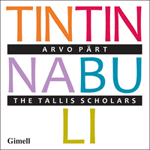 Pärt: Tintinnabuli Pärt: TintinnabuliStudio Master: CDGIM049Download onlyStudio Master FLAC & ALAC downloads available  “It is with great pleasure that we present our tribute to Arvo Pärt in his 80th year. Tintinnabuli (from the Latin for ‘bell’) is the compositional style created by Arvo Pärt which informs every work on this recording. In all my searchings for ins ...» More |
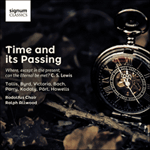 Time and its Passing Time and its PassingStudio Master: SIGCD445Download onlyStudio Master FLAC & ALAC downloads available  The Rodolfus Choir returns to Signum with a new collection of choral works drawn from composers spanning over 500 years.» More |
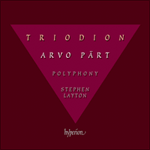 Pärt: Triodion & other choral works Pärt: Triodion & other choral worksThis album is not yet available for downloadSACDA67375Super-Audio CD — SOLD OUT!  |