Welcome to Hyperion Records, a British classical label devoted to presenting high-quality recordings of music of all styles and from all periods from the twelfth century to the twenty-first.
Hyperion offers both CDs, and downloads in a number of formats. The site is also available in several languages.
Please use the dropdown buttons to set your preferred options, or use the checkbox to accept the defaults.

| Sir Stephen Hough (piano)» More |
Both of the original Bach themes mentioned above refer to the sufferings of Christ, and the ‘motto’ motif of redemption happens to be shaped like a cross. The final (unintentional?) pun is that this same ‘motto’ theme, present and transformed in both works, appears in the ‘Transformation Scene’ from Parsifal when bread and wine are changed into Christ’s Body and Blood—the redeeming re-enactment of the Last Supper. This interpretation might not seem too far-fetched if we recall that Franck habitually left his organ bench during the Mass to kneel at this same moment of transformation.
In spite of the internal similarities, the two pieces have significant differences. Where the Prelude, Chorale and Fugue has a distinctly religious flavour, the Prelude, Aria and Finale seems more secular (the Chorale a divine song, the Aria a human one); and where the former work is universal in its message, the latter seems almost domestic, though no less spiritually serious. The Prelude, Chorale and Fugue has a tremendous unity, a feeling of magnetic inevitability which almost pulls it forward to its triumphant close; the Prelude, Aria and Finale is more like a sonata in three separate movements, although the thematic material is profusely and masterfully interconnected throughout the work. The ending, in contrast to that of the Prelude, Chorale and Fugue, is profoundly tranquil and peaceful, the ‘motto’ theme not so much representing a victory over evil as a healing of pain.
from notes by Stephen Hough © 1997
Les deux thèmes bachiens originaux susmentionnés font référence aux souffrances du Christ, et le «motif conducteur» de la rédemption se trouve être en forme de croix. La paronymie finale (inintentionnelle?) est que ce même «motif conducteur», présent de manière transformée dans les deux œuvres, apparaît dans la «scène de la transformation» de Parsifal, lorsque le pain et le vin sont changés en corps et sang du Christ—reconstitution rédemptrice de la Cène. Cette interprétation peut ne pas sembler trop saugrenue si nous nous rappelons que Franck quittait habituellement le banc d’orgue durant la messe pour s’agenouiller au moment précis de cette transformation.
Toutes ces similitudes internes n’excluent pas des différences importantes. Là où Prélude, Choral et Fugue recèle une saveur franchement religieuse, Prélude, Aria et Final se montre plus profane (le Choral, chant divin, l’Aria, chant humain); et là où la première pièce est universelle dans son message, la seconde a l’air quasi domestique, quoique tout aussi spirituellement sérieuse. Prélude, Choral et Fugue renferme une formidable unité, une sensation d’inévitabilité fascinante qui tire presque l’œuvre vers l’avant, jusqu’à sa conclusion triomphante; Prélude, Aria et Final ressemble plus à une sonate en trois mouvements distincts, même si le matériau thématique est abondamment et magistralement connecté tout au long de l’œuvre. La fin, contrairement à celle de Prélude, Choral et Fugue, est profondément tranquille et paisible, le «motif conducteur» représentant moins une victoire sur le mal qu’une guérison de la douleur.
extrait des notes rédigées par Stephen Hough © 1997
Français: Hypérion
Die beiden obenerwähnten ursprünglichen Bachschen Themen beziehen sich auf das Leiden Christi, und das „Erlösungsmottomotiv“ ist kreuzförmig gestaltet. Die letzte (unbeabsichtigte?) Ähnlichkeit ist, daß dasselbe „Mottomotiv“, in den beiden Werken gegenwärtig und umgestaltet, in der „Wandlungsszene“ in Parsifal erschien, wo Brot und Wein in Leib und Blut Christi verwandelt werden—die erlösende Wiederholung des letzten Abendmahls. Diese Auslegung dürfte nicht allzu weithergeholt scheinen, wenn wir bedenken, daß Franck während der Messe die Orgelbank zu verlassen pflegte, um zu dem genauen Zeitpunkt der Wandlung niederzuknien.
Trotz der inneren Ähnlichkeiten gibt es wichtige Unterschiede zwischen den beiden Werken. Im Vergleich zu Prélude, Choral et Fugue, die eine ausgesprochen religiöse Atmosphäre haben, scheinen Prélude, Aria et Final profaner zu sein—der Choral ist ein göttliches, die Aria hingegen ein menschliches Lied. Hinzu kommt, daß jenes Werk eine universale, dieses eine fast häusliche Botschaft verkündet, welche jedoch nicht weniger geistlich ernstzunehmen ist. Prélude, Choral et Fugue bilden eine gewaltige Einheit und enthalten eine unaufhaltsame Anziehungskraft, die sie zu ihrem triumphalen Schluß gleichsam vorantreibt, während Prélude, Aria et Final mit ihren drei getrennten Sätzen sonatenartiger wirken, obgleich die thematischen Ideen durch das ganze Werk hindurch sowohl reichlich als auch meisterhaft miteinander verknüpft sind. Im Gegensatz zum Schluß von Prélude, Choral et Fugue ist hier der Schluß zutiefst sanft und ruhig, wobei das „Mottothema“ eher eine Heilung von Schmerzen als einen Sieg über das Böse darstellt.
aus dem Begleittext von Stephen Hough © 1997
Deutsch: Margaret Morey
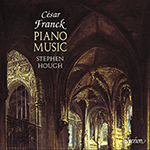 Franck: Piano Music Franck: Piano MusicCDA66918  This recording contains all of the mature piano music by César Franck, and includes Stephen Hough’s own stunning transcription of the ‘Troisième Choral’, originally composed for organ. Also featured is the ‘Grand Caprice’, one of numerous ‘salon’- ...» More |