
Welcome to Hyperion Records, a British classical label devoted to presenting high-quality recordings of music of all styles and from all periods from the twelfth century to the twenty-first.
Hyperion offers both CDs, and downloads in a number of formats. The site is also available in several languages.
Please use the dropdown buttons to set your preferred options, or use the checkbox to accept the defaults.

Beethoven’s obvious model for the tight integration of slow introduction and allegro was the first movement of Haydn’s ‘Drumroll’ Symphony, No 103, likewise in E flat and 6/8 time. The connection between the two works carries over into their not-so-slow second movements. Both are cast as a set of double variations on two alternating and related themes, one in C minor, the other in C major. Haydn begins in C minor and ends in C major. Beethoven reverses the process, opening with a charmingly demure – and distinctly Haydnesque – C major tune, and closing with fragments of the truculent, faintly Hungarian-sounding C minor theme, linked to the C major by its flicking ‘Scotch snap’ figures. After a full variation of each theme (the C major in wonderfully airy, dancing textures), the second variation of the C major tune is drastically shortened; then, in the movement’s climactic section, Beethoven powerfully exploits the C minor theme’s exotic, Hungarian flavour, with violin and cello in turn hurling out the tune against flamboyant keyboard figuration.
The third movement, noted as a minuet in the composer’s sketches but in the autograph marked simply ‘Allegretto ma non troppo’, is in A flat rather than the expected E flat major. The trio is thus the earliest instance in Beethoven of a work with movements in three different keys, a pattern he repeated in the ‘Harp’ Quartet of 1809, where the tonal centres are again E flat, A flat and C. Hearing this exquisitely tender, lulling music ‘blind’, many listeners would exclaim ‘Schubert!’. And it left a profound effect on the younger composer in a piece like the A flat Impromptu D935 No 2. Yet this romantic intermezzo, with its contrasting ‘trio’ that dissolves magically back into the main section, also recalls Haydn by quoting the beginning of the famous Largo from his Symphony No 88. Could it be that Beethoven, who had made peace with the now frail old man at a performance of The Creation in March 1808, consciously or unconsciously conceived the whole trio as a homage to his former teacher? Certainly the genial and exhilarating finale, full of rhythmic wit and good-humoured instrumental repartee, recreates Haydn’s spirit in terms of Beethoven’s own ‘middle period’ style. In keeping with the whole trio, the movement shows a fondness for relationships between keys a third apart: the gloriously exuberant second group of themes is in G major rather than the orthodox B flat, and is later recapitulated in C major. This prolonged emphasis on C major demands a long coda affirming the tonic, E flat. But what Beethoven gives us is not so much a coda as a second, varied, recapitulation that brings back all the themes in reverse order, then subsides to a quizzical pianissimo before generating a rousing send-off from the opening scales.
from notes by Richard Wigmore © 2003
Le modèle évident de Beethoven en ce qui concerne l’intégration étroite du mouvement lent à l’Allegro est emprunté au premier mouvement de la Symphonie n°103 dite « Drumroll » de Haydn, également en mi bémol majeur. La relation entre les deux œuvres se poursuit dans leurs seconds mouvements dénués de lenteur. Tous deux sont élaborés en un recueil de double variation sur deux thèmes alternés et parents, l’un en do mineur, l’autre en do majeur. Haydn débute en do mineur et finit en do majeur. Beethoven renverse le procédé, débutant par une mélodie d’une retenue charmante – typique de Haydn d’ailleurs – en do majeur, et terminant par des fragments du thème truculent, vaguement teinté d’un air hongrois, en do mineur, associé à celui majeur par les motifs virevoltants en « rythme lombard ». Après une variation complète de chaque thème (celui en do majeur réalisé dans des textures merveilleusement aériennes et dansantes), la seconde variation de la mélodie en do majeur est dramatiquement écourtée, puis dans la section de tension maximale du mouvement, Beethoven exploite avec force l’exotisme du thème en do mineur, les saveurs hongroises avec le violon et le violoncelle qui clament la mélodie à tour de rôle sur les motifs flamboyants du clavier.
Le troisième mouvement, noté menuet dans les esquisses du compositeur mais simplement qualifié de « Allegretto ma non troppo » dans l’autographe, est en la bémol et non dans la tonalité attendue de mi bémol majeur. Le trio est ainsi donc le premier exemple chez Beethoven d’une œuvre dotée de mouvements dans trois tonalités différentes, un procédé qu’il reprendra dans le Quatuor dit de « La Harpe » en 1809 où les centres tonals sont, une fois encore, mi bémol, la bémol et do. Si l’on écoutait cette musique apaisante d’une tendresse exquise sans en connaître l’auteur, on pourrait croire à du Schubert ! Elle suscita d’ailleurs chez le jeune compositeur un sentiment profond comme en témoigne une pièce tel l’Impromptu D935 n°2 en la bémol majeur. Pourtant, cet intermezzo romantique, avec son « trio » contrastant qui se dissout magiquement en une section principale évoque également Haydn en citant le début du célèbre Largo de la Symphonie n°88. Serait-il possible que Beethoven, qui s’était réconcilié avec le frêle vieil homme lors d’une exécution de La Création en mars 1808 ait conçu tout ce trio comme un hommage à son ancien professeur ? Il est vrai que le finale génial et exubérant, plein de vitalité rythmique, riche en réparties instrumentales enjouées, recrée l’esprit de Haydn dans des termes propres au style du Beethoven de la seconde période. A la manière du trio, le mouvement dévoile une attirance pour les relations tonales à la tierce : le second groupe thématique glorieusement exubérant est en sol majeur, et non le si bémol orthodoxe, tandis qu’il renoue avec do majeur durant la réexposition. Cette emphase prolongée sur do majeur nécessite une longue coda affirmant la tonique, mi bémol. Mais ce que Beethoven nous offre n’est pas tant une coda qu’une seconde réexposition variée qui rappelle les thèmes en ordre inversé, puis perdure en un pianissimo énigmatique avant que les gammes brillantes initiales ne viennent conclure l’affaire avec brio.
extrait des notes rédigées par Richard Wigmore © 2003
Français: Isabelle Battioni
Beethovens Vorbild für die enge Verzahnung von langsamer Introduktion und Allegro war eindeutig der Kopfsatz von Haydns ebenfalls in Es-Dur angelegter Sinfonie Nr. 103 “mit dem Paukenwirbel”. Und die Bezüge zwischen den beiden Werken setzen sich bis in die garnicht so langsamen zweiten Sätze fort. Beide sind als Folge von Doppelvariationen über zwei alternierende und miteinander verwandte Themen angelegt, von denen eines in c-Moll, das andere in C-Dur steht. Haydn beginnt in c-Moll und endet in C-Dur. Beethoven kehrt die Reihenfolge um und setzt mit einer bezaubernd sittsamen – und unbedingt an Haydn gemahnenden – C-Dur-Melodie ein, um mit Bruchstücken des aufsässigen, leicht ungarisch anmutenden c-Moll-Themas zu schließen, das durch seine schnalzenden “Scotch-Snap”-Figuren mit dem Abschnitt in C-Dur verbunden ist. Nach einer vollständigen Variation jedes Themas (wobei jenes in C-Dur wundervoll luftige, tänzerische Texturen aufweist), wird die zweite Variation der C-Dur-Melodie drastisch verkürzt; danach bringt Beethoven am Höhepunkt des Satzes eindrucksvoll den exotischen ungarischen Anklang des c-Moll-Themas zum Tragen, wenn Geige und Cello abwechselnd über farbenprächtiger Kavierfiguration die Melodie hervorschleudern.
Der dritte Satz, in den Entwürfen des Komponisten als Menuett markiert, aber im autographischen Manuskript schlicht als “Allegretto ma non troppo” bezeichnet, steht in As-Dur statt dem zu erwartenden Es-Dur. Das Trio ist demzufolge das früheste Werk Beethovens mit Sätzen in drei verschiedenen Tonarten – er bediente sich des gleichen Musters beim “Harfenquartett” von 1809, dessen tonale Anker wiederum Es, As und C sind. Beim “blinden” Anhören dieser bezaubernd zarten, einlullenden Musik würde manch einer sicherlich “Schubert” ausrufen! Und sie hinterließ bei dem jüngeren Komponisten auch einen entsprechend tiefen Eindruck, wie z.B. aus dessen Impromptu in As-Dur op. 142 Nr. 2 (D 935) zu ersehen ist. Doch dieses romantische Intermezzo mit seinem kontrastierenden “Trio”, das sich wie magisch wieder in den Hauptabschnitt auflöst, erinnert insofern auch an Haydn, als es den Anfang des berühmten Largo aus dessen Sinfonie Nr. 88 zitiert. Könnte es sein, dass Beethoven, der sich mit dem inzwischen gebrechlichen alten Mann bei einer Aufführung der Schöpfung im März 1808 versöhnt hatte, das ganze Trio bewusst oder unbewusst als Huldigung an seinen ehemaligen Lehrer konzipiert hatte? Das liebenswürdige und erhebende Finale voll rhythmischem Witz und gutmütigem instrumentalem Wechselspiel beschwört jedenfalls Haydns Geist herauf, umgesetzt in den Stil von Beethovens eigener “mittlerer” Schaffensperiode. Der Gesamtanlage des Trios entsprechend zeigt der Satz eine Vorliebe für Tonarten, die eine Terz auseinanderliegen: Die wunderbar überschwängliche zweite Themengruppe steht in G-Dur statt dem orthodoxen B und wird später einer Reprise in C-Dur unterzogen. Diese anhaltende Hervorhebung von C-Dur verlangt eine ausführliche Coda, in der die Tonika Es-Dur bekräftigt wird. Doch Beethoven bietet uns weniger eine Coda als vielmehr eine zweite, variierte Reprise, die alle Themen in umgekehrter Reihenfolge anführt, um dann in ein zweifelndes Pianissimo abzuklingen, ehe die brillanten Skalen der Eröffnung zu einem mitreißenden Abschluss wiederkehren.
aus dem Begleittext von Richard Wigmore © 2003
Deutsch: Anne Steeb/Bernd Müller
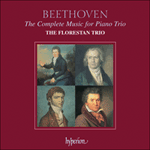 Beethoven: The Complete Music for Piano Trio Beethoven: The Complete Music for Piano TrioCDS44471/44CDs Boxed set (at a special price)  Each instalment of The Florestan Trio’s Beethoven Piano Trio cycle was rapturously received. Now reissued as a special-price box-set, this superb series of benchmark recordings should not be missed.» More |