Welcome to Hyperion Records, a British classical label devoted to presenting high-quality recordings of music of all styles and from all periods from the twelfth century to the twenty-first.
Hyperion offers both CDs, and downloads in a number of formats. The site is also available in several languages.
Please use the dropdown buttons to set your preferred options, or use the checkbox to accept the defaults.

| Marc-André Hamelin (piano), Takács Quartet» More |
The second movement is a four-voiced fugue beginning with a strict exposition by the muted strings in this order: violin I, violin II, cello, viola. The subject’s answer is tonal, and the fugue continues with the entry of the piano, which almost paradoxically reduces the texture to two lines, reverting to four later. Towards the end of the fugue G major is again tentatively established, but this time by its first inversion – which has B as the root. This subtle point leads directly to the B major tonality of the central movement, the whirlwind Scherzo. This is the first occasion all five instruments have played together for an extended passage in the Quintet, and the central (in classical procedure, the trio) section begins as a danse macabre from first violin, taken up by the piano in high octaves. A reprise of the scherzo leads to a breathless coda.
The Intermezzo is cool and relaxed, with unhurried and essentially single-line music over a gentle walking bass. This builds into a fine and impassioned climax which dies away, finally leaving Ds separated by six octaves. At last, the deep tonal plan of this masterpiece becomes clear: D both completes the major triadic endings of the movements (G, B and now D), implying the final major mode, and is also the classical dominant of G, in which major key the Finale follows, attacca, stealing in with a gentle piano theme, itself having grown thematically from the intial germinal ideas. As the movement progresses, other ideas are recalled, and the music now smiles rather than laughs until, in the closing bars, the Quintet ends gently but swiftly in a complaisant G major.
from notes by Robert Matthew-Walker © 2004
Le deuxième mouvement est une fugue à quatre voix qui commence par une exposition stricte aux cordes en sourdine, dans cet ordre: violon I, violon II, violoncelle, alto. La réponse du sujet est tonale et la fugue se poursuit avec l’entrée du piano qui, presque paradoxalement, réduit la texture à deux lignes pour revenir à quatre lignes ultérieurement. Vers la fin de la fugue, le sol majeur est de nouveau timidement rétabli, cette fois dans sa première inversion, avec le si à sa racine. Ce point subtil mène directement à la tonalité de si majeur dans le scherzo tourbillonnant du mouvement central. Pour la première fois, les cinq instruments jouent un long passage ensemble, et la section centrale (à la manière classique, représentée par le trio) entame une danse macabre au premier violon, empruntée par le piano aux octaves supérieures. La reprise du scherzo mène à une coda haletante.
L’Intermezzo est calme et détendu. Le mouvement prend son temps, marqué par une ligne unique de musique sur une basse douce et régulière. L’ensemble progresse vers un sommet subtil et exalté qui se termine en mourant, sur des ré que séparent six octaves. Enfin, le plan tonal profond de ce chef d’œuvre devient plus clair: le ré complète la conclusion triadique des mouvements (sol, si et maintenant ré), suggérant le mode majeur final. Mais il s’agit aussi de la dominante classique de sol, tonalité majeure du finale. Il entre en scène par un thème très doux au piano, thème marqué lui-même par une évolution depuis ses idées d’origine. Alors que le mouvement progresse, d’autres idées sont rappelées, et la musique sourit, à défaut de rire, dans les mesures finales, jusqu’à ce que le quintette ne s’envole rapidement sur une tonalité complaisante de sol majeur.
extrait des notes rédigées par Robert Matthew-Walker © 2004
Français: Marie Luccheta
Der zweite Satz ist eine vierstimmige Fuge, die mit einer strengen Exposition beginnt, in der die sordinierten Streicher in der folgenden Reihefolge einsetzen: I. Violine, II. Violine, Violoncello und Viola. Die Beantwortung des Themas ist tonal. Dann fährt die Fuge mit dem Einsatz des Klaviers fort, das auf fast paradoxe Weise den Stimmsatz zur Zweistimmigkeit reduziert und erst später zur Vierstimmigkeit zurückkehrt. Gegen Ende der Fuge wird wiederum G-Dur wage eingeführt, aber diesmal in Form seiner ersten Umkehrung – wo H den Grundton bildet. Dieser feine Kunstgriff führt direkt zur Tonart H-Dur des Mittelsatzes: das stürmische Scherzo. Hier spielen zum ersten Mal im Quintett alle fünf Instrumente eine längere Passage zusammen. Der mittlere Abschnitt (konventionell käme hier ein Trio) beginnt in der ersten Violine als ein Danse macabre, der vom Klavier in hohen Oktaven übernommen wird. Eine Reprise des Scherzos führt zu einer atemlosen Coda.
Das Intermezzo ist kühl und entspannt mit einer ruhigen, im Wesentlichen einstimmigen Musik über einen gemächlich fortschreitenden Bass. Das entwickelt sich zu einem feinen und leidenschaftlichen Höhepunkt, der verklingt, bis schließlich nur die Note D auf sechs Oktaven verteilt übrig bleibt. Endlich entpuppt sich das zugrunde liegende Tonartenschema dieses Meisterwerkes: D war in allen aus Durakkorden bestehenden Satzschlüssen (G, H und jetzt D) enthalten und lässt vermuten, das das Werk auch als Ganzes in Dur enden wird. D ist aber auch die klassische Dominante von G, in dessen Dur-Variante der Schlusssatz attacca folgt. Dieser Satz schleicht sich mit einem zarten Klavierthema ein, das selber thematisch aus den anfänglichen Grundgedanken erwachsen ist. Im Verlauf des Satzes werden auch andere musikalische Motive in Erinnerung gerufen. Die Musik lächelt nun eher, als das sie lacht, bis in den abschließenden Takten das Quintett sanft und doch geschwind in einem gefälligen G-Dur endet.
aus dem Begleittext von Robert Matthew-Walker © 2004
Deutsch: Elke Hockings
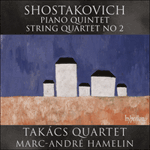 Shostakovich: Piano Quintet & String Quartet No 2 Shostakovich: Piano Quintet & String Quartet No 2Studio Master: CDA67987Studio Master FLAC & ALAC downloads available  Shostakovich’s Piano Quintet and String Quartet No 2 have never sounded more portentous than in the sonorous hands of the Takács Quartet and Marc-André Hamelin. An important recording.» More |
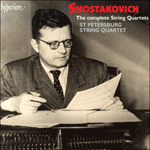 Shostakovich: The Complete String Quartets Shostakovich: The Complete String QuartetsCDS44091/66CDs Boxed set (at a special price) — Download only ‘These players approach Shostakovich's mighty cycle with a natural authority that's unanswerable, along with tireless precision and virtuosity, plus a ... ‘The St Petersburg musicians play with tremendous control of technique and expression; the effect is one of huge emotional strength’ (Birmingham Post)» More |