Welcome to Hyperion Records, a British classical label devoted to presenting high-quality recordings of music of all styles and from all periods from the twelfth century to the twenty-first.
Hyperion offers both CDs, and downloads in a number of formats. The site is also available in several languages.
Please use the dropdown buttons to set your preferred options, or use the checkbox to accept the defaults.

| Albion Quartet» More |
The first movement has claim to be Walton’s most perfect and original sonata structure, exhibiting a cohesive variety of invention that is immensely resourceful. The cohesion is the clarity of the music, wholly exceptional in immediate post-Second World War art, yet containing a wide range of varied material that is nonetheless organic throughout. The ‘classical’ string-quartet genre caused Walton to adopt ‘classical’ forms, but in ways that are new. We have a double exposition of theme and counterpoint, of lyrical first and gritty second subjects, which is repeated; there then follows a third theme of much rhythmic flexibility, derived from the first and second subjects. The development faces classical precepts head on, nothing less than a four-part fugue on a theme derived from first and second subjects, which flows into a new development, a freer fantasia that modulates beautifully towards the recapitulation, where first and second subjects are compressed. The arrival of the third theme, largely omitted in the development, sets off an original ‘developmental recapitulation’ before the extended coda muses gently on the opening ideas, spaciously and gently arriving at A minor.
The Scherzo (Presto) is placed second, as in the First Symphony, and has a tensile brilliance in contrast to the preceding Allegro, but whose quicksilver ending almost catches us by surprise. The Lento is one of Walton’s finest slow movements—relaxed, yet powerful and hauntingly beautiful, bringing a new character to his instrumental writing. The finale is an outpouring of concentrated energy, reinforcing A minor after the balm of F major in the slow movement, and the Phrygian E (a variant of the classical dominant) of the Scherzo. Structurally it is a rondo which recalls elements from the earlier movements in its varied episodes, which are in turn engulfed in the headlong rush to the breathless final bars.
from notes by Robert Matthew-Walker © 1994
Le premier mouvement peut être considéré à juste titre comme la forme sonate la plus originale et la plus achevée qu’ait composé Walton, offrant en effet une diversité cohésive d’inventions qui témoigne de son extrême habilité en tant que compositeur. Le deuxième mouvement est comme dans la Première Symphonie un Scherzo (Presto). Celui-ci a un brillant et une force souple contrastant avec I’Allegro précédent, mais ces dénouements de vif-argent nous prennent souvent par surprise. Le Lento est un des mouvements lents les plus accomplis qu’ait écrit Walton: modéré, mais vigoureux et d’une beauté obsédante, il apporte une nouvelle lumière sur son talent de compositeur. Le finale est une effusion d’énergie canalisée qui renforce la tonalité en la mineur du mouvement, après la quiétude du fa majeur du mouvement lent et le mi phrygien (une variante de la dominante classique) du Scherzo. Sa structure est un rondo qui fait écho à certains éléments des mouvements précédents dans ses épisodes variés, épisodes qui sont tour à tour engloutis dans le mouvement vertigineux et précipité des dernières mesures fébriles.
extrait des notes rédigées par Robert Matthew-Walker © 1994
Français: Béatrice Lesade
Der erste Satz kann Anspruch darauf erheben, Waltons perfekteste und originalste Sonatenstruktur zu sein, da er eine eng miteinander verbundene Vielzahl äußerst einfallsreicher Erfindungen aufweist.
Das Scherzo (Presto) wurde, wie in der Ersten Sinfonie, auf den zweiten Platz gestellt und besitzt, im Gegensatz zum voraufgehenden Allegro, eine weitgespannte Brillianz, deren lebhafter Schluß uns fast überrascht. Das Lento ist einer von Waltons großartigsten langsamen Sätzen—entspannt und doch kraftvoll und eindringlich schön. Es verleiht seiner Instrumentalmusik einen ganz neuen Charakter. Das Finale ist ein Ausströmen von konzentrierter Energie. Nach dem wohltuenden F-dur des langsamen Satzes und dem phrygischen E (einer Variante der klassischen Dominante) des Scherzos wird im Finale a-moll wieder bestätigt. Strukturell ist es ein Rondo, welches in seinen verschiedenen Episoden Elemente aus früheren Sätzen wieder zurückruft. Diese Elemente wiederum werden fast verschlungen in dem überstürzten Drängen zu den atemlosen Schlußtakten.
aus dem Begleittext von Robert Matthew-Walker © 1994
Deutsch: Angelika Malbert
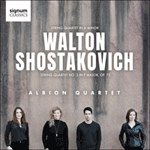 Walton & Shostakovich: String Quartets Walton & Shostakovich: String QuartetsStudio Master: SIGCD727Download onlyStudio Master FLAC & ALAC downloads available  William Walton's A minor string quartet—his second work in the genre, the first being a two-movement affair dating from the early 1920s—makes an intriguing pairing with Shostakovich's masterful third quartet in these new performances from the Albi ...» More |