
Welcome to Hyperion Records, a British classical label devoted to presenting high-quality recordings of music of all styles and from all periods from the twelfth century to the twenty-first.
Hyperion offers both CDs, and downloads in a number of formats. The site is also available in several languages.
Please use the dropdown buttons to set your preferred options, or use the checkbox to accept the defaults.

| Julian Bliss (clarinet), James Baillieu (piano)» More |
Although the slow second movement in A flat gives the impression of dreamy ease, it is also economical, and its return to the main theme through a foreign key characteristically saves space as it suggests leisure (one thinks of the slow movement of the Piano Concerto No 2). With the lyrical Allegretto grazioso we stay in A flat, and the F minor of the trio, with its syncopated accompaniment, is the last extended use of the tonic minor in the whole work.
The exuberant finale, Vivace, is in F major and its second subject looks like being one of those gloriously expansive Brahmsian themes in swinging triplets. But with the economy typical of this work, Brahms does not allow it to spread and it is soon invaded by terser action. At the end we feel that, although the sonata has been officially in F minor (Beethoven’s ‘barbarous’ key), it has been composed more with pleasure than pain.
from notes by Robert Simpson © 1986
Même s’il donne l’impression d’une aisance de rêve, le second mouvement lent en la bémol s’avère parcimonieux et son retour au thème principal, via une tonalité étrangère, économise typiquement de la place en suggérant l’idée de temps libre (l’on songe au mouvement lent du Concerto pour piano no2). Le lyrique Allegretto grazioso nous fait demeurer en la bémol, cependant que le fa mineur du trio, avec son accompagnement syncopé, est le dernier recours de toute l’œuvre au mineur de la tonique.
Quant à l’exubérant finale, Vivace, en fa majeur, il voit son second sujet ressembler à ces thèmes brahmsiens glorieusement expansifs, en triolets cadencés. Mais, toujours parcimonieux, Brahms ne laisse pas ce sujet s’éployer: une action plus laconique vient bientôt l’envahir. À la fin, il nous apparaît que, bien que composée officiellement en fa mineur – la tonalité «barbare» de Beethoven –, cette sonate fut écrite plus dans la joie que dans la douleur.
extrait des notes rédigées par Robert Simpson © 1986
Français: Hypérion
Obwohl der langsame Satz in As-Dur einen Eindruck träumerischen Wohlbehagens vermittelt, ist er gleichzeitig ökonomisch angelegt und die Rückkehr des Hauptthemas durch eine fremde Tonart spart an Raum und sorgt für ein Gefühl von Muße (man wird an den langsamen Satz des Klavierkonzerts Nr. 2 erinnert). In dem lyrischen Allegretto grazioso bleiben wir in As-Dur. Die Molltonika f-Moll erscheint zum letzten Mal im Trio, das außerdem eine synkopierte Begleitung hat.
Das überschwängliche Finale, Vivace, steht in F-Dur und das zweite Thema scheint zunächst eines jener wundervollen und ausgedehnten Brahmsschen Themen mit schwungvollen Triolen zu sein. Angesichts der Ökonomie des Werks lässt Brahms jedoch eine Entfaltung nicht zu und es wird bald durch eine knappere Figur verdrängt. Am Ende hat man den Eindruck, dass, obwohl die Sonate offiziell in f-Moll steht (Beethovens „barbarische“ Tonart), das Werk eher mit Vergnügen denn Schmerz komponiert wurde.
aus dem Begleittext von Robert Simpson © 1986
Deutsch: Viola Scheffel
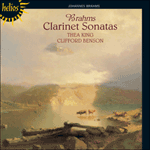 Brahms: Clarinet Sonatas Brahms: Clarinet SonatasCDH55158Download only  ‘Really, I have only two words to say about this disc—'Buy it!' (BBC Record Review)» More |
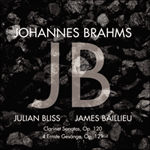 Brahms: Clarinet Sonatas & Vier ernste Gesänge Brahms: Clarinet Sonatas & Vier ernste GesängeStudio Master: SIGCD671Download onlyStudio Master FLAC & ALAC downloads available  Two of the finest chamber musicians around today revel in the supreme craftsmanship of Brahms's sublime clarinet sonatas—works inspired by the great clarinettist Richard Mühlfeld whose Mozartian brilliance coaxed the composer out of retirement to ...» More |