The eighteen
Little Preludes are among the most valuable pieces ever written for beginners. They form a bridge between the easiest pieces of the
Anna Magdalena Notebook (1725) and the Two-part Inventions, giving the player a wonderful introduction to voice imitation, pedal points, cadenza-like passages, and basic ornamentation. They cover many different moods, from the affirmative (all three preludes in C major), to the tender (the C minor minuet, BWV924), the improvisatory (BWV940), the joyful (BWV927 and 937), and the very grand (BWV928). The C minor prelude, BWV999, was originally written for the lute. Many of them are far from easy (the A minor, BWV942, for instance), and require quite complicated fingering (BWV943). Even in these little pieces, big decisions have to be made concerning tempo, phrasing, articulation, dynamics, and timing, and this challenges the teacher as much as the student. Bach wrote them for his son Wilhelm Friedemann and other pupils, but never grouped them into any particular arrangement. Like the French Suites, many of them survive only in copies made by another hand. There are several traditional groupings of which I have chosen one, changing the order of the first six to make a more pleasing progression in performance. For me they recall fond childhood memories, and are as fascinating now as they were then.
from notes by Angela Hewitt © 1995
Les dix-huit
Petits Préludes figurent parmi les morceaux les plus précieux pour débutants. Ils permettent de passer des morceaux les plus faciles du
Petit Livre d’Anna Magdalena Bach (1725) aux inventions à deux voix et donnent à liinterprète une remarquable initiation à l’imitation de la voix, aux points d’orgue, aux passages de cadences, et à l’ornementation de base. Ils couvrent de nombreux modes différents, de l’affirmatif (les trois préludes en do majeur), au tendre (le menuet en ut mineur, BWV924), à l’improvisé (BWV940), au joyeux (BWV927 et 937), et au très grand (BWV928). Le prélude en ut mineur, BWV999, était écrit à l’origine pour le luth. Beaucoup d’entre eux sont loin d’être faciles (celui en la mineur, BWV942, par exemple) et exigent un doigté assez compliqué (BWV943). Même dans ces petits morceaux, il faut prendre des décisions importantes en ce qui concerne le tempo, le phrasé, l’articulation, les nuances et le sens du rythme, ce qui met à l’épreuve aussi bien le professeur que l’étudiant. Bach les a composés pour son fils, Wilhelm Friedemann, et pour ses autres élèves, mais ne les a jamais regroupés dans un arrangement particulier. Comme les Suites françaises, il n’en reste plus que des copies. Il y a plusieurs groupements traditionnels, j’en ai choisi un et j’ai changé l’ordre des six premiers pour que l’interprétation ait une progression plus agréable. Ils me rappellent de tendres souvenirs d’enfance, et sont aussi fascinants maintenant qu’ils l’étaient alors.
extrait des notes rédigées par Angela Hewitt © 1995
Français: Sophie Dameron
Die achtzehn
Kleinen Präludien gehören zu den wertvollsten Stücken, die je für Anfänger geschrieben wurden. Sie bilden eine Brücke zwischen den einfachen Werken aus dem
Clavierbüchlein für Anna Magdalena Bach (1725) und den Zweistimmigen Inventionen, die die Spieler auf wundervolle Weise in die Stimmenimitation, Orgelpunkte, kadenzähnlichen Passagen, und grundlegende Verzierungen einführen. Sie decken viele verschiedenen Stimmungen ab – von der bejahenden (alle drei Präludien in C-Dur), der sanften (das Menuett in c-moll, BWV924), der improvisierenden (BWV940), zu der freudigen (BWV927 und 937), und der äußerst prachtvollen (BWV928). Das Präludium in c-moll, BWV999, wurde ursprünglich für die Laute geschrieben. Viele der Präludien sind alles andere als leicht (die in a-moll, BWV942, zum Beispiel), und erfordern einen ziemlich komplizierten Fingersatz (BWV943). Sogar in diesen kurzen Stücken müssen wichtige Entscheidungen in Bezug auf das Zeitmaß, das Phrasieren, die Artikulation, Dynamik und das Timing getroffen werden, und dieses fordert sowohl den Lehrer als auch den Schüler heraus. Bach schrieb sie für seinen Sohn, Wilhelm Friedemann, und seine anderen Schüler, schloß sie aber nie in einer besonderen Anordnung zusammen. Wie die Französischen Suiten sind viele von ihnen nur in Kopien, die von Dritten erstellt wurden, erhaltengeblieben. Es gibt verschiedene traditionelle Anordnungen, von denen ich eine ausgesucht habe, während ich die Reihenfolge der ersten sechs verändert habe, um einen angenehmeren Ablauf der Darbietung zu gewährleisten. Sie bringen schöne Erinnerungen an meine Kindertage zurück, und sind heute wie damals gleich faszinierend.
aus dem Begleittext von Angela Hewitt © 1995
Deutsch: Elke Millies


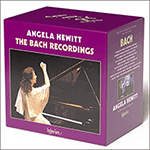 Bach: Angela Hewitt – The Bach Recordings
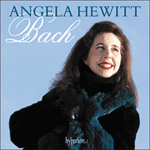 Bach: Angela Hewitt plays Bach
 Bach: Preludes, Inventions & Sinfonias