Welcome to Hyperion Records, a British classical label devoted to presenting high-quality recordings of music of all styles and from all periods from the twelfth century to the twenty-first.
Hyperion offers both CDs, and downloads in a number of formats. The site is also available in several languages.
Please use the dropdown buttons to set your preferred options, or use the checkbox to accept the defaults.

| The Nash Ensemble» More |
The opening allegro con spirito, which is cast in a D minor sonata form, is thrillingly tumultuous; indeed, it has the feeling of starting in medias res, the main theme having a curiously circular harmonic characteristic that Benedict Taylor suggests reveals the continuing influence of Schumann, and which allows for plenty of repetition. This harmonic circularity also characterizes the A major second subject, which likewise eschews cadential closure. A development section that climaxes in A flat minor eventually leads us back to a full-throated return of the main theme and re-statement of the second subject in the parallel major. The movement ends with a coda that is underpinned by a long dominant pedal; this is eventually resolved harmonically by a ‘più mosso, vivace assai’ section and a concluding prestissimo as we rush to the finish in unambiguous, symphonic-sounding D minor. The adagio second movement, though, opens unmistakably in the sonorous world of the composer’s earlier Serenade for strings (1880), and Roland John Wiley posits that this self-referentiality is a sign of both compositional lateness and, indeed, Tchaikovsky’s awareness of his mortality and declining health. The graceful ‘Florence’ melody itself is then heard in the first violin in D major, climaxing in a declamatory A major theme. A spooky, texturally unified central D minor section, with surging dynamics and off-beat accents, is followed by a return of the ‘Florence’ melody in the first cello, with the triplet pizzicatos now compressed into semiquavers, and featuring a repeat of the declamatory theme, this time in the home key of D major.
The revised final two movements have a distinctive folk-like character. The allegretto moderato begins with a mournful A minor viola theme that is explored contrapuntally before culminating in a melodic passage of unison cellos, with the other strings providing machine-gun-style chordal accompaniment. The section ends with distinctive repeated pairs of tritone-separated triads (an octatonic progression also beloved of Korngold) that lead to a central cheery A major section which provides a contrasting sparkling vivacity courtesy of its distinctive thrown saltando bowing and pizzicato leaps. A return to the A minor theme combined with elements of the saltando figurations of the central section characterizes the final part of the movement. The work’s closing allegro vivace then begins with a typically Russian-sounding D minor/Aeolian theme but soon shows Tchaikovsky exploring the contrapuntal possibilities of his six instrumental voices. A graceful theme in C major provides temporary respite, but before long Tchaikovsky is drawn back into ‘academic’ developmental procedures. Thus, the centrepiece of the movement is a fugal section that caused the composer considerable unease: despite its strict ‘correctness’, he worried in a letter to Eugen Albrecht about its perceived dissonance. A three-part fugato had been cut from the revised third movement, but this moment of high seriousness survived revisions to the fourth movement. The return of the graceful theme in the home key of D major resolves the remaining harmonic tension of the movement, and Tchaikovsky uses an increased ‘più vivace’ tempo to generate the excitement that takes the work to its conclusion, with the folk-like theme appearing triumphantly in unambiguous D major.
from notes by Ben Winters © 2024
L’allegro con spirito initial, coulé dans une forme sonate en ré mineur, est d’une agitation saisissante; en fait, il donne l’impression de débuter in medias res, le thème principal ayant une caractéristique harmonique étrangement circulaire qui, selon une suggestion de Benedict Taylor, révèle l’influence soutenue de Schumann, et qui permet plein de reprises. Cette circularité harmonique caractérise aussi le second sujet en la majeur qui évite de même la clôture cadentielle. Un développement qui atteint son point culminant en la bémol mineur nous ramène finalement à un retour retentissant du thème principal et à une réexposition du second sujet au parallèle majeur. Le mouvement s’achève avec une coda étayée par une longue pédale de dominante; l’ensemble se résout finalement harmoniquement par une section «più mosso, vivace assai» et un prestissimo conclusif lorsque l’on se précipite vers la fin dans un ré mineur aux sonorités symphoniques sans équivoque. Le deuxième mouvement, adagio, débute toutefois de façon bien nette dans l’univers sonore de la Sérénade pour cordes (1880) antérieure du compositeur, et Roland John Wiley avance que ce côté autoréférentiel est un signe à la fois de retard en matière de composition et, en fait, de la conscience qu’avait Tchaïkovski de sa santé déclinante et de sa mortalité. La gracieuse mélodie «Florence» elle-même est ensuite exposée au premier violon en ré majeur, atteignant son point culminant dans un thème déclamatoire en la majeur. Une section centrale unifiée sur le plan texturel en ré mineur, avec une dynamique montant en flèche et des accents sur les temps faibles, est suivie d’un retour de la mélodie «Florence» au premier violoncelle, avec les triolets de pizzicatos maintenant comprimés en doubles croches, avec une reprise du thème déclamatoire, cette fois dans la tonalité d’origine de ré majeur.
Les deux derniers mouvements révisés ont un caractère populaire caractéristique. L’allegretto moderato commence avec un thème d’alto mélancolique en la mineur qui est exploré de façon contrapuntique avant de culminer dans un passage mélodique des violoncelles à l’unisson, les autres instruments à cordes assurant un accompagnement en accords dans le style d’une mitrailleuse. Cette section s’achève avec des paires répétées caractéristiques d’accords parfaits séparés par des tritons (une progression octatonique également appréciée par Korngold) qui mènent à une joyeuse section centrale en la majeur d’une brillante vivacité contrastée grâce à ses coups d’archet saltando et ses sauts pizzicato. Un retour au thème en la mineur associé à des éléments des figurations saltando de la section centrale caractérise la partie finale du mouvement. L’allegro vivace conclusif de cette œuvre débute ensuite avec un thème éolien en ré mineur à la sonorité typiquement russe mais on voit bientôt Tchaïkovski explorer les ressources contrapuntiques des six voix instrumentales. Un gracieux thème en ut majeur offre un répit passager, mais Tchaïkovski revient vite aux procédés de développement «académiques». Ainsi, le clou du mouvement est une section fuguée qui causa au compositeur beaucoup d’appréhension: malgré sa stricte «rigueur», il s’inquiéta dans une lettre à Eugen Albrecht de sa dissonance perçue. Un fugato à trois parties a été coupé lors de la révision du troisième mouvement, mais ce moment de grand sérieux a survécu aux révisions du quatrième mouvement. Le retour du gracieux thème dans la tonalité d’origine de ré majeur résout la tension harmonique restante du mouvement, et Tchaïkovski utilise un tempo «più vivace» accru pour créer l’excitation qui mène l’œuvre à sa conclusion, avec le thème dans le genre de la musique traditionnelle qui apparaît triomphalement dans un ré majeur sans équivoque.
extrait des notes rédigées par Ben Winters © 2024
Français: Marie-Stella Pâris
Das eröffnende Allegro con spirito in d-Moll ist in Sonatenform gehalten und verläuft aufregend und turbulent; man hat das Gefühl gleich in medias res zu sein, wobei das Hauptthema eine ungewöhnlich zyklische Harmonie aufweist, die laut Benedict Taylor den anhaltenden Einfluss von Schumann erkennen lässt und viele Wiederholungen erlaubt. Diese harmonische Zirkularität kennzeichnet auch das zweite Thema in A-Dur, welches ebenfalls auf einen kadenzierenden Abschluss verzichtet. Ein Durchführungsabschnitt, dessen Höhepunkt in as-Moll erklingt, führt schließlich zu einer volltönenden Rückkehr des Hauptthemas und einer erneuten Wiederholung des zweiten Themas in der Durvariante. Der Satz endet mit einer Coda, der ein langer Orgelpunkt auf der Dominante zugrunde liegt. Dies wird schließlich harmonisch durch einen „Più mosso, vivace assai“-Abschnitt und ein abschließendes Prestissimo aufgelöst, in dem die Musik auf ein eindeutiges, symphonisch klingendes Ende in d-Moll zueilt. Der zweite Satz, Adagio, beginnt jedoch unverkennbar in der Klangwelt von Tschaikowskys früherer Serenade für Streicher (1880), und Roland John Wiley vermutet, dass dieser Bezug auf seine eigene Musik sowohl ein Merkmal eines Spätwerks als auch ein Hinweis auf Tschaikowskys Bewusstsein über seine schwindende Gesundheit und Sterblichkeit ist. Die anmutige „Florence“-Melodie selbst wird dann von der ersten Violine in D-Dur gespielt und gipfelt in einem deklamatorischen A-Dur-Thema. Auf einen gespenstischen, strukturell einheitlichen d-Moll-Abschnitt mit anschwellender Dynamik und Akzenten auf unbetonten Zählzeiten in der Mitte des Satzes folgt eine Wiederholung der „Florence“-Melodie im ersten Cello, wobei die Pizzicato-Triolen nun zu Sechzehntelnoten komprimiert sind und das deklamatorische Thema wiederholt wird, diesmal in der Ausgangstonart D-Dur.
Die beiden überarbeiteten Schlusssätze haben einen ausgeprägten volksmusikartigen Charakter. Das Allegretto moderato beginnt mit einem schwermütigen a-Moll-Thema der Bratsche, das kontrapunktisch ausgearbeitet wird, bevor es in einer melodischen Passage der Unisono-Celli gipfelt, wobei die anderen Streicher eine maschinengewehrartige Akkordbegleitung liefern. Der Abschnitt endet mit markanten Dreiklangspaaren im Tritonusabstand (eine oktatonische Fortschreitung, für die Korngold ebenfalls eine Vorliebe hatte), die zu einem heiteren A-Dur-Abschnitt führen, welcher dank Saltando-Bogenstrich und Pizzicato-Sprüngen eine kontrastierende funkelnde Lebendigkeit bietet. Im letzten Teil des Satzes erfolgt eine Rückkehr zum a-Moll-Thema, kombiniert mit Elementen der Saltando-Figurationen des Mittelteils. Das abschließende Allegro vivace beginnt mit einem typisch russisch klingenden d-Moll-Äolsthema, zeigt aber bald, dass Tschaikowsky die kontrapunktischen Möglichkeiten seiner sechs Instrumentalstimmen auslotet. Ein anmutiges C-Dur-Thema sorgt für eine vorübergehende Atempause, doch schon bald wird Tschaikowsky wieder in „akademische“ Entwicklungsprozesse hineingezogen. So ist das Herzstück des Satzes ein fugierter Abschnitt, der dem Komponisten erhebliches Unbehagen bereitete: trotz seiner strikten „Ordnungsmäßigkeit“ sorgte Tschaikowsky sich in einem Brief an Eugen Albrecht über die gefühlte Dissonanz des Stücks. Ein dreistimmiges Fugato war aus dem revidierten dritten Satz gestrichen worden, doch dieser zutiefst ernste Moment überdauerte die Revisionen des vierten Satzes. Die Rückkehr des anmutigen Themas in der Ausgangstonart D-Dur löst die verbleibenden harmonischen Spannungen des Satzes auf, und Tschaikowsky verwendet ein gesteigertes „Più vivace“-Tempo, um die Erregung zu erzeugen, die das Werk zu seinem Abschluss führt, wobei das volkstümliche Thema triumphierend in unmissverständlichem D-Dur erklingt.
aus dem Begleittext von Ben Winters © 2024
Deutsch: Viola Scheffel
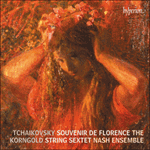 Tchaikovsky & Korngold: String Sextets Tchaikovsky & Korngold: String SextetsStudio Master: CDA68406Studio Master FLAC & ALAC downloads available  The Nash Ensemble responds thrillingly to the lush, heady Romanticism which courses through Tchaikovsky’s ‘Souvenir de Florence’ and Korngold’s string sextet, two of the greatest contributions to the genre. Both works can seldom have sounded so pe ...» More |