This is another poem from Albert Samain’s
Au jardin de l’Infante. The song is Fauré’s final farewell to the courtly world of Verlaine’s
Fêtes galantes – the park that is mentioned here with its ‘nymphs’ suggest an eighteenth-century landscape au clair de lune. Samain’s poem itself is part of a fantasy sequence (an extended
Embarquement pour Cythère) which begins with a parody of Gautier’s
Où voulez-vous aller?.
Nocturne, the poem before
Arpège, describes a ‘Fête à Bergame’ (the ‘bergamasque’, a dance that originated in Bergamo, appears in the Fauré/Verlaine
Clair de lune) where ‘Lulli’ conducts an orchestra of strings and flutes. Lully wrote the original music for
Le bourgeois gentilhomme (1670) and
Arpège has a strong similarity to the
Sérénade from Fauré’s music for the same Molière play (1893) – a 9/8 rhythm with skipping dotted rhythms, and similar trills and ornaments. Are these allusions meant to amuse Emma Bardac, fan of Samain’s poetry? The music for the first strophe in the minor key is elegant and deft, somewhat malign (for a ‘nuit de mensonge’); the second strophe recalls the barcarolle of the Venetian
À Clymène (gondolas are a feature of this Samain fantasy sequence); the final verse in the major key is perhaps the most original with its sighing descents of triplets in octaves, music for a swoon, if not a Liebestod, compressed sequences of harmony in continual metamorphosis. The postlude, now in the major key, traverses the keyboard lightheartedly, bottom to top, as if to admit that the whole of this song has been nothing more than a jeu d’esprit at a fancy-dress ball.
from notes by Graham Johnson © 2005
Arpège désigne un autre poème issu d’
Au jardin de l’Infante (Albert Samain) et l’ultime adieu de Fauré au monde courtisan des
Fêtes galantes verlainiennes—le parc, avec ses « nymphes », évoque un paysage dix-huitiémiste, au clair de lune. Le poème de Samain ressortit lui-même à une séquence-fantaisie (un
Embarquement pour Cythère prolongé) , qui commence par une parodie d’
Où voulez-vous aller ? de Gautier.
Nocturne, le poème qui précède
Arpège, dépeint une « Fête à Bergame » (la « bergamasque », danse originaire de Bergame, apparaît d’ailleurs dans le
Clair de lune de Fauré/Verlaine), où « Lulli » dirige un orchestre de cordes et de flûtes. Lully composa la musique originale du
Bourgeois gentilhomme (1670) et
Arpège ressemble beaucoup à la
Sérénade tirée de la musique écrite par Fauré pour la même pièce de Molière (1893)—un 9/8 aux rythmes pointés sautillants, avec trilles et ornements. Ces allusions sont-elles là pour divertir Emma Bardac, admiratrice de la poésie de Samain ? La musique de la première strophe, en mineur, est élégante et habile, un rien pernicieuse (à « une nuit de mensonge ») ; la deuxième strophe rappelle la barcarolle de l’
À Clymène vénitienne (les gondoles font partie de la séquencefantaisie de Samain) ; la dernière strophe, en majeur, est peut-être la plus originale des trois, avec ses soupirantes descentes de triolets en octaves—une musique de pâmoison, sinon de Liebestod—et ses séquences harmoniques comprimées, en perpétuelle métamorphose. Le postlude, désormais en majeur, traverse le clavier le coeur léger, de bas en haut, comme pour admettre que toute cette mélodie n’a été qu’un jeu d’esprit à un bal masqué.
extrait des notes rédigées par Graham Johnson © 2005
Français: Hypérion

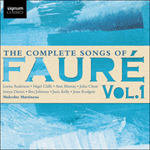 Fauré: The Complete Songs, Vol. 1