Welcome to Hyperion Records, a British classical label devoted to presenting high-quality recordings of music of all styles and from all periods from the twelfth century to the twenty-first.
Hyperion offers both CDs, and downloads in a number of formats. The site is also available in several languages.
Please use the dropdown buttons to set your preferred options, or use the checkbox to accept the defaults.

The ‘Eroica’ variations are his most bravura-orientated set. The work opens with a single massive chord of E flat major, summoning our attention. Then Beethoven begins solely with the bass of the theme (just as he does in the symphony), which nevertheless has much life of its own. Three variations on the bass follow, each time adding another voice. Only then do we hear the ‘real’ theme, which should immediately remind us of its dance origins. The fifteen variations following that delight us with their compositional and pianistic fancies. There is a lot of hand-crossing, and an awful lot of jumping about, and the mood on the whole—at least until we reach the mysterious variation 14 in minor mode—is one of joyous carnival. Or as the critic and musicologist Michael Steinberg once said: ‘It’s Beethoven on a spring bank holiday Monday!’
The fifteenth variation provides a richly embellished slow movement, leading us via a rumbling transition to an energetic and very difficult fugue. The coda, marked ‘andante con moto’, brings back the theme in its most recognizable guise so far, and the piece ends with the first four notes of the theme being condensed into ever-shorter note values. One can imagine with what relish Beethoven himself would have played it!
from notes by Angela Hewitt © 2020
Les variations «Eroica» constituent son recueil le plus orienté vers la bravoure. Cette œuvre débute par un seul accord massif de mi bémol majeur, qui requiert notre attention. Beethoven commence ensuite uniquement avec la basse du thème (tout comme il le fait dans la symphonie), qui s’anime néanmoins d’une vie qui lui est propre. Viennent ensuite trois variations sur cette basse, où s’ajoute à chaque fois une autre voix. C’est seulement à ce moment qu’apparaît le «véritable» thème, qui devrait nous rappeler d’emblée ses origines dansées. Les quinze variations suivantes nous enchantent par leur imagination tant sur le plan de la composition que de l’écriture pianistique. Il y a beaucoup de croisements de mains et une quantité incroyables de sauts; et, dans l’ensemble—au moins jusqu’à la mystérieuse variation 14 en mode mineur—l’atmosphère est celle d’un joyeux carnaval. Ou comme me l’a dit un jour le critique et musicologue Michael Steinberg: «C’est Beethoven un lundi férié de printemps!»
La quinzième variation est un mouvement lent richement orné, qui nous mène via une transition grondante à une fugue énergique et très difficile. La coda, marquée «andante con moto», ramène le thème sous son aspect le plus reconnaissable jusqu’ici, et l’œuvre s’achève sur les quatre premières notes du thème condensées en valeurs de notes toujours plus courtes. On peut imaginer avec quel plaisir évident Beethoven lui-même devait la jouer!
extrait des notes rédigées par Angela Hewitt © 2020
Français: Marie-Stella Pâris
Die Eroica-Variationen sind Beethovens am meisten auf Bravour ausgerichteter Variationenzyklus. Das Werk beginnt mit einem einzelnen, massiven Es-Dur-Akkord, der unsere Aufmerksamkeit fordert. Dann beginnt Beethoven nur mit dem Bass des Themas (ebenso wie er es in der Sinfonie hält), der nichtsdestotrotz fast ein Eigenleben führt. Es folgen drei Variationen über den Bass und jedes Mal wird eine weitere Stimme hinzugefügt. Erst hierauf ist das „richtige“ Thema zu hören, das sofort an seine tänzerischen Ursprünge erinnert. Die sich dann anschließenden 15 Variationen sind voller reizvoller kompositorischer und pianistischer Kunstgriffe. Es kommen viele Handüberkreuzungen und Sprünge vor und die Stimmung—jedenfalls bis zu der geheimnisvollen 14. Variation in Moll—gleicht einem fröhlichen Karneval. Oder, wie der Kritiker und Musikwissenschaftler Michael Steinberg einmal zu mir sagte: „Das ist Beethoven an einem Feiertag im Frühling!“
Die 15. Variation ist ein reich verzierter langsamer Satz, der über eine grollende Passage in eine energische und sehr schwierige Fuge hineinführt. Die Coda ist mit „Andante con moto“ überschrieben und bringt das Thema in der bisher erkennbarsten Version zurück. Das Stück endet damit, dass die ersten vier Töne des Themas in immer kleinere Notenwerte verdichtet werden. Man kann sich gut vorstellen, mit welchem Genuss Beethoven es wohl gespielt hat.
aus dem Begleittext von Angela Hewitt © 2020
Deutsch: Viola Scheffel
 Beethoven: Beethoven Unbound Beethoven: Beethoven UnboundStudio Master: SIGCD52712CDs Download onlyStudio Master FLAC & ALAC downloads available  A comprehensive new cycle of the Beethoven sonatas recorded live at London's Wigmore Hall during the pianist's epic fourth rendition of these masterpieces .» More |
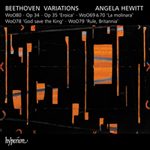 Beethoven: Variations Beethoven: VariationsStudio Master: CDA68346Studio Master FLAC & ALAC downloads available  The great ‘Eroica’ variations are the centrepiece of an album which contains some surprisingly under-appreciated Beethoven. This is an indispensable pendant to Angela Hewitt’s ongoing survey of the piano sonatas.» More |
