
Welcome to Hyperion Records, a British classical label devoted to presenting high-quality recordings of music of all styles and from all periods from the twelfth century to the twenty-first.
Hyperion offers both CDs, and downloads in a number of formats. The site is also available in several languages.
Please use the dropdown buttons to set your preferred options, or use the checkbox to accept the defaults.


The finale produces another of those tunes apt to delight listeners while deterring those proud of an elevated taste from admitting their enthusiasm. The resurgent repeated chord device for accompaniment enhances the sense of a light rather than an elegant purpose, almost suggesting the style of the drawing room galop so beloved of the later Victorians. This is the kind of music which mocks any attempt at straight-faced analytical comment. Suffice it to say that there follows a secondary theme in the tonic key (now G major). There is much of a textural nature similar to the first movement, as well as a passage of more Mozartian (though breathlessly high-spirited) dialogue. The work’s concision proclaims an aversion to self-regarding display, and its conclusion admits of the conventional orchestral last word. Liszt, incidentally, had just met Mendelssohn in Paris when, at the Erard piano showrooms, he was shown the new and barely legible score of this concerto. ‘A miracle, a miracle!’ exclaimed Mendelssohn to Hiller afterwards, having just witnessed Liszt sit down and play the work easily at sight (Alan Walker: Franz Liszt: The Virtuoso Years, 1811–1847; Faber and Faber, London, 1983). Whatever Mendelssohn’s subsequent opinion of how Liszt used his gifts, there can be no doubt that he was bowled over by their awesome extent.
from notes by Francis Pott © 1997
Le finale engendre une autre de ces mélodies à même de ravir les auditeurs tout en dissuadant ceux qui se targuent de goûts élevés d’admettre leur enthousiasme. Les accords répétés résurgents utilisés pour l’accompagnement préfèrent la sensation de clarté à un dessein élégant, suggérant presque le style du Galop de salon si cher aux derniers Victoriens. Voici le genre de musique qui déjoue toute tentative de commentaire analytique impassible. Inutile de préciser qu’un thème secondaire suit; sis dans la tonique (désormais sol majeur), il présente une nature de texture très similaire à celle du premier mouvement, ainsi qu’un passage de dialogue plus mozartien (quoique d’une fougue haletante). La concision de l’œuvre affirme une aversion pour la démonstration narcissique, tandis que sa conclusion laisse conventionnellement le dernier mot à l’orchestre. Liszt venait incidemment de rencontrer Mendelssohn à Paris et se trouvait dans la salle des pianos Erard lorsqu’on lui montra la partition, nouvelle et à peine lisible, de ce concerto. «Un miracle! Un miracle!», s’exclama Mendelssohn à Hiller, juste après avoir vu Liszt s’installer au piano et jouer sans peine le concerto à vue (Alan Walker: Franz Liszt: The Virtuoso Years, 1811–1847; Faber and Faber, Londres, 1983). Quoique Mendelssohn pensât ensuite de la manière dont Liszt utilisa ses dons, il ne fait aucun doute qu’il fut sidéré par leur étendue stupéfiante.
extrait des notes rédigées par Francis Pott © 1997
Français: Hypérion
Das Finale bringt erneut eine von diesen Melodien hervor, die auf der einen Seite Hörer in Verzückung versetzen können, auf der anderen Seite aber diejenigen abschrecken, die auf ihren gehobenen Geschmack stolz sind und ihre Begeisterung nicht zugeben können. Das stilistische Mittel des immer wieder auftauchenden Akkordes in der Begleitung erweckt das Gefühl eines eher leichten als eleganten Ausdrucksvorhabens und ruft fast schon den Stil des später in den Salons der Viktorianer so geschätzten Galopps in Erinnerung. Dies ist die Art von Musik, die jeglichen Versuch eines starrgesichtigen, analytischen Kommentars ad absurdum führt. Es mag an dieser Stelle die Feststellung genügen, daß ein zweites Thema auf der Tonika der Tonart (nun G-Dur) folgt. Bezüglich seiner Kompositionsstruktur bestehen viele Ähnlichkeiten mit dem ersten Satz. Auch taucht eine Dialogpassage eher mozartscher Prägung (doch atemberaubend temperamentvoll) auf. Die Kürze des Werkes kündet von einer Ablehnung gegenüber gefälliger Selbstschau. Sein Schlußteil läßt dem Orchester in konventionellem Stil das letzte Wort.
Liszt, das sei hier nur beiläufig erwähnt, hatte gerade Mendelssohn in Paris getroffen, als er in den Erardschen Klaviervorführungsräumen die neue und kaum lesbare Partitur dieses Konzerts zu Gesicht bekam. „Ein Wunder, ein Wunder“ soll Mendelssohn im Beisein Hillers ausgerufen haben, nachdem er Zeuge wurde, wie Liszt sich ans Klavier setzte und das Konzert vom Blatt spielte (Alan Walker: Franz Liszt: The Virtuoso Years, 1811–1847; Faber and Faber, London, 1983). Was auch immer Mendelssohns spätere Meinung über Liszts Gebrauch von seinen Talenten war, es kann kein Zweifel daran bestehen, daß er von deren ehrfurchtgebietenden Ausmaßen fast umgewurfen wurde.
aus dem Begleittext von Francis Pott © 1997
Deutsch: Inge Schneider
 The Hyperion Romantic Piano Concerto Edition - 1991-2007 The Hyperion Romantic Piano Concerto Edition - 1991-2007CDS44701/5050CDs Boxed set (at a special price) Higher-value orders will be automatically discounted at check-out  The first of two box sets celebrating one of the most ambitious, and successful, series in the history of classical recording. This volume features 130 works from 59 composers, performed by 19 different pianists, and all luxuriously presented with ...» More |
 Jesús María Sanromá - The complete Boston ‘Pops’ recordings Jesús María Sanromá - The complete Boston ‘Pops’ recordingsAPR60452CDs for the price of 1 — Download only  The Puerto Rican pianist Jesús María Sanromá (1902-1984) came to the USA to study and subsequently built his career there. He had a very wide repertoire and gave the US premieres of many contemporary works, including Ravel’s G major Concerto, but ...» More |
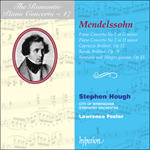 Mendelssohn: Piano Concertos Mendelssohn: Piano ConcertosCDA66969 This disc brings together, for the first time to our knowledge, all of Mendelssohn’s published works for piano and orchestra, and in performances from the Gramophone Award-winning team of Sir Stephen Hough, the City of Birmingham Symphony Orchestr ...» More |
 Hyperion sampler - March 2026 Vol. 2 Hyperion sampler - March 2026 Vol. 2FREE DOWNLOADHYP202603BDownload-only sampler |