
Welcome to Hyperion Records, a British classical label devoted to presenting high-quality recordings of music of all styles and from all periods from the twelfth century to the twenty-first.
Hyperion offers both CDs, and downloads in a number of formats. The site is also available in several languages.
Please use the dropdown buttons to set your preferred options, or use the checkbox to accept the defaults.

As we left the theatre we met the poet Körner with whom I was on very friendly terms. I presented the little composer to him, of whom he had already heard a certain amount from me. He was glad to make his acquaintance and encouraged Schubert to live for art, which would make him happy.
Later that evening in a restaurant Körner and Schubert almost got involved in a brawl in defence of the singers Milder and Vogl who were being insultingly discussed at the next table. Like the young Schumann's one encounter with Heine, this evening together was sufficient to make the composer fall under the spell of the poet. On that night in Spaun's and Körner's company, Schubert must have felt very much an artist, part of a community with shared ideals. His determination to resist parental pressure to stay in schoolteaching was strengthened by the youg poet's advice. Körner was killed in action at Gadebusch, a skirmish in the Wars of Liberation against Napoleon, in August 1813. He left five tragedies, five comedies, short stories and much poetry including the patriotic poems Leyer und Schwert, the impact and popularity of which were much enhanced by the manner of his death.
This song sets a poem taken from Körner's Knospen (Buds)—a title appropriate for a collection of freshly youthful, if not fully mature or original, poetry. Sängers Morgenlied is the first of Schubert's fourteen Körner settings and it deserves to be better known. There is a touch of Weber in the piano introduction and in the vocal melismas. This is music of high spirits which takes its cue from the exclamation mark after the first two words; it sparkles like bright light breaking through darkness. The poem has six verses of which we perform the first four.
from notes by Graham Johnson © 1989
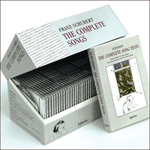 Schubert: The Complete Songs Schubert: The Complete SongsCDS44201/4040CDs Boxed set + book (at a special price) — Temporarily out of stock  ‘This would have been a massive project for even the biggest international label, but from a small independent … it is a miracle. An ideal Christ ... ‘Please give me the complete Hyperion Schubert songs set—all 40 discs—and, in the next life, I promise I'll "re-gift" it to Schubert himself … fo ...» More |