
Welcome to Hyperion Records, a British classical label devoted to presenting high-quality recordings of music of all styles and from all periods from the twelfth century to the twenty-first.
Hyperion offers both CDs, and downloads in a number of formats. The site is also available in several languages.
Please use the dropdown buttons to set your preferred options, or use the checkbox to accept the defaults.


| The Nash Ensemble» More |
The restless ‘Allegretto malincolico’ focuses on a descending chromatic idea, preceded by an arpeggiated flourish, with Poulenc enjoying major and minor inflections. Frequent trills and demisemiquaver tonguing attest to the flautist’s technique. The Classical legacy is evident in the piano’s Alberti-bass figurations, and the debt to the Baroque in the flute’s dotted rhythms within the slower middle section. A quiet, song-like ‘Cantilena’ explores the flute’s vocal qualities with an arching melodic contour: ‘a great rainbow of melody’. (Some have also noted connections with Poulenc’s contemporary opera, Dialogues des Carmélites.) Extensive use of smooth scalic figures is contrasted by more dotted rhythmic material in the central portion. The ‘Presto giocoso’ has a light-hearted, rondo-like character, again with a strong rhythmic identity; it enjoys imitative textures and cyclical elements, with an arpeggiated figure and later the dotted idea (‘mélancolique’) from the first movement, together with a thematic hint of the second (reaching up to a top C). A confident, extrovert reprise of the opening concludes, ‘strictly in time without any slowing down’
from notes by Deborah Mawer © 2001
L’agité «Allegretto malincolico» se focalise sur une idée chromatique descendante, précédée d’une fioriture arpégée, où Poulenc se délecte des inflexions majeures et mineures. Les trilles fréquents et les coups de langue en triples croches attestent la technique du flûtiste. L’héritage classique est manifeste dans les figurations pianistiques en basse d’Alberti, tandis que la dette envers le baroque transparaît dans les rythmes pointés de la flûte, au sein de la section centrale ralentie. Une «Cantilena» paisible, cantabile, explore les qualités vocales de la flûte avec un contour mélodique en arche: «un grand arc-en-ciel de mélodie». (D’aucuns ont également noté des liens avec l’opéra contemporain de Poulenc, Dialogues des Carmélites.) À l’usage poussé de figures en gammes coulantes répond, par contraste, un matériau rhythmique davantage pointé dans la portion centrale. Le «Presto giocoso», au caractère léger, alla rondo, de nouveau marqué par une forte identité rythmique, goûte les textures imitatives et les éléments cycliques, avec une figure arpégée et, plus tard, l’idée pointée («mélancolique») du premier mouvement, le tout augmenté d’une allusion thématique au second mouvement (atteignant un ut aigu). Une reprise confiante, extravertie, de l’ouverture sert de conclusion, «strictement en mesure, sans le moindre ralentissement».
extrait des notes rédigées par Deborah Mawer © 2001
Français: Hypérion
Das rastlose „Allegretto malincolico“ konzentriert sich auf eine absteigende chromatische Idee mit vorangestellter Arpeggioverzierung, die Poulenc mit Genuß nach Dur und Moll moduliert. Häufige Triller und in Zweiunddreißigstelnoten angegebene Zungenstöße zeugen von den technischen Fertigkeiten des Flötisten. Das klassische Erbe offenbart sich in den Alberti-Baßfigurarionen des Klaviers, die Verpflichtung gegenüber dem Barock in den punktierten Rhythmen der Flöte im langsameren Mittelteil. Eine stille liedhafte „Cantilena“ lotet mit einer weit ausgreifenden Melodielinie—„einem großen melodischen Regenbogen“—die sanglichen Fähigkeiten der Flöte aus. (Manche Besprechungen haben außerdem Bezüge zu Poulencs Oper Dialogues des Carmélites bemerkt, die um die gleiche Zeit entstand.) Im Kontrast zum ausführlichen Gebrauch glatter Tonleiterfiguren steht stärker punktiertes rhythmisches Material im Mittelteil. Das „Presto giocoso“ hat einen beschwingten Rondocharakter, wiederum mit einer starken rhythmischen Identität; es besticht durch imitative Strukturen und zyklische Elemente und verarbeitet erst eine arpeggierte Figur und später das punktierte Motiv („mélancolique“) aus dem ersten Satz, zusammen mit einem thematischen Hinweis auf den zweiten Satz (der bis zum hohen C hinaufreicht). Eine selbstbewußte, extravertierte Reprise der Einleitung „streng im Takt, ohne jede Verlangsamung“, bildet den Abschluß.
aus dem Begleittext von Deborah Mawer © 2001
Deutsch: Anne Steeb/Bernd Müller
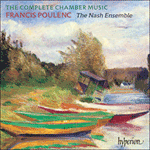 Poulenc: The Complete Chamber Music Poulenc: The Complete Chamber MusicCDA67255/62CDs  An important set from The Nash Ensemble presenting the complete chamber music output of Francis Poulenc in all its glorious variety: ‘an altogether first-class collection … the undisputed yardstick for the future’ (Gramophone).» More |