
Welcome to Hyperion Records, a British classical label devoted to presenting high-quality recordings of music of all styles and from all periods from the twelfth century to the twenty-first.
Hyperion offers both CDs, and downloads in a number of formats. The site is also available in several languages.
Please use the dropdown buttons to set your preferred options, or use the checkbox to accept the defaults.

In musical terms everything seems unearthly perfection in this song, from the disposition of the chords (another example of a great deal of music in the aerial treble clef) to the placing of the exquisite single trill in the piano part before the entry of the voice. Once the vocal line has begun it seems suspended on a thread of silver, a balancing act on a moonbeam. For the second verse (the composer creates an ABA form from the poet's two verses) the music comes down to earth as the music reflects the poet's mortal concerns. The passage beginning 'Auf ihnen bluten Herzen' is heartrendingly chromatic, the better to contrast with the happy diatonic scale ('sie aber strahlen heiter') which describes the ever hopeful and cheery stars who do not allow accidental meteors to enter their orbit. The reprise is set up with heart-stopping simplicity and once more we tread on moonbeams. The postlude 'So werden Sterne/Durch die Ferne' is a superb piece of poetic shorthand in a language (and poet) often given to prolixity. The brevity of its understatement, the humble acceptance of the miracles of nature which it implies – these things make it among the most moving of codas in all Schubert. Even the final bar of piano writing seems unbearably eloquent and full of meaning.
This is one of the great Mayrhofer songs, although it is curiously neglected in performance – perhaps because of its difficulty. In the original key of D flat (as recorded here) as opposed to the B flat of the first edition (and thus Peters), the whole is bathed in a type of seraphic moonlight which emanates from a special and separate jewel box in the Schubertian's treasure trove. It is as if we are hearing, in that gentle 6/8 pulse, the music of the spheres.
from notes by Graham Johnson © 1993
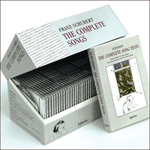 Schubert: The Complete Songs Schubert: The Complete SongsCDS44201/4040CDs Boxed set + book (at a special price) — Temporarily out of stock  ‘This would have been a massive project for even the biggest international label, but from a small independent … it is a miracle. An ideal Christ ... ‘Please give me the complete Hyperion Schubert songs set—all 40 discs—and, in the next life, I promise I'll "re-gift" it to Schubert himself … fo ...» More |