Welcome to Hyperion Records, a British classical label devoted to presenting high-quality recordings of music of all styles and from all periods from the twelfth century to the twenty-first.
Hyperion offers both CDs, and downloads in a number of formats. The site is also available in several languages.
Please use the dropdown buttons to set your preferred options, or use the checkbox to accept the defaults.


| Mary Bevan (soprano), Joseph Middleton (piano)» More |
The form of the song is a simple ABA with art concealing art in the way that the composer returns to the music of the first strophe with a tiny bridge passage (a single bar) of simplicity and delicate ingenuity. There are delicious touches throughout: the exotic introduction of A sharp in the bass (the key is E major) on the perfumed word 'Rosen', thus slyly initiating a brief move to the dominant; the use of triplets in the vocal line to paint green shoots ('frisches Grün') cheekily emerging, as well as the caressing west wind and the singing of birds; the sudden rapturous semiquavers on 'reisst mich hin'; the beautiful little postlude where the semiquavers go into the left hand while the tune in the right suggests gratitude and piety.
Schubert selected only the first three of Uz's seven strophes, and the song seems the perfect length for the open-hearted yet simple pantheistic hymn the composer makes of it. It reflects the composer's own religious conviction in the absence of a commitment to the church of his fathers – that intuition accompanied by strong emotion which Spinoza called 'the intellectual love of God' and which acknowledges the dependence of all things, including the human being himself, on the whole of nature.
from notes by Graham Johnson © 1993
 Flottiana - The Art-Song Legacy of Dame Felicity Lott Flottiana - The Art-Song Legacy of Dame Felicity LottCDS44771/8010CDs Boxed set (at a special price) Available Friday 6 November 2026 Higher-value orders will be automatically discounted at check-out  This boxed-set—issued in collaboration with Champs Hill Records and Wigmore Hall Live—celebrates Felicity Lott’s legacy as a brilliantly versatile art-song exponent: 10 bespoke programmes curated by long-time collaborator Graham Johnson.» More |
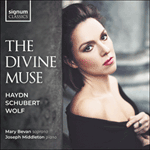 Haydn, Schubert & Wolf: The divine muse Haydn, Schubert & Wolf: The divine museStudio Master: SIGCD606Download onlyStudio Master FLAC & ALAC downloads available  After the success of their debut disc, ‘Voyages’, Mary Bevan and Joseph Middleton present their second recital disc exploring Lieder in German and Italian by Schubert, Haydn and Wolf. The programme is woven around songs inspired by the ‘muses’ of ...» More |
 Schubert: The Complete Songs Schubert: The Complete SongsCDS44201/4040CDs Boxed set + book (at a special price) — Temporarily out of stock ‘This would have been a massive project for even the biggest international label, but from a small independent … it is a miracle. An ideal Christ ... ‘Please give me the complete Hyperion Schubert songs set—all 40 discs—and, in the next life, I promise I'll "re-gift" it to Schubert himself … fo ...» More |