
Welcome to Hyperion Records, a British classical label devoted to presenting high-quality recordings of music of all styles and from all periods from the twelfth century to the twenty-first.
Hyperion offers both CDs, and downloads in a number of formats. The site is also available in several languages.
Please use the dropdown buttons to set your preferred options, or use the checkbox to accept the defaults.

Fox Strangways, the well-known British translator of the Schubert songs into English, chose to put this song into Devon dialect. Shakespearian echoes of comic characters with Mummerset accents come to mind, and this hearty bonhomie is appropriate for the way that the composer has set the poem. Schubert's Viennese Ländler and waltzes are generally more gracious and less rustic than this, but music from the sophisticated big city is bound to different from that of the 'provinces' – the German-speaking equivalent of Mummerset. In Schweizerlied we hear suggestions of cowbells and clog dancing, yodels and thigh-slapping in mid-dance (on the strong second beat of the bar) – in other words all the clichés of this type of character piece. The composer seems to have had as much fun with it as the poet had in writing it. Schubert being Schubert, the tune is marvellously infectious and although it may have been Goethe's intention to have fun at the expense of the Swiss, the end result is an affectionate salute to neighbours across the mountains. As with his Italian evocations, the composer seems to be no less in love with a style because it makes him smile. Despite the simplicity of the piano writing, it is amazing that in the spacing of the chords and in the intervals of the vocal line, Schubert creates a page of vocal music unlike any other in his output; it is a vivid thumbnail sketch, executed in a flash by the hand of a master. Unlike Goethe, the composer never had the opportunity to visit Switzerland, and the song pre-dates by eight years his own mountain holiday in Upper Austria where he might have heard folk music similar to this.
from notes by Graham Johnson © 1994
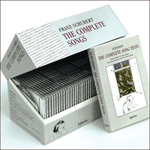 Schubert: The Complete Songs Schubert: The Complete SongsCDS44201/4040CDs Boxed set + book (at a special price) — Temporarily out of stock  ‘This would have been a massive project for even the biggest international label, but from a small independent … it is a miracle. An ideal Christ ... ‘Please give me the complete Hyperion Schubert songs set—all 40 discs—and, in the next life, I promise I'll "re-gift" it to Schubert himself … fo ...» More |