
Welcome to Hyperion Records, a British classical label devoted to presenting high-quality recordings of music of all styles and from all periods from the twelfth century to the twenty-first.
Hyperion offers both CDs, and downloads in a number of formats. The site is also available in several languages.
Please use the dropdown buttons to set your preferred options, or use the checkbox to accept the defaults.

The boy's fevered terror, and the father's stoic attempts to hide his own worst fears that he will lose his son, are remarkable enough. But the depiction of sweet, reasonable and honeyed evil is something new and sinister. This is not the voice and demeanour of a conventional villain, but that of a torturer with exquisite manners, a person who does the unspeakably cruel with a smile on his lips and in his eyes the psychopathic gleam of an embellished vocal line in the major key, empty of joy and devoid of truth. This is the seductive evil of Peter Quint luring Miles to a spiritual abyss, and it is perhaps in the ability to portray the defilement of innocence that Schubert and Britten have something else in common. Erlkönig is one of those songs that defies age (the composer's, particularly) and defines an age. Like Beethoven's Fifth Symphony it appeals to the great unwashed and the squeaky-clean in equal measure, to those who see something symbolic in the poem, and to those who simply love a rattling good yarn excitingly told. It was that rare thing: a hit that absolutely deserved to be. The four versions vary in this and that detail. We love Schubert ali the more that in one of these he re-writes the fiendish piano triplets as simple quaver duplets. He found it hard for his own piano technique to keep pace with his demands as a composer. There were, however, certain compensations. The composition of this song was also certainly the moment when he knew that no virtuoso pianist whether he was called Hummel, Moscheles, or the Liszt and Horowitz of the future, could hope to match him or play a stronger musical hand.
from notes by Graham Johnson © 1990
extrait des notes rédigées par Richard Wigmore © 2011
Français: Hypérion
aus dem Begleittext von Richard Wigmore © 2011
Deutsch: Viola Scheffel
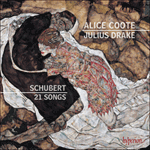 Schubert: 21 Songs Schubert: 21 SongsStudio Master: CDA68169Studio Master FLAC & ALAC downloads available  One of the leading mezzos of our day in a Schubert recital which offers seventy minutes of pure pleasure.» More |
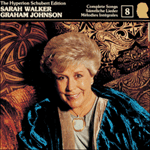 Schubert: The Hyperion Schubert Edition, Vol. 8 - Sarah Walker Schubert: The Hyperion Schubert Edition, Vol. 8 - Sarah WalkerCDJ33008Download only ‘Walker, in probing, glowing form throughout, closes this long and profoundly satisfying recital with a hair-raising account of Erlkönig’ (The ... ‘This is distinguished singing indeed … Graham Johnson's unimpeachable choice of mood and the impeccable musicality and technique of his creative ...» More |
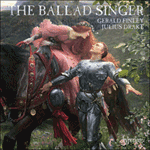 The Ballad Singer The Ballad SingerCDA67830 This latest release from the multi-award-winning partnership of Gerald Finley and Julius Drake features a literary and musical form which inspired the greatest voices of German Romanticism. The foremost poets and composers of the age saw the balla ...» More |
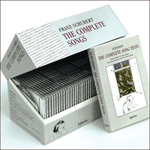 Schubert: The Complete Songs Schubert: The Complete SongsCDS44201/4040CDs Boxed set + book (at a special price) — Temporarily out of stock ‘This would have been a massive project for even the biggest international label, but from a small independent … it is a miracle. An ideal Christ ... ‘Please give me the complete Hyperion Schubert songs set—all 40 discs—and, in the next life, I promise I'll "re-gift" it to Schubert himself … fo ...» More |
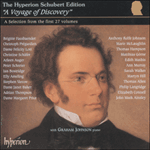 Schubert: An introduction to The Hyperion Schubert Edition Schubert: An introduction to The Hyperion Schubert EditionHYP200Super-budget price sampler — SOLD OUT! 'Irresistible!' (BBC Music Magazine) 'A delightful sampler' (The Penguin Guide to Compact Discs)» More |